This is a look at some recent major political and food/health events in the U.S. not always accurately reported in major news outlets.
Tariffs
“May 2025, the U.S. Treasury reported a record $22.8 billion in gross customs duties, a significant increase from the $6.2 billion collected in the same month the previous year.”
Hundreds of economists have pointed out that tariffs are just taxes imposed on the end user since foreign companies are forced to increase their prices if tariffs increase their costs. The alternative is to simply stop exports to the U.S. since companies can’t sell at a loss.
While President Trump has used tariffs to force other countries to treat US goods more fairly there have been some unexpected short term problems.
There can be major short term problems caused when governments threaten imposition of new tariffs in the near future, problems which are difficult to see coming in advance.
Tomato Tariff on Mexico
For example, a mid-level agribusiness the DiMare’s family owns 4,000 acres of tomato farms across Florida and California, sounds like they should be in a great position when Mexican tomatoes are about to be placed under new tariffs. Right?
Maybe not so good. Seeing massive new tariffs about to begin Mexican produce companies concentrated on shipping all their produce to the U.S. over other markets where no new tariffs are expected.
Supply and Demand
When you flood a market with vast amounts of new products the prices go down. It is pretty obvious that to sell large numbers of new product the prices have to be attractive.

In the case of Mexican tomatoes flooding the market ahead of new tariffs which would make them more expensive, a standard produce box of tomatoes in January went from $16 wholesale down to $3.50-$4 per box.
But the break even price (profit vs loss price) for US grown tomatoes is $11. The other $5 was profit and taxes.
Since the DiMare family would package and sell a box of their U.S. tomatoes at a $7 LOSS per box the company decided to plow most of the 4000 acres of tomatoes under to recover at least minimal fertilizer benefit.
Other U.S. tomato growers have done the same because there is no market for their fields of tomatoes. The canned tomato market is already filled to capacity and it is a different kind of tomatoes, they would rot before they could be transported to canneries anyway so the fields of tomatoes can’t be sold except at a financial loss making it more sensible to just take a tax loss.
So Florida farmers now plowing over perfectly good tomatoes as Trump’s tariff policies cause prices to plummet. A more obvious problem affects other produce farmers.
Who Picks the Delicate Fruit and Vegetables?
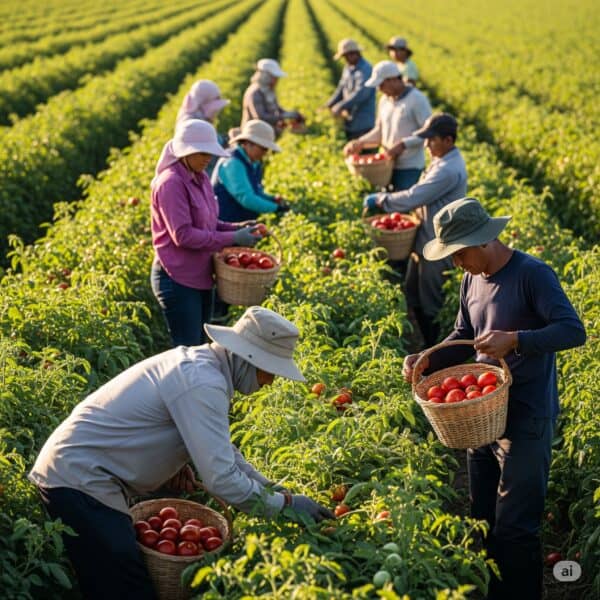
Machines pick corn, soybeans, and thrash wheat but delicate produce is picked in hot fields where stoop work is the only way to get the produce into shipping boxes.
According to according to Farmonaut, a farm technology company, half the U.S. produce field workers are, or were until very recently, undocumented (illegal) workers who are either hiding, afraid to go to farm jobs since ICE targets farms and construction jobs to pick up and deport illegal aliens, the only people who are willing to do most of the stoop work.
Same for meat packing plants, a hard, dangerous job which will contribute to further rises in meat prices.
Who Will Staff Factories?
While lower wages have been cited as the major reason U.S. companies have moved much of their assembly work to Asian factories, there is another simple explanation.
U.S. workers who made $90K/year in union car factories are not willing to work long hours at minimum wage ($7.25/hr fed. minimum wage is $15K/year) in the kind of dangerous mind-numbing tasks which Asian children work at. $15,000 per year is rated as poverty level.
The head of a sports shoe company pointed out that Americans simply won’t work 10 hour days bending over sewing machines. Especially in a country where unemployed and disabled individuals, often raising families, have cars and color TVs, even cable.

“Reebok’s founder, Joe Foster, stated that it’s difficult to move apparel manufacturing to the West because there is a lack of workforce willing to work long hours in front of a sewing machine, according to Business Insider and Apparel Resources. He explained that finding enough people to operate sewing machines, particularly women, is a challenge outside of Asia. Foster also mentioned that the industry needs more automation to shift production to the West, as complex shoe designs with numerous components are difficult to automate currently, according to Apparel Resources.” – summarized by AI Google Gemini AI tools.
The BBB and Hungry Children
Starting In the 60s and until two-three years ago the farm subsidy bill which gave billions to big agribusiness (mostly growing soybeans and corn turned into bio fuels and the sort of high fructose corn syrup rightly denigrated by the titular head of the FDA, Mr. Kennedy, Sec. HHS as causing many health problems), was tied to the food stamp program (now SNAP) so each was funded automatically when the other was approved every few years.
This was a political tie-in so opposing sides were able to vote for the benefits by voting for their own pet projects.
Food banks have been stressed since COVID and the cuts to school lunch programs, SNAP and Medicaid funding for children, the elderly, and the disabled would approximately double the number of people needing food assistance according to food bank organizations.
But the Big Beautiful Bill (BBB passed by VP Vance’s tie breaking vote) split those into separate authorizations making it possible for the Republican majority to renew big AG tax benefits while voting to reduce food aid to the poor. The BBB when fully enacted cuts $1,000,000,000,000 from food aid programs serving U.S. citizens, including 40 million children, over the next decade.
The farm and food sections of the BBB makes massive cuts to food aid for children while boosting the corn syrup and vegetable fat food additives which Robert F. Kennedy, Jr., the 26th Secretary of the U.S. Department of Health and Human Services, has designated as a major cause of America’s overweight problem contributing to heart disease and diabetes.
45 million or about 40% of American children depend on government SNAP food benefits. SNAP and other food benefits for disabled, elderly, and at-risk children account for less than 2% of the Federal Budget. The GOP reconciliation bill proposes a $300 Billion cut in SNAP benefits.
At $830 Billion the U.S. military budget is about 13% of the federal budget, the same as the next nine countries COMBINED.
Burned food
But you can’t believe every headline. At least you can’t take them at face value – things can be twisted to appear worse or even completely different from the underlying facts behind even accurate headlines.
That is one reason people distrust reporters, although reporters don’t make up the headlines.
There are some recent scare headline reports that the government is burning 100 or so tons of emergency food already paid for in the FoodAid program.
That is true, but most or all of the food was reportedly outdated/expired and can’t legally be used as food so it is being routinely disposed of.
Inflation
Overall inflation rate has been around 2.3% with food costs having increased by about 2.4% for the average grocery bag.
That is very much in line with other price increases through out the economy.
With so much meat consumption in the U.S. the 8-9% increase in the price of beef has gotten the attention of families and media.
Food Inflation
Below is an AI (Google Gemini) generated summary of food inflation in the past year.
Based on recent data, food price inflation in the U.S. remains a factor in the economy, though the rate has moderated significantly from its peak in recent years. Here is a summary of the current situation and the key factors at play.
Current Inflation Rates (as of June 2025)
Overall Food Inflation: The price of all food rose 3.0% over the 12-month period ending in June 2025.
Food at Home (Groceries): Prices for groceries increased by 2.4% over the same period.
Food Away from Home (Restaurants) : The cost of dining out and other food services increased by 3.8% over the past year.
Price Changes in Specific Categories
While overall food inflation has cooled, certain categories continue to see significant price increases or volatility:
Eggs: Despite recent monthly price decreases, egg prices remain notably higher than a year ago, primarily due to persistent supply disruptions from avian influenza.
Meat: Beef and veal prices were up 8.6% in May 2025 compared to the previous year, driven by tight supplies and steady consumer demand.
Fresh Produce: In contrast, prices for fresh vegetables like lettuce and tomatoes have been declining, with some categories showing a decrease of over 6% compared to a year ago.
Key Factors Contributing to Food Price Inflation
Several complex factors are influencing food prices, with recent changes in trade policy emerging as a significant new element:
Tariffs: Recent and proposed tariffs on imported goods are a major new driver of price increases for a wide range of products, including food.
Supply Chain and Labor: While improving from the post-pandemic era, supply chain challenges and labor costs continue to have an impact on production and distribution expenses.
Disease Outbreaks: Avian influenza continues to affect the supply of poultry and eggs, leading to price volatility.
Geopolitical and Environmental Issues: Global conflicts and extreme weather events continue to pose risks to food production and supply chains, contributing to price instability.
Droughts Threaten Food Safety in U.S. And Limit Exports – Research by Google Gemini AI