
Some of you following my hospice stories may have begun to wonder how I am still writing them. I know friends are often too polite to ask the simple, nagging question: “Why are you still here?” That’s the hospice paradox at work.
I find myself asking the same thing.
Hospice is a specific medical protocol, distinct from the general palliative care I received for a decade. It begins with the anticipation of approaching death; a physician must certify that a patient is likely to pass within a specific window. While you aren’t “kicked out” if you outlive the prediction, you do have to be recertified.
So, while I was quite ill when I qualified, I find that I actually feel relatively good many days. I am slowly weakening, and my appetite has diminished to the point where I am ordering specialized foods just to sustain myself, but I do not feel as if I won’t see next week.
I finally asked my Digital Counsel, Gemini, to help me explain this discrepancy. It turns out that hospice isn’t what it was a decade ago.
The End of “Watch and Wait”
The old “watch and wait” philosophy—keeping a patient comfortable while nature took its course—has been replaced in the better programs by something far more sophisticated. In fact, many more people should consider hospice if they understood one simple fact: Patients in modern hospice often live longer than they would otherwise—sometimes by months.
I began to suspect this when I noticed my nurses weren’t just letting me pass in comfort; they were aggressively jumping on every new symptom, even while adhering to the rule of not “treating” my existing terminal conditions.
It is a subtle, vital difference. When I experienced new pain while breathing, I received immediate attention, even though my own measurements (I still track my own blood pressure and blood oxygen) showed I wasn’t actually short of breath. My nurse’s constant concern over the mild swelling in my lower legs—edema—wasn’t just about comfort, either. It was about physics.
The Science of Stability
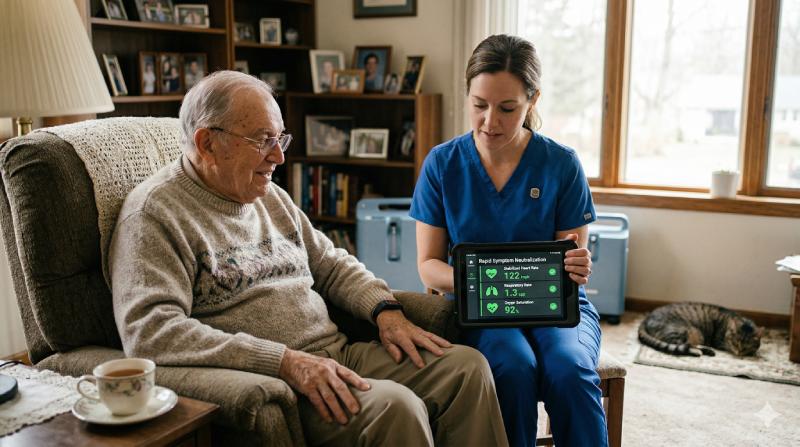
The modern paradigm is called Rapid Symptom Neutralization. By attacking symptoms with the same vigor a surgeon might attack a tumor, hospice “buffers” the patient against the acute events that typically cause a sudden end.
As someone who trained in behavioral psychology (having taken several courses at B.F. Skinner’s own university), this focus on treating observable symptoms rather than searching for “trauma” made perfect sense to me. I spent decades applying behavioral principles to animals—where you can’t exactly ask them to lie on a couch and analyze their dreams for $300 an hour. Applying it to end-of-life care is simply high-level stability engineering.
The Hospice Paradox in Practice
Here is how that “Stability Engineering” works in practice:
| Intervention | Proactive Goal | Longevity “Side Effect” |
| Low-Dose Morphine | Resolve “Air Hunger” | Reduces cardiac strain and systemic anxiety. |
| Diuretics | Manage Edema/Swelling | Prevents fluid from taxing the heart and lungs. |
| Anxiolytics | Calm Agitation | Prevents exhaustive tachycardia (racing heart). |
| Selective Antibiotics | Treat secondary infections | Prevents a minor issue from turning into sepsis. |

The Hospital vs. The Home
If you’ve ever spent a night in a hospital, you know the environment is often the enemy of rest. Nurses poke at you, wake you up on the doctor’s schedule, and the ambient noise of a roommate or a bored staff member can make sleep impossible. In one hospital, I had to fight for a single room just to get more than thirty minutes of shut-eye at a time.
My hospice nurse doesn’t do that.
For the elderly or terminal patient, “the best medical care” is often NOT being plugged into monitors with IVs in both arms and vitals checked every hour. Aggressive, expensive hospital care is frequently counterproductive. The Hospice Paradox—confirmed by 2025–2026 longitudinal studies—shows that avoiding “hospital-acquired” complications like sleep deprivation, delirium, and infections allows the body to divert its remaining energy toward maintaining homeostasis.

Redefining Agency
The model has evolved. We are no longer “fighting a war” we cannot win; we are optimizing a state we can maintain. Modern hospice uses everything from wearable biosensors to AI-driven telemetry to detect “subtle deviations” in heart rate or oxygen before a patient even feels distressed.
So, the reason I am still here? It’s quite simple, really. I am thriving because I am not getting the “best” hospital care available. I am at home, stable, and meticulously managed. It is the hospice paradox.
And as long as the data holds, I’ll keep writing.
Written by John McCormick With Research Assistance from Gemini, Digital Counsel
Part of John McCormick’s “Last Deadline” series — reflections from a journalist writing through his final chapter.
Explore more from John McCormick and his books.
Series so far:
- Hospice, The Last DEADLINE of a Correspondent
- A Correspondent’s Notes: Day Two in Hospice
- Hospice Notes Day 3–4: Pain, Swelling, and the Relief of Oxygen
- Hospice Notes, Week Two: Pain, Cookies, and Letting Go of a Library
- Another Day in Hospice — A Good One This Time
- Hospice Notes: Good Days, Bad Days, and Broken Pipes
- The Mechanic, The Sailor, The Journalist, and The New Definition of Self-Reliance
- Dispatch From the Frontier: The Mechanics of the Long Sleep
- Good Days, Bad Days, and the “Hospice Paradox”