
“From the river to the sea, Palestine will be free,” protesters chant.
The slogan raises a basic question.
Which river? Which sea? And what Palestine do they mean?
The phrase refers to the land between the Jordan River and the Mediterranean Sea. That is the land where the State of Israel stands today.
The Palestine name history is complicated. It moves through Rome, Byzantium, the Ottoman Empire, the British Mandate and modern Arab nationalism.
But one point remains central: the name Palestine was never the name of an ancient sovereign Arab state.
Roman Palaestina
The Roman Empire took control of Judea in 63 BCE.
After the Bar Kokhba revolt in 135 CE, Rome renamed the province of Judaea as Syria Palaestina. Jerusalem also received a Roman name: Aelia Capitolina.
For Jews, this was not a neutral administrative change. It attacked Jewish identity, Jewish memory and the Jewish connection to Jerusalem.
The Latin name Palaestina came from the Greek Palaistinē, a term linked to the Philistines.
The Philistines lived along the southwestern coastal plain of ancient Canaan. Scholars often connect them to the Peleset, one of the Sea Peoples mentioned in ancient Egyptian records.
Archaeological and genetic research also points to an Aegean or southern European component in early Philistine origins.
The word Peleshet in Hebrew referred to Philistia, the land of the Philistines. It did not refer to an Arab state.
Editor’s Note: Nurit Greenger examined historical Palaestina and Palestine in a 2024 NewsBlaze article based on Hadriani Relandi’s 1714 work.

Palestine Name History Through Language
Over the centuries, Peleshet, Palaistinē and Palaestina evolved into Palestine in English and Filastin in Arabic.
The name persisted as a geographic term.
But geography and sovereignty are not the same thing.
A region can carry a name for centuries without becoming an independent state by that name.
That distinction matters in the modern argument over Israel, Palestine and the meaning of the river-to-sea slogan.
Ottoman Empire Period
The Ottoman Empire ruled the land for about 400 years, from 1516 to 1917.
During Ottoman rule, the region was often called Palestine by Europeans and others as a geographic description. But the Ottomans did not create a sovereign Arab state called Palestine.
They administered the area through Ottoman districts and provinces, including the Jerusalem district and surrounding districts connected to Damascus and Beirut.
So far, the historical record shows a region known by several names.
It does not show an independent Arab state called Palestine.
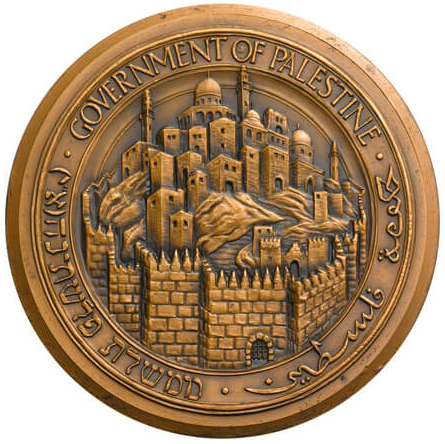
British Mandate for Palestine-Eretz Israel
The British Mandate for Palestine came into force on September 29, 1923, and ended in May 1948.
The Mandate created a distinct political entity called Palestine under British rule.
Hebrew usage included the abbreviation א״י, standing for Eretz Yisrael, the Land of Israel.
People born during the Mandate period received documents under British Mandate Palestine. Jews born there could also be called Palestinian under British administrative terminology.
That historical fact is often forgotten.
The word Palestinian did not originally exclude Jews living in the land.
From The River to The Sea
“From the river to the sea, Palestine will be free” refers to the land between the Jordan River and the Mediterranean Sea.
That means Israel.
Some activists describe the slogan as a call for freedom. Many Jews and Israelis hear something very different: a call to erase Israel from the map.
That is why the slogan carries such force.
It does not merely call for better conditions in Gaza or Palestinian self-government in parts of Judea and Samaria.
It points to the whole land between the river and the sea.

Biblical Claim to The Land of Israel
For Jews, the claim to the Land of Israel begins in the Bible.
The Abrahamic Covenant stands at the center of that claim. In Genesis 12:1–3, God commands Abraham to leave his homeland and go to the land He will show him.
Genesis 12:7 says: “To your offspring I will give this land.”
Genesis 26:3 repeats the promise to Isaac.
Genesis 28:13–14 repeats the promise to Jacob.
Ezekiel 37:21 speaks of gathering Israel from among the nations and bringing them back to their land.
This biblical foundation shaped Jewish memory for thousands of years.
It also shaped the Zionist return to the Land of Israel.
Theodor Herzl and Zionism
Theodor Herzl, the visionary of modern political Zionism, understood that Jewish assimilation in Europe would not end antisemitism.
Herzl covered the Dreyfus Affair in France. The antisemitic fury around that case helped convince him that Jews needed a state of their own.
In 1897, Herzl convened the First Zionist Congress in Basel.
In 1898, he visited the Land of Israel.
In 1903, British Colonial Secretary Joseph Chamberlain raised the idea of a Jewish refuge in British East Africa, commonly called the Uganda Scheme. Herzl considered it as a temporary refuge for Jews facing danger, but he did not abandon the Zionist goal of a homeland in the Land of Israel.
In 1905, after Herzl’s death, the Seventh Zionist Congress rejected the Uganda Program.
The decision confirmed what Zionism had always understood.
The Jewish homeland could not be replaced by a foreign substitute.
Is There a Palestine?
The question is not whether many Arabs today identify as Palestinians. They do.
The real question is whether that modern political identity should erase older Jewish history, biblical memory, Roman Judea, Eretz Israel and the modern State of Israel.
Calling all Arabs whose ancestors lived under the British Mandate “Palestinians,” while excluding Jews whose ancestors also lived there, creates a political distortion.
It suggests that only one people belongs to the land.
That is historically false.
The land carried many names across history: Canaan, Judea, Palaestina, the Holy Land, Palestine and Eretz Israel.
But the Jewish connection to the land did not begin in 1948.
It did not begin with the British Mandate.
It did not begin with Herzl.
The Palestine name history shows how a Roman renaming became a modern political weapon. The land called Israel today remains the historic homeland of the Jewish people.