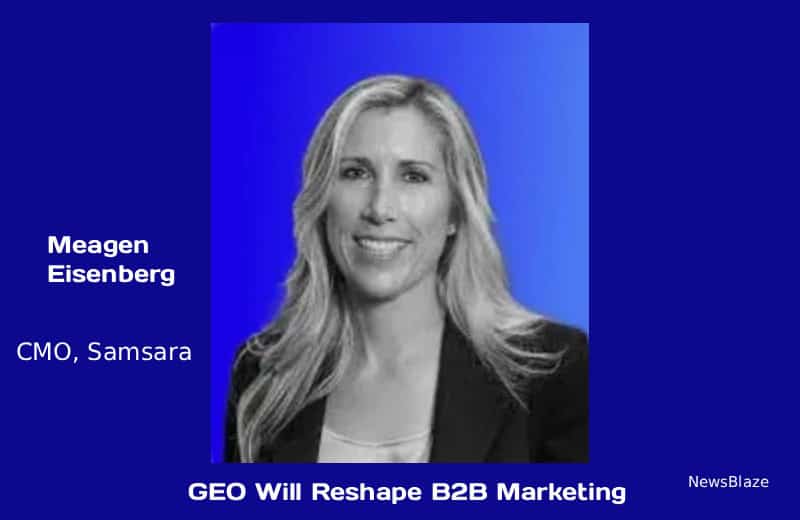

Meagen Eisenberg, CMO of Samsara, will tell Index’25 that B2B marketers must overhaul their strategies as GEO redefines how buyers will discover and evaluate vendors.
Why B2B Must Pay Attention
Eisenberg will say B2B companies often lag in adopting new marketing models. “You can’t afford to be late to GEO,” she will warn. “Your buyers will be asking AI for answers before they come to your website.”
She is expected to explain that the stakes are higher in B2B than in consumer markets. Enterprise deals involve longer cycles, higher-value contracts, and multiple decision-makers. If a brand is absent from AI-driven search results, it will risk losing credibility before the sales conversation even starts.
GEO in the Buyer Journey
Eisenberg highlights how GEO intersects with long B2B sales cycles. Trust-building across months of engagement now doubles as the signals AI engines use to recommend vendors.
She gives the example of how procurement teams are changing. “They no longer rely solely on analyst reports or vendor demos. They’re typing questions into AI-powered tools. If your brand isn’t consistently seen as authoritative, you’re invisible.”
This represents a profound shift in how buyers narrow their choices. First impressions may not come from websites or sales reps but from AI answers powered by GEO signals.
The Cost of Late Adoption
Eisenberg will warn that companies ignoring GEO will be at a disadvantage. Late adopters may find their competitors entrenched as trusted authorities in AI-driven search environments.
“Once AI engines start associating credibility with a set of vendors, it’s hard to displace them,” she says. “You can’t just switch on GEO when it’s convenient. You have to earn it over time.”
The risk is not simply being slower to adopt a trend. The risk is being locked out of the buying conversation altogether.
Practical Advice for B2B CMOs
Eisenberg is expected to outline practical steps for B2B leaders:
- Build thought leadership: Share insights in trusted industry forums and communities.
- Encourage credible customer validation: Case studies, verified reviews, and testimonials strengthen trust signals.
- Rethink metrics: Don’t just measure traffic or leads — track how often your brand appears in AI-generated insights.
- Invest in authority: Partner with analysts, influencers, and experts who reinforce your credibility.
- Focus on consistency: Authority is built through repeated signals, not one-off campaigns.
GEO and B2B Innovation
Eisenberg will also highlight the upside. GEO will create opportunities for B2B marketers willing to innovate. Companies that integrate AI-ready trust signals into their strategy can leapfrog larger competitors who are slower to adapt.
She is expected to point to startups that gain early visibility in AI answers by producing high-quality, expert-led content. “Smaller firms that are agile can use GEO to punch above their weight,” she will say.
Key Takeaways
- GEO is already reshaping B2B discovery.
- Sales cycles amplify the stakes of trust-building.
- Late adopters risk being invisible to buyers.
- Credibility must be earned over time and across channels.
- GEO offers an opening for agile firms to disrupt larger rivals.
Meagen Eisenberg – Looking Ahead
Eisenberg will close her Index’25 talk with a challenge: “The question is not whether GEO will change B2B marketing. It already has. The question is whether you’re building credibility now or waiting until it’s too late.”
Her message will echo the wider Index’25 theme: in the AI-first era, the battle for visibility is shifting. For B2B companies, the next competitive advantage will lie not in ranking higher but in being trusted enough to appear in the answer.
See the overview: Index’25 Brings GEO Into Focus for Global Marketing Leaders