At the Tokyo Conference on Afghanistan in Japan, US Secretary of State Hillary Rodham Clinton announced that Japan has pledged $16 billion to support Afghanistan’s development over the next four years.
In her remarks with Foreign Minister Koichiro Gemba, Ms. Clinton says the conference became a venue to discuss a different kind of long-term economic partnership, one built on Afghan progress in meeting its goals, in fighting corruption, in carrying out reform, and providing good governance.
“The $16 billion is more than enough to meet the World Bank’s estimated requirements. And we thank Japan for its generous pledge.” -Ms. Clinton

She states that the United States will be working with Congress to provide assistance at or near the levels of the past decade through 2017, both to help secure Afghanistan’s gains and to protect the already considerable investment that the United States has made not only in financial terms but in the sacrifice of our men and women in the last decade.
“We must ensure that the transition is irreversible and that Afghanistan can never again be a safe haven for international terrorism.” -Ms. Clinton
She cites as they met in Chicago three months ago to safeguard Afghanistan’s security future, at the Conference, they have charted a way forward on Afghanistan’s economic requirements.
Ms. Clinton believes that they have really made a good commitment to putting Afghanistan on a path to economic self-sufficiency.
“As Afghan capacity and revenues increase, our contributions can decline.” -Ms. Clinton
According to Ms. Clinton, the US government emphasizes key factors about the role of the Afghan Government and people in stepping up to meet the challenges that they have ahead of them; the role of the international community to support its commitments and to do so within the Tokyo Framework of Mutual Accountability; the role of the neighbors to work together to build a prosperous, interconnected zone of commerce and trade across South and Central Asia; and the role of the private sector in helping bring investment, training, and jobs.
Yesterday, with its commitment to strengthen Afghanistan’s institutions, the United States of America announced that Afghanistan is officially designated as its major non-NATO ally.
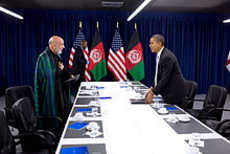
In her remarks with Afghan President Hamid Karzai in Kabul, US Secretary of State Hillary Rodham Clinton said the security situation of Afghanistan is more stable.
The Government of Afghanistan has signed partnership agreements with many countries, and the United States is among those.
Both nations have worked together to set forth a long-term political, diplomatic, and security partnership, and it entered into force just a few days ago.
The US government sees the alliance as a powerful symbol of its commitment to Afghanistan’s future.
The United States wants to continue to invest in doing what the Afghans believe they need.
The United States will continue to protect Afghanistan from any efforts by insurgents and outsiders to destabilize Afghanistan.
The US government has supported President Karzai in his effort to have an Afghan-owned, Afghan-led reconciliation process.
The US government wants to see Afghanistan be the center of a region of greater communication between countries and people, more trade and investment, a kind of New Silk Road that will bring more economic opportunity not only to Afghanistan, but to the entire region.
The US government pledges to continue its support and to work with the Afghans to get more international support, Ms. Clinton stressed.
In December 2011, the United States withdrew 10,000 U.S. troops from Afghanistan.
July 2011 marked the beginning of a responsible transition that will see Afghan forces gradually taking the lead in securing their own country.
By 2014, the process of transition will be complete, and the Afghan people will be responsible for their own security.
The Afghan security forces move into the lead, the United States continues to reduce its military footprint. Its mission will change from combat to support. The remaining 23,000 “surge” troops in December 2009 will leave Afghanistan by the end of summer 2012.
The U.S. government has made significant progress towards their goals.
Reports say the U.S. government is redoubling its efforts to pursue a peaceful end to the conflict in the region.
The U.S. government has taken tangible steps to advance Afghan reconciliation and reintegration initiatives, including support to the Afghan High Peace Council and provincial police and reintegration councils.
The international Bonn Conference on Afghanistan took place in December, 2011, where the international community renewed their commitment to provide continuous support during the “decade of change” starting from the end of 2014, when ISAF withdraws, to 2025. At the Chicago NATO Summit this May, there was further discussion on maintaining public order in Afghanistan, and now, on July 8, 2012, the Tokyo Conference was held by the Governments of Japan and Afghanistan to identify ways to continue sustainable support for Afghanistan.