

With the theory beginning to make headlines that somehow the United States and China and India and Russia were in competition for influence and for strategic gain in Central Asia, Assistant Secretary Robert O. Blake, Jr Bureau of South and Central Asian Affairs said it is not seeking to pursue opportunities in Central Asia at the expense of other countries.
In a Question and Answer Session at University for World Economy and Diplomacy at Tashkent, Uzbekistan, Mr. Blake explains there are very significant opportunities for US, China and Russia and also quite important opportunities for the countries to work together.
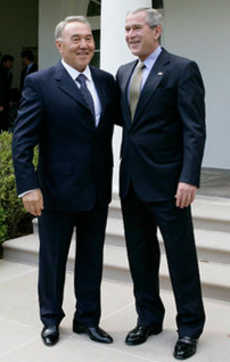
“We are not seeking to pursue opportunities in Central Asia at the expense of Russia or China or any other country.” – Mr. Blake
US and Russia can work together on counter-narcotics
Mr. Blake says the United States and Russia have important shared interests in things like counter-narcotics, to help stop the flow of narcotics that flows northward through Central Asia to Russia.
Both countries have important interests in things like development.
“Certainly we have important interests in the stability of Afghanistan.” – Mr. Blake
So for that reason, US and Russia had a very good dialogue for many years with the Russians about Central Asia and how they can work together and how they can coordinate our policies.
And Mr. Blake thinks that’s been quite successful.
Likewise with China
US thinks that China has a quite important role to play in Central Asia as well.
Mr. Blake says China has been very helpful in developing infrastructure and pipelines and things like that that have benefited the countries of Central Asia.
China also helped to diversify sources of supply and sources of demand for the region’s energy resources, he added.
It is US interest to promote – diversification of energy supplies – and that’s one of the reasons it supports strongly the Turkmenistan-Afghanistan-Pakistan-India Gas Pipeline.
Today, Turkmenistan exports most of its gas to China and mr. Blake says there are obviously very, very important markets in India and even Bangladesh that have expanding populations, have expanding economies, that very badly need new energy sources.
“So this is a very good win/win situation for which, again, I think there is good progress being made.” – Mr. Blake
Again, Mr. Blake points out this is not a great game and this is in fact a great gain and US always tries to emphasize that.
US Fights terrorism in Central Asia
Highlighting its interest in combating terrorism around the world, the United States of America has revealed efforts to address imminent Islamist militant threats to Central Asian states.
Despite the real gains in stability in Afghanistan, US planned drawdown in Afghanistan and continued use of the Northern Distribution Network has raised anxiety levels among our Central Asian partners about the increased potential for instability and extremism, especially beyond 2014.
Actions to address extremism in the region
US foreign assistance programs seek to build the capacity of Central Asian countries to address transnational threats such as those posed by Islamist militant groups while promoting regional economic integration and development.
To achieve these objectives, the US is using a combination of diplomatic engagement and bilateral and multilateral assistance.
On the diplomatic front, the United States holds annual bilateral consultations with each of the five Central Asian countries.
These consultations, which Mr. Blake chair with the Foreign Ministers or Deputy Foreign Ministers of each country, form the cornerstone of US bilateral relationships.
Through these, the US conveys a consistent message that democratic reform, respect for freedom of expression and religion, and an active civil society all contribute to stability, while cracking down on dissent and driving it underground may create more favorable conditions for radicalism.
In addition, US public diplomacy and assistance programs also reinforce our objective of strengthening respect for human rights and the rule of law.
US bilateral security assistance is helping build the Central Asian states’ capacity to counter a broad range of threats, including terrorism.

In 2012, the United States provided approximately $215 million of security assistance to the countries of Central Asia.
The bulk of this assistance focused on building capacity of law enforcement agencies to address transnational threats, including terrorism and narcotics trafficking.
US recognizes that its interest in combating terrorism and other cross-border threats are shared by others, so it is engaging with other countries that are active in Central Asia in a cooperative approach to regional security and stability.
US efforts and assistance commitments are based on a comprehensive and proactive approach to strengthening the capacity of Central Asian states to address a range of transnational threats.
Central Asian states face a broad range of challenges that, as in many other societies, could fuel radicalism in the long run and threaten the security and interests of the United States and our allies.
UN says Central Asia is one of the most interdependent regions of the world, with a large population, a potential common market and a crossroad of energy routes.
To date, UN says the region’s five countries have been spared large-scale terrorist attacks.
Yet it cannot be denied that there is a growing concern about the possibly of intensifying activities of various extremist, terrorist, and criminal groups and networks operating in Central Asia, fuelled by instability in the wider region and porous borders through which extremism and criminal networks penetrate the region.
UN points out vigilance and measures that have tightened security in Central Asia have helped keep the threat of terrorism at bay, but extremists, criminal groups and instability in the wider area mean that the region is still vulnerable.
Prevention of terrorism in Central Asia is key not only to protecting the well-being of populations and ensuring national and regional stability, according to UN.
UN formulates scheme to fight the scourge
The new UN scheme for Central Asia aims to help Kazakhstan, Kyrgyzstan, Tajikistan, Turkmenistan and Uzbekistan establish a regional counter-terrorism plan in line with the UN Global Counter-Terrorism Strategy.
That Global Strategy, unanimously adopted by the General Assembly in 2006, focuses on four key pillars of action: tackling the conditions conducive to the spread of terrorism; preventing and combating terrorism; building State capacity and bolstering the role of the UN; and ensuring respect for human rights and the rule of law against the backdrop of the fight against terrorism. Further expert meetings will be held in the region next year looking at other parts of the UN’s Global Counter-Terrorism Strategy. The meetings will lead to the drawing up of a joint action plan implementing the United Nations Global Counter-Terrorism Strategy in Central Asia, which is expected to be adopted during a regional ministerial conference to be held in 2011.
Central Asia countries include five republics of the former Soviet Union: Kazakhstan, Kyrgyzstan, Tajikistan, Turkmenistan, and Uzbekistan. Other areas included are Afghanistan, Mongolia, eastern Iran, and northwestern Pakistan.
