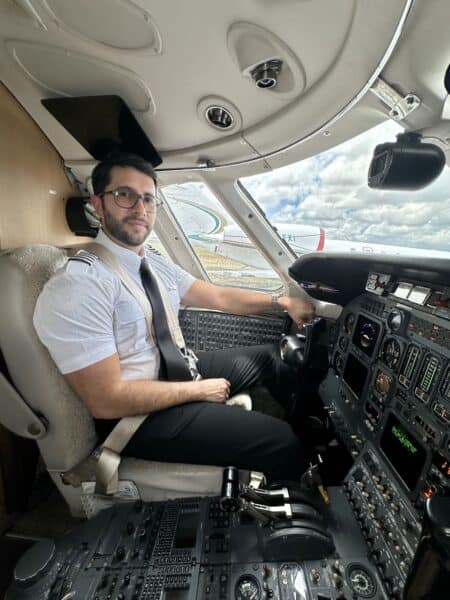
In a career that spans remote jungle runways, international airline operations, and high-stakes medical flights, Captain Alberto Jose Labrador Cicerone exemplifies a pilot whose depth of experience is matched by an analytical mindset and a commitment to excellence. With over 4,100 hours logged and ATPL licenses in four countries, Alberto’s approach blends technical precision with a strategic, systems-oriented perspective.
Operating on the Edge: Flying Into Canaima
For Alberto, some of the most challenging moments in his flying career came in the skies above Venezuela’s Gran Sabana. “Flying into Canaima was easily one of the most demanding and rewarding missions of my career,” he says. Piloting larger aircraft like the DHC-7 and ATR 43 through jungle airstrips and tight canyon passes was a feat normally reserved for lighter aircraft. “Every turn had to be precisely planned and flown. We had to account for terrain clearance, wind, weight and balance—there was no margin for error.” The reward, however, was extraordinary: delivering passengers unforgettable views of Angel Falls, surrounded by tepuis and cloud banks.
Adapting Across Aircraft: A Methodical Approach
Having flown the MD-80, B737NG, ATR-42, CE650, and more, Alberto credits adaptability to a disciplined study of aircraft systems. “It all starts with the SOPs and the AFM. The Aircraft Flight Manual isn’t just a reference—it’s the foundation.” Whether transitioning to a new type or revisiting familiar systems, he emphasizes a continuous learning approach. “The best pilots I’ve met are always studying, even after thousands of hours.”
Lessons from Copa Airlines: Punctuality as Culture
During his time at Copa Airlines—once ranked the most punctual airline globally—Alberto experienced the operational benefits of a high-performance culture. “Punctuality wasn’t just a metric—it was a mindset. Everyone, from dispatchers to pilots, owned their part in the system.” The result was not only efficiency, but a deeply ingrained discipline that shaped how he approaches every flight.
Building Safety from the Inside: Practical SMS Leadership
Through his consulting firm, Labrador Aviation, Alberto helps operators implement functional Safety Management Systems (SMS). “Many operators focus on documentation but neglect the reporting culture. Without trust, there is no data. And without action, data is just paperwork.” One standout case involved transforming an operator’s poor audit performance by implementing a fatigue risk management system and training personnel in hazard recognition. “Within months, the change was measurable. Crews were engaged, safety metrics improved, and audits passed cleanly.”
Regulatory Experience Across Borders
Having worked under FAA, ANAC (Brazil), INAC (Venezuela), and AAC (Panama), Alberto notes that the core regulations tend to align with ICAO standards—but administration and efficiency differ. “Some authorities, like the FAA, are more structured and transparent. Others can be slower or less predictable. Knowing how to navigate those systems is part of the job.”
Rebuilding After COVID: A Case in Resilience
Like many aviators, Alberto’s career was abruptly halted by the COVID-19 crisis. “One day I was flying regularly, the next I was grounded, with no clear path forward.” Forced to start over, he moved to the U.S. without a job or network, completed the ATP-CTP, and rebuilt his career from scratch. “It made me a better pilot—more adaptable, and more grateful. Today, every flight is a reminder of what it took to get back in the sky.”
Strategic Thinking Beyond the Cockpit
Alberto’s academic background in organizational design and business management informs both his consulting and cockpit leadership. “Flying teaches precision; business strategy teaches systems thinking. Combined, they allow me to design safety programs that don’t just check boxes—they improve decision-making, communication, and performance.”
Corporate and Medical Flights: Autonomy Under Pressure
Compared to airline operations, corporate and medical flights test different muscles. “You don’t have a dispatch department or ops control. You manage the entire mission—from fuel planning to logistics.” Medical flights, in particular, require calm under pressure. “You might be flying at night into unfamiliar airports with lives on the line. Precision and flexibility become your top tools.”
Skydiving and Split-Second Thinking
Alberto is also an experienced skydiver—an activity he credits with sharpening his decision-making and preparation. “Skydiving teaches you to be present. You rehearse emergencies, you know your equipment cold. That mindset carries directly into aviation.”
Automation and the Modern Cockpit
On the topic of automation, Alberto advocates a balanced approach. “Automation is an incredible tool, but you need to understand its limits. The real skill is recognizing when to intervene and when to trust the system.” Training, preparation, and familiarity with system logic, he notes, are the keys to safe operations in automated environments.
For the Next Generation of Pilots
To aspiring aviators, Alberto offers grounded advice: “You don’t need to have it all figured out. Take it one license, one flight at a time. Stay curious, stay disciplined. Aviation will test you—but if you’re committed, it will reward you in ways no other career can.”
Alberto Labrador’s career is a blueprint for resilience, technical mastery, and adaptive leadership in aviation. Whether flying above the Amazon or consulting on safety audits, his philosophy remains consistent: know your systems, respect the mission, and never stop learning.