
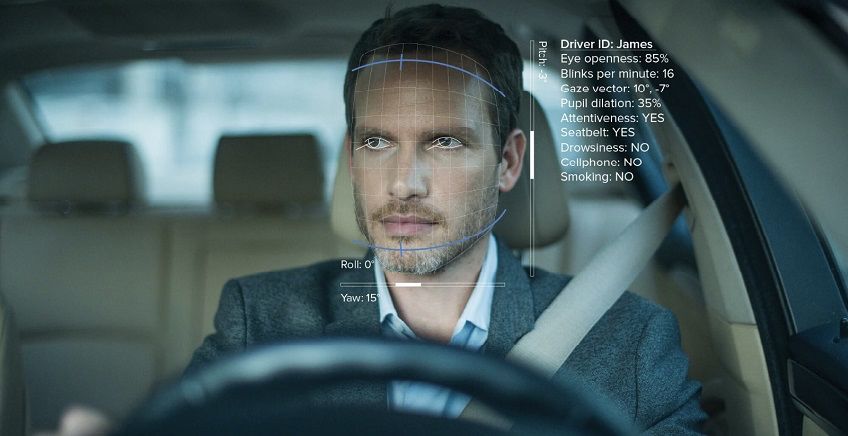

The demand for advanced in-cabin safety solutions is rising as global regulations tighten around driver monitoring systems (DMS). At Embedded World 2025, Cipia, a leader in AI-powered driver monitoring, and semiconductor powerhouse Arm are demonstrating how cutting-edge technology can enhance road safety while maintaining cost and energy efficiency.
The global DMS market, valued at approximately $3.55 billion in 2023, is projected to reach $10.67 billion by 2032, reflecting a 13% compound annual growth rate (CAGR). Against this backdrop, Cipia and Arm’s collaboration showcases an optimized DMS that delivers real-time driver behavior detection—without the need for costly dedicated neural processing units (NPUs) or additional accelerators.
Optimized AI Efficiency with Arm Compute
Cipia’s Driver Sense DMS is designed to detect drowsiness, distraction, and other unsafe driving behaviors. By integrating seamlessly with Arm Cortex CPUs, the solution maximizes performance without relying on specialized hardware, making implementation more accessible for automakers and Tier 1 suppliers.
Unlike many in-cabin monitoring systems that demand additional compute resources, Cipia’s AI technology is built to run efficiently on existing Arm-based processors. This cost-effective, power-efficient approach aligns with the industry’s growing focus on streamlined hardware solutions that reduce manufacturing complexity and overhead.
Additionally, by eliminating the need for external accelerators, Cipia’s system reduces hardware costs, power consumption, and heat dissipation—critical factors as automakers increasingly prioritize efficiency in electric and hybrid vehicle platforms. With EV adoption on the rise, optimizing energy use in vehicle electronics is becoming an industry-wide priority, making Cipia’s solution particularly relevant for next-generation vehicles.
Scalability and Compliance in a Shifting Market
As regulatory agencies push for more sophisticated driver monitoring technology, automakers are seeking solutions that strike a balance between compliance, performance, and affordability. Cipia’s software, optimized for Arm’s compute infrastructure, provides a scalable, regulation-ready approach that enables automakers to meet evolving safety requirements without the burden of extra hardware.
The collaboration highlights how AI-driven driver monitoring can be deployed efficiently across various vehicle segments, from mass-market models to premium cars, making the technology more accessible across the industry. Furthermore, as Euro NCAP regulations tighten, requiring enhanced driver attention monitoring by 2026, solutions like Cipia’s DMS will become a standard feature in vehicles worldwide.
Building on Momentum: Cipia’s Recent Advances
Cipia’s latest demonstration with Arm is part of a broader push to expand its in-cabin sensing capabilities. In December 2024, the company announced plans to integrate infrared (IR) and radar sensors for in-cabin monitoring, further enhancing the accuracy of driver safety solutions. Additionally, in August 2024, Cipia strengthened its market strategy by appointing Dr. Yuebing Lu as Chairman of its Global Advisory Board, reinforcing its expansion into China’s growing automotive sector.
In January 2025, Cipia expanded its fleet safety offerings with the introduction of Advanced Driver Assistance System (ADAS) capabilities to its Cipia-FS10 product, providing a comprehensive 360° road and driver monitoring solution.
Beyond these developments, Cipia has been steadily increasing its footprint in the automotive industry, securing multiple design wins with global automakers and Tier 1 suppliers. As more vehicles integrate AI-powered monitoring systems, Cipia’s approach—focusing on software-driven efficiency rather than hardware-intensive solutions—positions it as a key player in the market.
The Future of AI-Driven In-Cabin Safety
With safety, efficiency, and compliance driving the next wave of automotive innovation, Cipia and Arm’s collaboration provides a compelling blueprint for the future of driver monitoring—delivering high-performance AI-powered solutions while reducing complexity and cost.
As automakers continue integrating advanced driver assistance technologies, Cipia’s software-first approach offers a scalable, future-proof alternative to traditional hardware-heavy solutions. With global regulators and consumers demanding higher safety standards, AI-driven monitoring is set to become an essential component in modern vehicles, ensuring safer roads and smarter mobility solutions for the years to come.

