
For years, software companies have used interactive demos to give prospective customers a closer look at their products without requiring a live sales call. But as AI changes how buyers search for information and evaluate software, the traditional demo is beginning to look less like an experience and more like a digital brochure.
Walnut is now trying to change that dynamic.
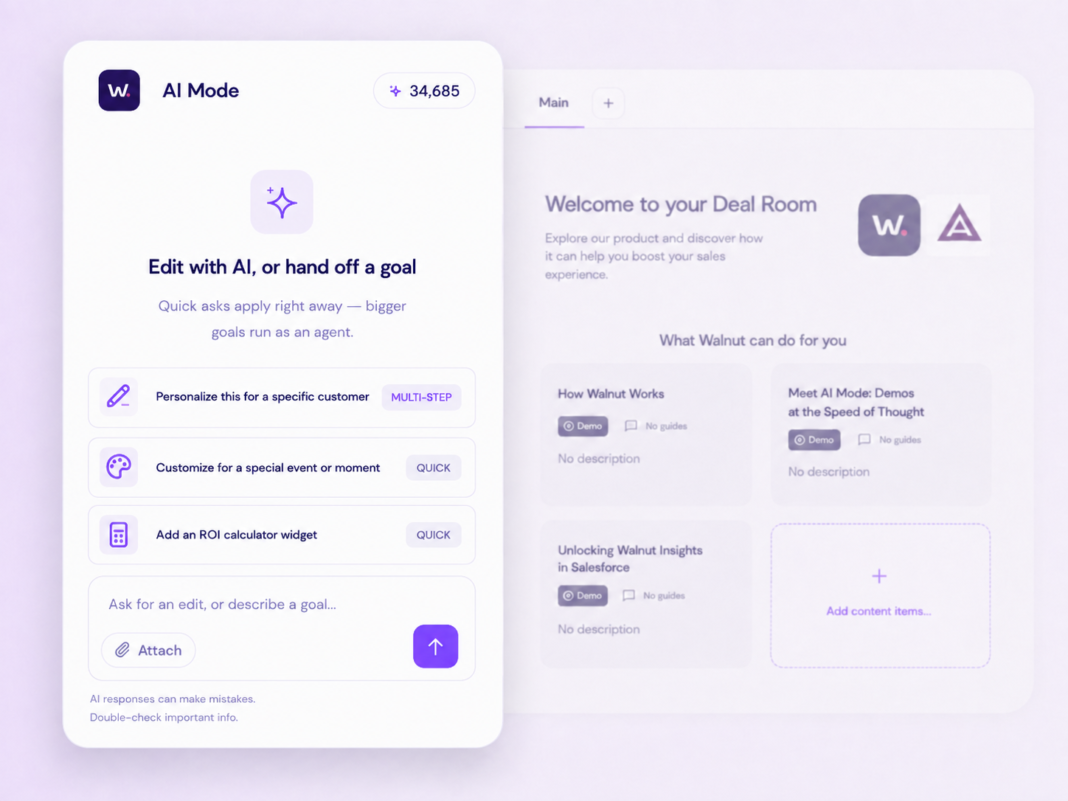
The company, which provides interactive demos, playlists and deal rooms for B2B software companies, has launched two new AI agents that extend its platform beyond creating product experiences. AI Mode for Playlists and Deal Rooms is designed to automate the creation of personalized buyer experiences, while Walnut Xpert allows prospects to interact directly with a demo by asking questions and exploring the product.
The announcement brings Walnut’s existing AI Mode for demos and InsightsAI together with the two new capabilities as part of a broader agent platform.
The Problem With Personalization at Scale
Personalized buying experiences have traditionally required significant manual work. A sales representative might assemble different product materials for a major account, create a customized demo and build a deal room around the prospect’s requirements.
That approach can work for a handful of strategic opportunities. It becomes considerably harder when a company has hundreds or thousands of potential buyers.
Walnut says creating a personalized playlist or deal room previously required an account executive or customer success manager to spend roughly three hours on each deal. Its new AI Mode for Playlists and Deal Rooms is intended to reduce that process to a prompt describing what the buyer needs.
The company has made a similar push with demo creation. According to Walnut, what once took days, and later hours, can now be completed in minutes through its demo creation and personalization agents.
The underlying idea is less about eliminating personalization than changing its economics. If an experience can be created quickly enough, sellers can potentially tailor more of the buying journey without dedicating hours to each individual opportunity.
When the Buyer Starts Asking Questions
The more notable shift may be on the other side of the transaction.
Most product demos are built around a predefined path. A prospect clicks through screens, watches an explanation or follows a sequence created by the seller. That structure gives companies control over the story, but it also limits what buyers can investigate.
Walnut Xpert is designed to make the demo interactive. A prospect can ask questions, go deeper into areas that matter to them and navigate the product without relying entirely on the path established by the seller.
Walnut says sessions with Xpert alongside a demo last more than twice as long as sessions without it. The company also sees the questions themselves as a source of buyer-intent information.
That could change the role of the demo. Instead of simply serving as an asset that a prospect views, it can become a mechanism for discovering what the prospect is actually trying to solve.
The company describes the experience as functioning somewhat like an AI SDR, qualifying interest and surfacing the topics buyers care about without requiring a sales team to manually handle every interaction.
Grounding the Agents in the Product
AI-generated sales content presents an obvious risk: the output can sound convincing while failing to accurately represent the underlying product.
Walnut’s approach is to anchor its agents to its existing product capture technology. The platform captures a company’s actual software, including its screens, flows and data, and uses that captured environment as the foundation for the AI-generated experiences.
That distinction is important to Walnut’s broader strategy. The company is not positioning its agents as general-purpose AI systems that simply generate content about a product. Instead, the agents operate on top of a shared representation of the product itself.
That same context can power a demo, personalized playlist, deal room or conversation with a buyer. The objective is to prevent each interaction from becoming a separate interpretation of the product.
“Every company has access to the same frontier models now, so the ability to build features isn’t a competitive advantage anymore. What is: your ability to go to market effectively, tell a coherent story, and create a buyer experience that actually helps your buyer make the informed decision,” said Oren Blank, CEO of Walnut.
Governance Moves Alongside Autonomy
Walnut is also putting governance alongside its expansion into autonomous AI.
The company introduced its AI Center before shipping the new agent capabilities, giving administrators visibility into AI usage along with permissions and guardrails. Walnut says the goal is to ensure organizations can control agent activity as these systems take on more responsibilities.
The company is extending that approach with bring-your-own-key support, allowing customers to use their own model keys and maintain direct control over security, privacy and spending.
Walnut’s argument is that the underlying models will continue to change, while the company’s value lies in the buyer-enablement layer built around captured product context, workflows and governance.
A Different Role for the Product Demo
The larger question for Walnut is whether the product demo can evolve from a static sales asset into an active participant in the buying process.
Its latest release suggests a model in which sellers still decide what story they want to tell and which buyers should receive it, but AI handles more of the execution. Personalized deal rooms can be assembled from a prompt, while buyers can explore the product conversationally once they arrive.
All four agents are now available to Walnut customers. BYOK support and a companion MCP that allows customers to run Walnut through the AI provider of their choice are expected to roll out in the coming weeks.
For B2B software companies, that could make the next generation of product-led selling less about building more content and more about creating an experience that can respond to the buyer in real time.