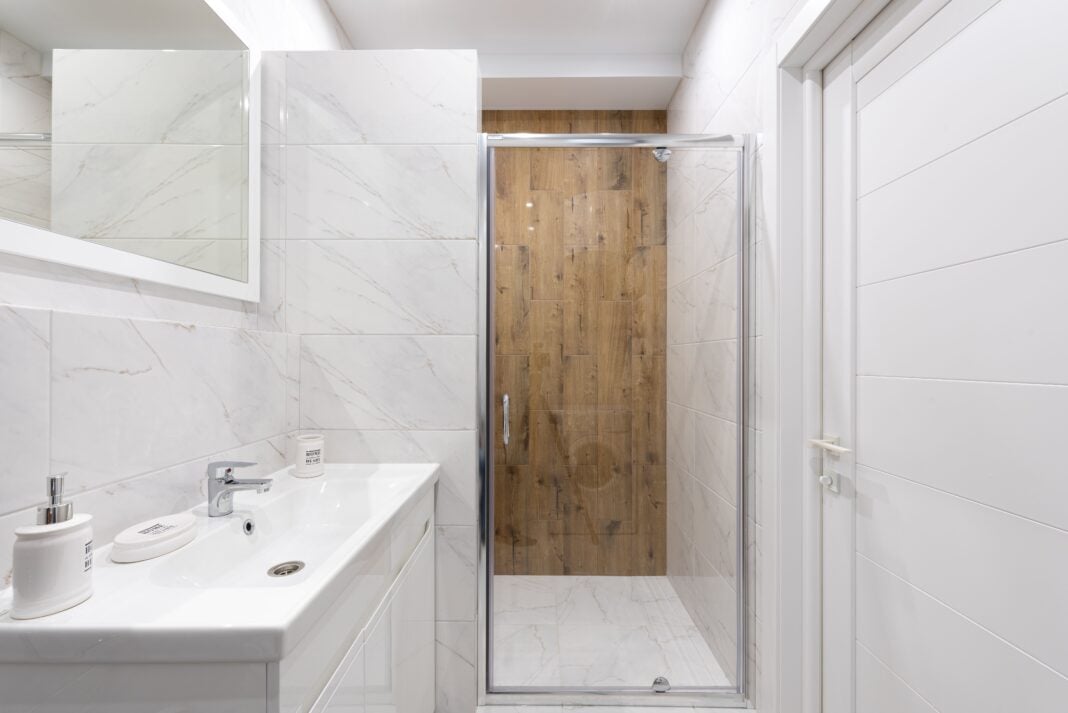

The tile is picked out, the old tub is gone, and the plumber has already framed the new alcove. Then the shower door question lands. In a 1990s Long Beach bungalow the outgoing unit is almost always a framed aluminum slider whose bottom track has been quietly feeding mildew for years, and nobody misses it. Here is the argument, stated plainly. The enclosure type you choose, far more than the brand stamped on the hardware, decides whether you are scrubbing a track in five years or wiping down a clean pane. That is why a shower door Long Beach CA glass shop cuts to your actual alcove behaves differently from a boxed unit sized for a standard opening. Fit is what you are buying.
Framed Semi Frameless and Frameless Compared
Three types cover nearly every alcove tub to shower conversion. A framed enclosure wraps metal around every edge of the glass, which is cheap and stiff and also gives water a place to sit. Semi-frameless keeps framing on the perimeter and drops it from the door edges. Frameless uses thick tempered panels, heavy hinges, and almost no metal at all. Weight drives that price as much as the looks do, since half-inch panels need real blocking behind the tile. The glass itself is not an upgrade option: federal rules classify shower doors and enclosures as Category II architectural glazing that has to pass a 400 foot-pound impact test, which ordinary annealed glass cannot survive.
Shower enclosure types compared, an illustrative example scenario for a modest alcove tub to shower conversion. All shower glass must be tempered safety glazing per 16 CFR 1201.
|
Enclosure type |
Relative cost | Leak and mildew resistance | Look |
|
Framed sliding |
Lowest | Lower: tracks and framing trap water and mildew |
Dated, more visible metal |
|
Semi-frameless |
Middle | Moderate: fewer tracks, less buildup |
Cleaner, some framing |
| Frameless tempered glass | Highest | Highest: minimal hardware, easiest to wipe down |
Open, modern, custom |
Ten years ago the framed slider was the default around here and frameless was a special order with a long wait, priced for the kind of remodel that also moved a wall. That gap narrowed. Tempering capacity and hardware supply caught up, so the semi-frameless middle option now sells in volumes it never used to. Lead times moved with it, and a unit that once meant a month of waiting is often closer to two weeks. Prices eased a little too, though never as far as homeowners hope. The case we see most often is a homeowner who wanted frameless, priced it honestly against the rest of the bathroom, and landed one step down without regret.
Questions to Ask Before You Order
Ten minutes of questions prevents most of the regret in this category. Ask about the glass, about the wall condition behind the new tile, and about who owns the problem if the opening turns out to be out of plumb, because bungalow walls from that era rarely are. Get those answers on the written estimate rather than over the phone. Safety is the one answer with no flexibility in it at all. Shower doors and enclosures are regulated architectural products, and safety glazing has been required in them since the federal standard took effect on July 6, 1977. A bid that quotes plain annealed glass for a shower is disqualified on the spot.
- What glass thickness are you quoting, and is it tempered? A good answer names a number, commonly 3/8 inch or 1/2 inch on frameless work.
- Will you template the opening on site after the tile goes in? A good answer is yes, and after, never before.
- How far out of plumb can these walls run before the design has to change? A good answer gives a tolerance in inches rather than a shrug.
- Which hardware finishes are in stock right now, and what is the lead time on the ones that are not? A good answer separates those two clearly.
Price the job before the tile is set, not after. Anyone pricing a shower door Long Beach CA project this year should expect the metal-heavy options to have quietly closed part of their gap with heavy glass. USGlass Magazine tracked metal door and frame prices running 10.8% higher year over year in April 2026, and framing metal is a real share of what a framed or semi-frameless unit costs to build. One thing I cannot pin down for you is how long the water-repellent coatings actually last: manufacturers quote years, homeowners report anywhere from two seasons to a decade, and I have never seen anybody track it properly.
Choosing the Door You Won’t Redo
Buy the enclosure for the twelve years after the remodel, not for the week of it.
Other glass work in the house comes with math you can actually run. Money.com, citing Department of Energy figures, reports that energy-efficient windows trim annual energy costs by 7% to 15%, roughly $70 to $500 a year. A shower enclosure carries no payback like that, which is precisely why the decision gets made on durability and cleaning time. Cleaning is the cost nobody prints on the estimate, and it is paid weekly for a decade. Measure the alcove, decide how much metal you are willing to scrub around, and pick the version you will not itch to replace at the next remodel. On a modest budget that is frequently the semi-frameless door, and choosing it is not a compromise anyone regrets.