
The lift itself is rarely the expensive part of this decision. What costs a family money is buying a permanent machine for a temporary problem, so anyone pricing stair lifts St Louis MO should measure the staircase and the recovery first. Those two measurements drive nearly everything else on the quote. A St. Charles home with a curved staircase and a ten-week recovery is a different job from a straight flight in an O’Fallon ranch. Matching the rail to the staircase and the term to the recovery costs less than buying the largest unit on the floor.
A Rushed Install Undoes a Safe One
Discharge dates move up, and the call we get most often comes on a Friday for a Monday homecoming. Speed is fine, but guessing is not, because a chair bolted to the treads without a real measurement binds at the turn or leaves one step at the top. That is often the exact step that sent the rider to the hospital in the first place. A July 2026 scoping review in OTJR: Occupational Therapy Journal of Research counted 16 reported outcomes from home modifications for adults 50 and over, fewer falls among them. Only 4 of the 38 studies reported what the installation actually cost. The benefits are documented and the prices are not, which is exactly why you have to ask.
Curved Staircases Rule Out Stock Rails
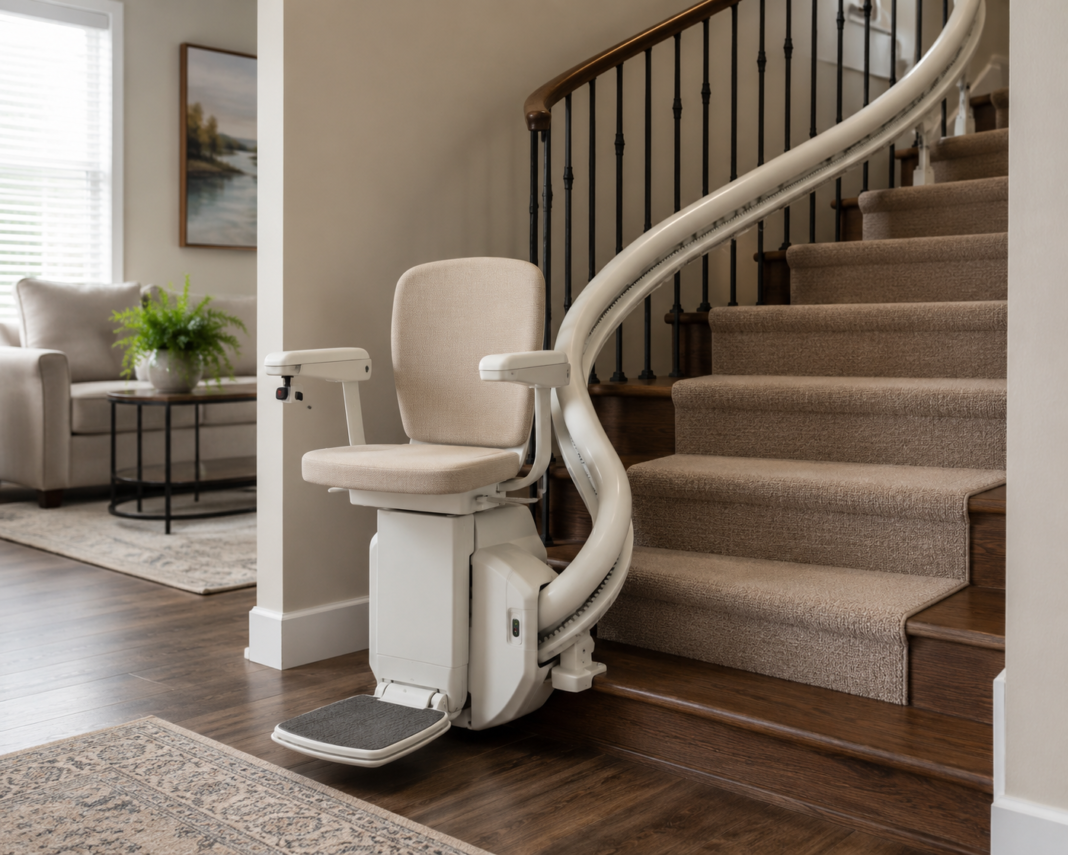
A straight staircase takes a rail off the shelf. A curved one does not, because the track is built to the precise turns, landing width, and pitch of your stairs. The cost guide at Fixr puts a straight stairlift at $2,000 to $8,000 installed and a curved model at $8,000 to $20,000, and that spread is almost entirely the custom rail. Ten years ago the rail meant a technician on the stairs with a paper template and several weeks of waiting while a fabricator bent the track. Today most shops photograph and digitally measure the flight, so the rail is cut from that model and the wait is shorter. It has never disappeared, though, and anyone promising a curved rail installed tomorrow is quoting a straight rail with a transfer at the landing.
Example scenario: matching a stair lift option to a St. Charles or O’Fallon recovery. Cost drivers are published U.S. ranges, not a quote.
|
Option |
Typical use case | Staircase type |
Typical cost driver |
|
Short-recovery rental |
10-week post-surgery recovery | Straight staircase | $150-$500 per month |
|
Long-term purchase |
Permanent mobility need | Straight staircase |
$2,000-$9,000 installed |
| Curved custom rail | Staircase with turns or a landing | Curved staircase |
$10,350-$25,000 custom track |
None of that makes a curved staircase a lost cause, only a measured one. The measuring has to happen before anyone hands you a number. A firm price quoted over the phone for a curved flight is a guess dressed up as a price, and it tends to grow once someone stands on the stairs.
Weight Rating and Battery Backup Come First
Two specifications matter far more than the upholstery color or the armrest style. Every lift carries a rated weight capacity covering the rider plus whatever they carry, and the lift must be professionally measured and installed to that rating. Get that number in writing instead of taking it in conversation. The second is battery backup, and as the Home Elevator of Texas stair lift guide explains, stair lifts run on batteries so the chair keeps working during a power outage. Never accept a unit without working battery backup, and never let anyone skip the fitting to save a day.
Rental Length Should Match the Recovery
Rental is the option families overlook, and it is usually the one that fits a surgery. A short-term rental covers the weeks the stairs are genuinely dangerous, then the equipment leaves with no resale problem. Plan the term against the surgeon’s timeline and add a cushion. Call it eight weeks for a hip replacement. Honestly, closer to twelve once physical therapy runs long and someone decides the upstairs bathroom needs a grab bar first. In practice this typically means a month-to-month term beats a discount for paying the whole block up front.
Questions Every Installer Should Answer Plainly
A good installer answers these without hedging, and the answers should be specific enough to write down. If a question gets a range instead of a number, ask what would move it to the low end. Three come up on nearly every call we take.
Can a stair lift work on a staircase with a landing?
Usually yes, either with one continuous curved rail that carries the chair around the turn, or with two straight lifts and a transfer at the landing. The continuous rail costs more and is easier on someone recovering from surgery, since nobody has to stand up mid-trip. Ask which one is being quoted, because the two are very different experiences for the rider.
Is renting really cheaper than buying for a short recovery?
For a recovery measured in weeks, renting a straight lift almost always wins on total cost. Buying makes more sense when the mobility limit is permanent, or when the staircase is curved, since a custom rail is built for one house and has little resale value. Run both numbers before deciding which way to go.
What happens to the stairs when the lift comes out?
The rail bolts to the treads rather than the wall, so removal leaves small screw holes a carpenter can fill in an afternoon. Ask whether removal and pickup are included in the rental price. On most jobs they are, but that belongs in the agreement instead of in someone’s memory.
Pick the Installer Who Measures First
The installer who shows up with a tape measure before quoting a price is the one to hire. A search for stair lifts St Louis MO returns plenty of listings, and the sorting question is simple: who measured the staircase, and who quoted from a catalog? Ask each one for the weight rating, the battery backup, the rental term, and the removal cost. A curved staircase and a ten-week recovery do not call for the biggest lift on the market. They call for the right rail, for the right number of weeks, fitted by somebody who saw the stairs.