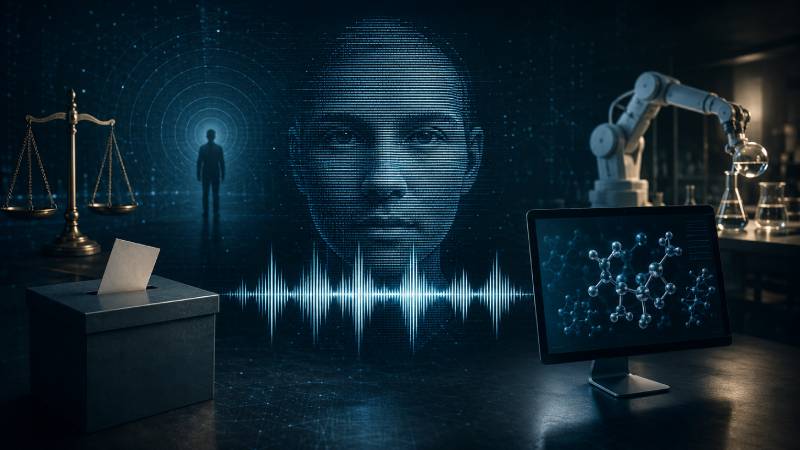

From political avatars to automated chemistry, artificial intelligence is testing safeguards faster than laws can respond. The danger is real, but the evidence requires precision.
AI risks that once appeared confined to science fiction have entered laboratories, election campaigns and criminal investigations.
Researchers have demonstrated systems that reproduce voices from seconds of audio. Others infer emotions from wireless signals, operate laboratory equipment and design virtual molecules predicted to be highly toxic.
Political campaigns and criminals already exploit synthetic media.
These developments do not prove that privacy has disappeared or science no longer needs people. They show that powerful capabilities are advancing faster than many safeguards governing their use.
Political Deepfakes Become a Present-Tense Problem
Brazil provided a striking example in July 2026.
An AI-generated replica of former president Jair Bolsonaro appeared at the launch of his son Flávio Bolsonaro’s presidential campaign.
The replica identified itself as an artificial intelligence simulation before endorsing Flávio.
The real Bolsonaro is serving a 27-year sentence under house arrest. The court barred him from public statements, social media and mobile phones.
Bolsonaro later denied authorizing the video.
Supreme Court Justice Alexandre de Moraes said authorization could represent a serious violation of Bolsonaro’s detention conditions.
He also warned that the video may have violated electoral rules prohibiting deepfakes used to favor or harm a candidate.
No final violation had been established at the time of writing. However, the dispute tests whether an AI avatar can represent somebody legally barred from campaigning.
AFP report on the Bolsonaro AI replica
The problem predates the current election.
The Digital Forensic Research Lab identified 78 pieces of content related to candidates during Brazil’s 2024 municipal elections. Researchers classified the material as either confirmed or alleged synthetic content.
The report did not classify all 78 cases as proven deepfakes.
Researchers found that some purported deepfakes were ordinary edited images. They could not determine the authenticity of other material.
Authorities received reports concerning 49 of the cases.
DFRLab investigation of Brazil’s 2024 elections
Voice technology has also lowered the barrier to impersonation.
Microsoft demonstrated that its experimental VALL-E system could produce personalized speech from a three-second recording.
Microsoft did not describe every result as indistinguishable from a real speaker. It said quality and similarity depended on the recording and other conditions.
The company also warned about impersonation and attacks against voice-authentication systems.
Automated Chemistry Creates a Dual-use Problem
In 2023, Carnegie Mellon University researchers reported that an AI system called Coscientist could design, plan and execute chemistry experiments.
Coscientist used large language models to search documentation and prepare experimental plans. It then sent instructions to automated laboratory instruments.
Researchers also examined whether users could induce the system to assist with hazardous or controlled chemicals.
Carnegie Mellon University report on Coscientist
Coscientist did not generate 40,000 nerve agents. That finding came from a separate 2022 experiment involving a system called MegaSyn.
Researchers associated with Collaborations Pharmaceuticals reversed the normal objective of the drug-discovery model.
Instead of penalizing predicted toxicity, they rewarded it.
In less than six hours, MegaSyn generated 40,000 virtual molecular designs. These included known chemical-warfare agents and previously unknown structures predicted to be highly toxic.
The researchers did not synthesize or test 40,000 compounds.
They warned that the predictions would include false positives. Producing any new chemical in the physical world would remain a major technical barrier.
However, the experiment demonstrated an important dual-use risk.
Researchers redirected a system designed to avoid toxic drugs toward potentially dangerous designs by changing its objective.
Nature Machine Intelligence paper
Interview with lead author Fabio Urbina
Privacy Threats Remain Partly Experimental
MIT researchers introduced EQ-Radio in 2016.
The laboratory prototype transmitted wireless signals and analyzed their reflections from a person’s body. It measured breathing and heartbeat patterns without requiring a camera or wearable device.
The system classified four emotional states: excited, happy, angry and sad.
It achieved 87 percent accuracy after training on the person being tested. Accuracy fell to 70 percent when the system examined someone it had not previously measured.
The research showed that wireless sensing could reveal biological information without physical contact.
It did not demonstrate that ordinary household Wi-Fi was already reading everybody’s emotions through walls.
A 2023 acoustic side-channel experiment demonstrated another potential privacy threat.
A machine-learning model classified laptop keystrokes with 95 percent accuracy using recordings from a nearby smartphone.
It achieved 93 percent using audio captured through Zoom.
However, researchers trained and tested the system on a particular laptop keyboard under controlled conditions.
The experiment demonstrated a serious side-channel vulnerability. It did not show a universal system automatically converting arbitrary typing into passwords or breaking encryption.
Acoustic side-channel research paper
Synthetic Abuse Produces Real Victims
AI-generated child sexual abuse material frequently involves real children and identified victims.
The U.S. National Center for Missing and Exploited Children received more than 400,000 CyberTipline reports with a generative-AI connection in 2025.
More than 182,000 concerned possessing, generating or attempting to generate AI child sexual abuse material.
Since NCMEC began tracking the problem in 2023, it has identified more than 275 victims.
The organization has also classified more than 158,000 images and videos as generative-AI abuse material.
Offenders also manipulate existing images of known victims to create new material.
The Internet Watch Foundation identified 8,029 realistic AI-generated abuse images and videos in 2025.
It has also documented criminals stealing ordinary photographs of real children. Offenders manipulated those photographs for abuse and blackmail.
Internet Watch Foundation report
These figures document a rapidly growing investigative burden. They do not measure its effect on overall police capacity.
Crime Forecasts Are Not Prophecies
A University of Chicago model published in 2022 forecast reported violent and property crime up to one week ahead.
The model produced a mean area under the receiver operating characteristic curve of about 90 percent in Chicago.
It made weekly predictions within areas roughly 1,000 feet across.
That figure represents a statistical performance measurement. It does not mean the system correctly predicted 90 percent of individual crimes.
The system did not name an offender, victim or exact address.
Its developers also warned against using the model to send police into predicted areas.
One of the study’s most important findings concerned unequal police responses between affluent and disadvantaged areas.
The research showed how forecasting tools could expose enforcement bias. It also demonstrated their potential to strengthen state surveillance.
AI Is Changing Research
A 2025 analysis examined more than 1.1 million papers and preprints.
Researchers found evidence of large-language-model modification in up to 22 percent of computer-science papers.
The estimates reached up to 9 percent in mathematics papers and Nature Portfolio journals.
The study measured probable AI-assisted writing. It did not conclude that those papers contained invented experiments or fraudulent results.
Wiley also retracted more than 11,000 papers published through Hindawi during a wider research-integrity cleanup.
Investigations found evidence of paper mills, incoherent content, publication-process manipulation and compromised peer review.
The publisher did not classify all those papers as AI-generated.
AI may help paper mills produce fraudulent material faster. However, the retraction total cannot serve as a count of AI-written papers.
ABC investigation of the Wiley and Hindawi retractions
AI Risks Are Real — Precision Strengthens The Case
The central distinction separates laboratory demonstrations, deployed systems and documented abuse.
Political impersonation, sexual exploitation and the dual use of scientific tools present immediate dangers.
Other technologies remain controlled demonstrations. Their wider misuse is possible but not yet proven.
AI risks are already here. Accurate reporting gives lawmakers, researchers and the public a stronger basis for building effective safeguards.