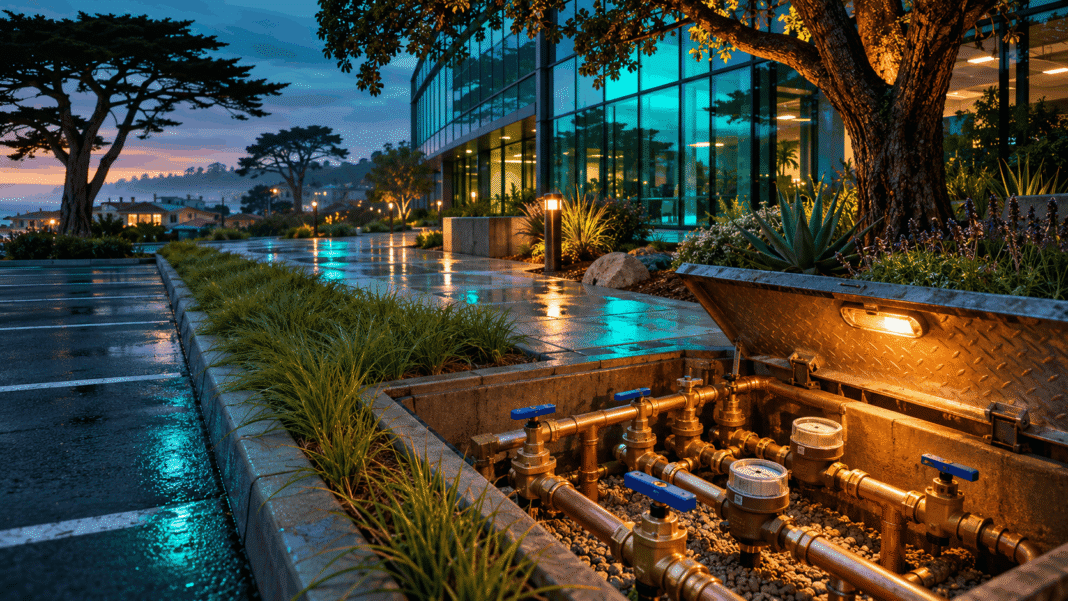

California’s 2028 watering deadline is approaching for commercial property owners whose landscapes contain decorative grass irrigated with drinking water. A strip of lawn around an office parking lot may seem like a minor maintenance issue, but it could require a closer look at how a property’s irrigation system uses water, where its supply lines run and which areas the current equipment serves.
Assembly Bill 1572, commonly called AB 1572, phases in restrictions on using potable water to irrigate nonfunctional turf at certain California properties. Most commercial, industrial and institutional properties face a January 1, 2028 compliance date. Common areas managed by homeowners’ associations and similar organizations generally have until January 1, 2029.
The law does not order every property owner to remove grass, replace an entire irrigation system or install new plumbing equipment. Its central restriction concerns the use of potable water on qualifying nonfunctional turf.
For property managers, the practical challenge is determining which planted areas are covered, where the water comes from and whether existing irrigation arrangements can be adjusted without creating additional problems.
What California AB 1572 changes in 2028
California Water Code section 10608.14 establishes restrictions on irrigating nonfunctional turf with potable water. The California State Water Resources Control Board explains that nonfunctional turf generally means mowed grass that does not serve an active recreational or community purpose.
Examples can include decorative lawn strips along parking lots, grass surrounding signs and other areas maintained primarily for appearance rather than regular use by people.
The distinction matters because a business property may contain both functional and nonfunctional turf. A landscaped area used for organized recreation or community gatherings is not necessarily treated the same way as a narrow ornamental strip bordering a driveway.
The restrictions are introduced in phases according to property type. Many public agency properties have a January 1, 2027 deadline. The January 1, 2028 phase applies to other commercial, industrial and institutional properties, subject to the law’s exclusions and exceptions. Common areas belonging to homeowners’ associations, common-interest developments and similar organizations generally follow in 2029.
Some publicly owned properties in disadvantaged communities have a later deadline tied to the applicable statutory provisions and state funding conditions.
Property owners should confirm their classification before relying on a date. A commercial building, public facility and association-managed common area may have different compliance timelines despite being located on the same street.
For businesses reviewing California AB 1572 irrigation plumbing requirements, an important starting point is identifying which irrigation zones currently supply decorative turf and which also serve trees, shrubs or other plantings.
That information can determine whether a relatively limited adjustment is possible or whether the existing system needs more extensive evaluation.
Santa Cruz has already incorporated the restrictions into local rules
The law is not merely a future proposal awaiting adoption. California enacted AB 1572 in 2023, and local water suppliers have been updating their own rules to reflect its requirements.
The City of Santa Cruz adopted Ordinance No. 2026-01 to amend its water-use regulations and address the irrigation of nonfunctional turf.
The resulting provisions of Santa Cruz Municipal Code Chapter 16.02 establish the phased restrictions, including January 1, 2028 for applicable commercial, industrial and institutional properties, and January 1, 2029 for qualifying association common areas.
For a property served by the Santa Cruz Water Department, the municipal code and current department guidance are important sources when assessing compliance.
Businesses outside the city’s water-service area should check their own supplier’s requirements. Santa Cruz County contains multiple water-service areas, and a general article about statewide rules does not replace locally applicable requirements.
Commercial owners should also distinguish between the state restriction and any separate water-waste provisions already applicable to their property.
Waiting until the 2028 deadline to investigate the system could leave little time to identify shared irrigation zones, obtain proposals or coordinate work around tenants and customers.
The law does not require every lawn to be removed
One persistent misunderstanding is that AB 1572 requires all commercial properties to remove their grass before the relevant deadline.
The restriction is more specific. Covered properties must stop using potable water to irrigate nonfunctional turf once their applicable compliance date arrives, except where the law permits continued use.
For example, a commercial property may have a decorative grass strip that is currently watered with potable water. The manager might consider converting it to a climate-appropriate landscape, disconnecting that zone from the drinking-water irrigation supply or using an allowable nonpotable source where one is available and properly approved.
The right solution depends on the site’s existing systems, landscaping requirements and water supply.
California’s rules also recognize limited circumstances in which potable water may continue to be used, including amounts necessary to protect trees and other perennial nonturf plantings or address an immediate health and safety need.
Those exceptions should not be interpreted as permission to continue routinely watering decorative grass without examining the actual circumstances.
The State Water Resources Control Board and the relevant water supplier can provide guidance on the law’s scope. Property managers should also consult qualified professionals when changes may affect irrigation equipment or protected landscape features.
Replacing turf can be one compliance strategy, but the law should not be presented as a blanket landscape-removal mandate.
Why irrigation zones deserve an early inspection
The first technical question is often whether a property’s irrigation system separates different landscape areas into distinct zones.
Some systems were installed long before AB 1572 was enacted. A single valve may supply water to decorative turf, nearby shrubs and trees. Shutting off that entire zone could reduce irrigation to plants that remain eligible for watering.
Other properties have separate valves for turf and planted beds, allowing more targeted adjustments.
A review should identify the water source, controller settings, active zones, valve locations and visible condition of supply lines.
It may also reveal equipment that has been modified over time without corresponding updates to system diagrams.
Property records are useful, but they do not always reflect every field change. A recent site inspection can help establish whether the documented arrangement matches the equipment actually operating.
The question is not simply which grass should stop receiving water. It is how to change that irrigation without unintentionally interrupting other areas or introducing avoidable leaks.
Where different plantings share one zone, separation may require evaluating valves, branch lines or other components. That should be determined from the physical installation rather than assumed from the lawn’s appearance.
Older irrigation systems can conceal water losses
A property owner preparing for AB 1572 may discover that the system has ordinary maintenance problems unrelated to the new law.
Leaking valves, damaged lateral pipes, broken sprinkler heads and poorly adjusted controllers can waste water regardless of whether the surrounding grass is considered functional.
The California State Water Resources Control Board’s conservation information stresses the importance of using water efficiently. An irrigation review offers a practical opportunity to identify losses before the property begins modifying its watering arrangements.
Water use can also be difficult to interpret when a commercial property has several meters, irrigation connections or shared systems.
A manager should establish which meter or supply connection serves each area before assuming that a particular zone uses recycled water or another nonpotable source.
Where nonpotable water is considered, the design must account for the water supplier’s requirements and applicable cross-connection protections. A change in water source cannot safely be treated as a simple hose or pipe connection.
Experienced contractors can help identify the physical arrangement and determine which modifications require permits, design approval or further specialist assessment.
The goal is a system that meets the applicable water-use restrictions while continuing to operate reliably for the remaining landscape.
Backflow protection is a separate water-safety obligation
AB 1572 and backflow prevention address different issues, although both may become relevant during an irrigation-system review.
AB 1572 restricts the use of potable water on qualifying decorative turf. Backflow prevention concerns the possibility of water moving in the wrong direction and introducing contamination into a drinking-water system.
Pressure differences or unsuitable connections can create backflow risks in some plumbing and irrigation arrangements.
The City of Santa Cruz Water Department maintains a cross-connection control and backflow prevention program under applicable state law, its municipal code and department policies.
According to the department’s published Engineering guidance, customers with required backflow prevention assemblies are responsible for arranging inspection and testing by approved personnel. The department specifies at least annual testing, or a more frequent interval when required by applicable rules.
That requirement should not be described as a new universal obligation created by AB 1572.
Instead, property managers reviewing commercial backflow testing considerations should determine which devices are installed, which are required and whether current inspections and testing records are available.
The location and condition of irrigation connections deserve attention when zones are being disconnected, rearranged or supplied from different water sources.
The City of Santa Cruz also publishes information about its approved backflow testers and cross-connection control procedures. Property owners should confirm current testing requirements directly with the relevant water utility.
A property may need an irrigation modification for AB 1572 while separately having an existing backflow testing obligation. Keeping those issues distinct helps prevent unnecessary work and misleading compliance claims.
What a commercial plumbing review should establish
Not every AB 1572 project requires extensive plumbing construction. A property with independent irrigation zones and reliable shutoff controls may have a different scope of work from one with shared supply lines and incomplete records.
Before authorizing changes, the property manager should obtain a clear description of the existing conditions and proposed work.
That description should distinguish landscape design decisions from plumbing and water-system work.
A landscaping professional may evaluate suitable replacement planting, while a plumbing or irrigation contractor may assess water supply, valves, fittings and connection arrangements. Some projects can require coordination between several disciplines.
When considering licensed commercial plumbing services, owners should verify the contractor’s applicable credentials and confirm that the proposed scope matches the work the contractor is authorized and qualified to perform.
In California, the Contractors State License Board provides public tools for checking contractor licensing information. The relevant classification, license status and project requirements should be assessed for the actual job.
Property owners should not assume that a licensed contractor automatically has every specialized certification required for backflow testing or a particular irrigation installation.
A written proposal should explain which components will be changed, whether the system will remain operational during the work and how completed modifications will be tested.
It should also identify who is responsible for permits, inspections and documentation if those are required.
Planning around tenants, access and daily operations
Commercial properties often have constraints beyond the irrigation equipment itself.
A shopping center may need work performed outside busy customer hours. An office property may have landscaped areas around walkways and vehicle entrances. A hotel may need to preserve guest access during construction.
These conditions can affect when contractors can inspect valves, isolate water lines or work near occupied spaces.
Property managers should record access restrictions and the locations of buried services before scheduling intrusive work.
Existing site plans may identify irrigation piping, electrical lines, drainage features and other infrastructure. If excavation is planned, the appropriate utility-location procedures should be followed before digging begins.
The work schedule should also address communication with tenants and site personnel. A temporary irrigation shutdown may be minor, but a broader water-service interruption requires more careful planning.
Proposals that do not explain operational impacts may be difficult to compare, even if they identify similar equipment changes.
For owners managing several properties, consistent documentation can make future inspections and maintenance easier. Each location should still be assessed individually because its water supplier, irrigation layout and compliance date may differ.
A practical schedule before January 2028
With the commercial deadline approaching, property managers can organize work around a sequence of decisions rather than immediately committing to a large conversion project.
- Identify the property category. Confirm whether the site is commercial, industrial, institutional, public agency or association-managed property, and establish the applicable deadline.
- Survey the landscape. Record where turf is used for recreation or community activity and where it appears primarily decorative.
- Map the irrigation supply. Determine which zones use potable water, where valves are located and whether turf shares irrigation with trees or other plantings.
- Review system condition. Look for leaking lines, damaged controls and maintenance problems that could complicate proposed changes.
- Check backflow records. Confirm whether required assemblies have current testing and whether changes will affect cross-connection controls.
- Evaluate options. Compare suitable landscaping changes, irrigation adjustments and any allowable alternative water supplies.
- Document the completed work. Preserve updated system information, relevant approvals and maintenance records for future operators.
This schedule is a practical planning framework, not a substitute for the property owner’s legal obligations.
Businesses should review current guidance from the State Water Resources Control Board and their water supplier before approving a final approach.
Compliance documentation may matter after the deadline
AB 1572 includes certification provisions for certain regulated properties. The State Water Resources Control Board is responsible for implementing those requirements.
Owners should check whether their property’s irrigated area, classification and reporting schedule make certification necessary.
Maintaining records of irrigation changes can be useful even where a particular certification requirement does not apply.
Updated zone diagrams, contractor records, photographs and maintenance documentation can help a future property manager understand what was changed and why.
They can also make it easier to distinguish an intentionally disconnected decorative-turf zone from equipment that has failed or been left out of service accidentally.
Reporting requirements should be checked against the latest state instructions rather than inferred from general summaries. A property owner should not assume that completing plumbing work automatically satisfies any required certification process.
The real deadline is the last practical day to make the right changes
January 1, 2028 is the legal compliance date for many California commercial, industrial and institutional properties affected by AB 1572. For a property with decorative grass watered from the drinking-water supply, the preparation process may begin much earlier.
The most useful first step is to establish the facts: which areas are covered, how water reaches them, what the local supplier requires and whether the irrigation system can be adjusted without affecting other plantings.
Backflow testing and ordinary plumbing maintenance should be reviewed on their own terms. They may overlap with a project involving irrigation modifications, but they are not interchangeable with the nonfunctional-turf restriction.
Commercial owners who understand those distinctions can request more accurate proposals, avoid unnecessary system replacement and document the changes they actually need.
The law is ultimately about where potable water may be used. Getting the plumbing and irrigation details right is what allows a property to respond without creating new maintenance and water-safety problems.