Human beings are practically designed for miscommunication. The inability to communicate something unintentionally is almost a feature of the human brain.
According to persuasion expert and cartoonist Scott Adams, “We humans like to think we are creatures of reason. We aren’t. The reality is that we make our decisions first and rationalize them later … Your illusion of being a rational person is supported by the fact that sometimes you do act rationally.”
On the Internet, the problem is magnified by the fact that words on a screen lack the all-important context of setting, tone, and body language. When it comes to translation for business purposes, linguistic shipwrecks are happening on a constant basis. Anyone who’s ever received a piece of spam from a foreign advertiser filled with questionable sentences knows this first hand.
But for corporations that work internationally, the problem is much more serious. Multinational corporations need reliable translation services– not office-bound researchers using a Google translator. There’s a rich and not so proud tradition of amateur translation in big business. Here are a couple of examples from the 80s and 90s.
Translated from English to Japanese and back, the Shakespearian phrase: ‘To be or not to be, that is the question,’ was transformed into ‘It is, it is not, what is it?’
Translated from English to Russian and back, the phrase: ‘Out of sight, out of mind’ became ‘Invisible idiot.’
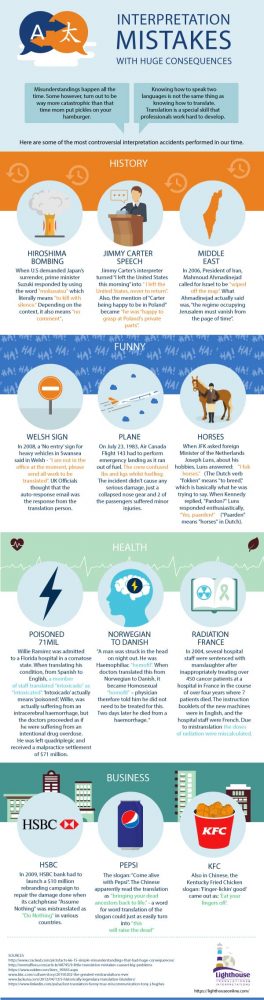
Some corporations, looking to promote their products abroad, have made similar mistakes, but the consequences are magnified when they are delivered to audiences in real time. Here are some of what can only be called Darwin Award-winning advertisement translations.
-Electrolux, a Swedish vacuum manufacturer wanted to promote their products in the US. To anyone wondering why they have never heard of this brand, it might be because the company’s slogan, translated into English is: ‘Nothing sucks like an Electrolux.’
One of the funniest miscommunications in advertising befell the Coca-Cola company. Their name in Chinese sounds like ‘Ke-kou-ke-la.’ What Coca-Cold executives did not realize for years is that in Chinese, that means “Bite the wax tadpole.” After discovering the hilarious mistranslation, Coca-Cola made things worse by creating a logo in Chinese characters which they thought would come across well. But in reality, what they came up with meant “Happiness in the mouth.”
KFC had just as much luck communicating in Chinese with their slogan “Finger-lickin’ good.” The closest Chinese translation was “Eat your fingers off.”
Perhaps in the future, multinational corporations will commission native speakers to do their translation.