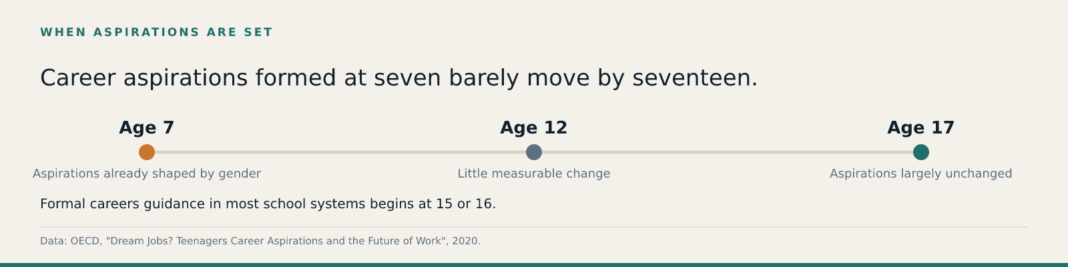

Coco Coders, an online coding school teaching school-age children, is arguing that schools introduce career exposure roughly six years later than the evidence supports. Founder Elizabeth Tweedale points to research showing that children’s ideas about what they might become are largely fixed before they reach secondary school, while most formal career guidance waits until year eleven or the American junior year.
The OECD’s 2020 report Dream Jobs? found that the career aspirations of seven-year-olds are already shaped by gender stereotypes and social background, and that those perceptions change little by the age of seventeen. A separate 2018 study by the UK charity Education and Employers, which asked more than 20,000 primary-age children to draw the job they wanted, found that fewer than one percent had learned about that job from someone visiting their school. The rest drew on television, social media, or a relative’s occupation.
“They don’t even start looking at life after graduation until they are 16 or 17,” Tweedale said. “By then, they are faced with an overwhelming paradox of choice and almost zero context.”
Sociologists have a term for the outcome. Identity foreclosure describes a young person committing to a path before they have had any real chance to examine the alternatives. In practice it looks like a fifteen-year-old choosing between a handful of jobs they have seen on screen, because nobody showed them the several hundred that exist behind the ones they can name.
Tweedale founded Coco Coders in 2016 after a career in which she was patenting technical systems well before generative AI reached boardroom agendas. Before designing the company’s curriculum, her team interviewed high school principals across the United States. Two complaints came back repeatedly: students arrived without basic technical fluency, and they had no working map of the professional world they were about to enter.
The company’s response was to treat coding as a lens rather than a subject. Its curriculum runs ten-week foundation blocks followed by four-week deep dives built around a real piece of technology. In a module on ocean conservation, students study Mr. Trash Wheel, the solar-powered device that intercepts rubbish in Baltimore’s Inner Harbor, then build a game or simulation modelled on the same problem.
The design point is that the child who says they like animals rarely knows that the regional shelter network runs on software somebody has to write, or that automated feeding systems are a job. Naming the technical infrastructure behind an interest turns a vague affinity into something a nine-year-old can act on.
Coco Coders has taught students in the US, the UK and other markets since 2016, with classes delivered live online in group and private formats.
The commercial case for early exposure is being made elsewhere too. Employers filling technical roles draw from a pool shaped a decade earlier, and the OECD data suggests that pool narrows long before anyone in recruitment gets a say.
“We’re solving longer-term problems,” she said. “The ones that don’t just exist for today, but for the world these kids are actually going to inherit.”
Coco Coders classes run year-round with rolling enrolment, and the company publishes its curriculum structure at cococoders.com.
About Coco Coders
Coco Coders is an online coding school founded in 2016 by Elizabeth Tweedale. It teaches Scratch, Python, HTML, CSS and JavaScript to school-age children through live interactive classes in group and private formats, and works with students in the United States, the United Kingdom and internationally. Course information is published at cococoders.com.