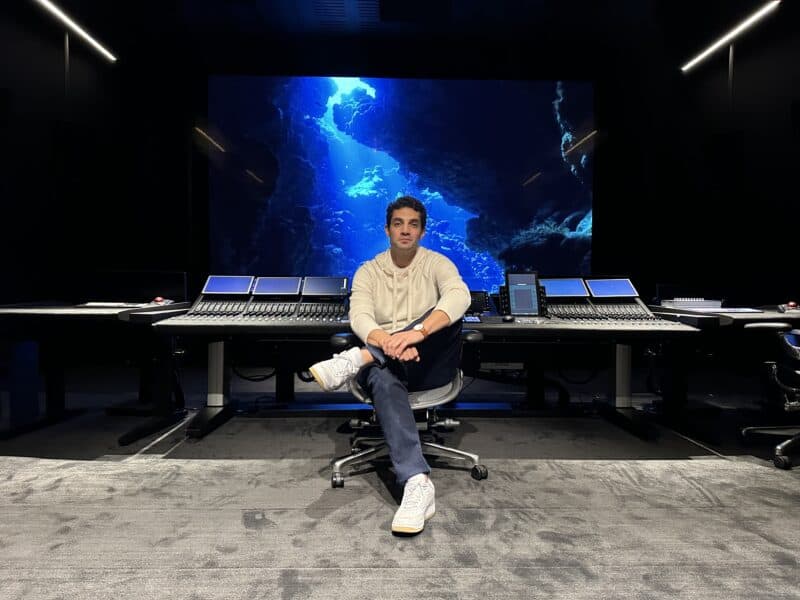

The film and television industry stands on the precipice of an audio revolution, driven not by new microphones or recording techniques, but by algorithms. Artificial intelligence, long viewed with a mixture of excitement and apprehension, is rapidly moving from a theoretical concept to an indispensable tool in the high-stakes world of post-production sound.
For seasoned professionals navigating this shift, the technology isn’t a replacement for human skill; rather, it’s a powerful accelerator. Ghassan Abdelnour, a Los Angeles-based sound engineer, is on the forefront of this transformation and a firsthand witness across his decade-plus career in the industry.
“I have been working in this field for over 10 years, whether it’s creative or technical work,” Abdelnour states. “The thing is, we are in the middle of the AI revolution and we’ve seen glimpses on how it’s going to change, but it’s only the tip of the iceberg, it is going to change industries in a way we can’t fathom at this moment in time.”
In the specialized, often meticulous environment of film sound—where every footstep, whispered dialogue, and sound effect must be perfectly balanced—AI is proving its worth by tackling the most time-consuming, repetitive tasks, freeing up sound engineers and designers to focus on the artistic vision.
The Algorithm as Assistant: Optimizing Workflow
Abdelnour, whose credits include work on films and series distributed by platforms like HULU and Amazon, emphasizes that for post sound, AI is primarily a “game changer when it comes to optimizing workflow and doing all the grunt work.”
There is an immense organizational labor that is involved with the start of a project: cleaning dialogue tracks, sorting thousands of sound effects, synchronizing sources, and assembling multiple takes. Before AI, these tasks could consume a bulk of a project’s timeline.
“From that aspect, it’s been extremely helpful,” Abdelnour confirms. “AI cuts the timeline of the work significantly, which means I can now focus and have more time on the creative aspects.”
This integration is not limited to a single phase; it’s systemic. The global AI market is set to reach $305.9 billion in the coming years, with 88% of organizations using AI. Generative AI leads content creation, and in the US, AI revenue will total $106.5 billion in 2026.
Over the past few years, AI technology has dramatically improved, capable of being utilized “in every single phase of music post-production, from dialogue editing, to sound effects, to mixing,” he explains. “For each stage of post-production, AI is being utilized to improve workflow and minimize mundane tasks.”
Days to Hours: The Dialogue Assembly Breakthrough
The most significant benefit AI offers is efficiency—the sheer gift of time. Abdelnour points to dialogue editing as a critical example where AI delivers massive returns.
“During dialogue editing, there is an entire assembly process of putting together tracks and comping the best takes, which sometimes can take some time to do,” he notes. “But AI can do most of that work in a couple of hours.”
Where organization, track assembly, and initial processing might have taken a sound team days, AI executes the task in a fraction of that time. “The main benefit is time,” Abdelnour stresses. “Instead of something like that taking a few days, you can now do it with AI in a couple of hours, which is huge, it’s a game changer.”
This compression of the technical timeline has a profound impact not only on schedules but on budgets. In an industry where time equals money, the savings are transformative.
Elevating Independent Cinema With Stellar Sound
While blockbuster studios have the resources to deploy massive teams, the efficiency offered by AI is particularly leveling the playing field for smaller productions.
“This is especially true of more independent projects with lower budgets,” Abdelnour observes. Because AI handles the procedural heavy lifting, more time and money can be channeled into bespoke sound design, foley, and the final critical stages of mixing and mastering.
Abdelnour recounts how this technological leverage has allowed him to deliver unexpected quality on constrained projects. “It has helped achieve a sound quality of the highest standard with a quarter of the cost,” he says. “That is the most satisfying thing when I am working on a project with a limited budget and get to see the client’s reaction when they hear the final mix and it has completely exceeded their expectations.”
In essence, AI serves as an immensely fast, tireless intern, managing the arithmetic of sound so the engineer and sound designer can focus on the artistry—the emotional resonance, the character of a scene, and the intentional imperfections that make a soundtrack compelling.
Addressing the Industry Pushback
Despite the clear technical advantages, the adoption of AI is not universally embraced, a skepticism that echoes sentiments felt across the creative industries. The fear of job displacement remains a significant hurdle.
“They will eventually, it’s just that there’s so much push back from it because it threatens a lot of jobs, which is understandable,” Abdelnour acknowledges, referencing why many sound studios are slow to implement fully streamlined AI technical aspects. “But like any technology, this is inevitable.”
However, he firmly positions AI as an evolutionary step, not an existential threat to the craft, especially in post-sound. “When it comes to this field in particular, I think it is just another tool to utilize.”
This view is supported by his analysis of AI in related fields: “Artificial intelligence is transforming music production, prompting debate over its impact on the music industry. Rather than being a threat, AI serves as a valuable tool—especially in mixing and mastering—streamlining processes and enhancing sound quality.”
The consensus forming among forward-thinking audio professionals is that AI will replace rote tasks, making the role of the sound engineer shift from a technical implementer to a high-level creative supervisor.
A Seat at the Table: Guiding the Future of Sound
As the industry navigates the rapid integration of AI, these discussions among seasoned professionals are vital for ensuring that technological progress serves, rather than diminishes, the standard of cinematic audio excellence.
Abdelnour’s perspective is informed not only by his hands-on experience at major studios but also by his engagement with the broader industry as a member of the Sound Editors Peer Group in the Television Academy (The Emmys).
This peer group involvement provides a crucial platform for discussion and setting standards. “The idea of being a member in the sound editing peer group is being part of a group of industry professionals that all share a love for their craft,” he explains. “We learn from each other; it’s a great networking platform, and learn how other top industry sound professionals are being affected by AI.”