
Artificial intelligence may have solved much of the everyday translation problem. It has not solved the problem of who takes responsibility when a translated document must be certified.
New internal data from Protranslate shows the distinction clearly. In February 2026, certified and sworn translations accounted for 907 of the company’s 1,276 translation orders.
Those jobs generated $2.81 million of $3.95 million in total order value that month, according to Protranslate.
The figures suggest an unusual outcome from the rapid improvement in AI translation. AI has taken business away from human translators at the simpler end of the market. Yet demand remains strong where courts, immigration authorities, universities and other institutions require someone to attest to a translation’s accuracy.
Certified Translation Remains Strong as AI Takes Commodity Work
Protranslate, which says it served more than 85,000 customers across 163 countries since 2014, sees the change from inside the industry.
The company says short, commodity translation jobs have largely stopped reaching it. Customers who simply want to know what a document says can increasingly use free AI tools instead.
Certified translation has proved much more resistant to AI.
Immigration and academic documents account for the majority of Protranslate’s certified orders. They include birth and marriage certificates, police clearance records, immigration filings, transcripts and diplomas.
Legal and civil documents, including court judgments, notarial deeds and contracts requiring official validity across borders, also generate demand.
Kerem Kalkancı, CEO of Protranslate, said AI accuracy is often not the issue.
“We increasingly see customers who ran their documents through a free AI tool, submitted them, and got them rejected,” Kalkancı said.
“What’s striking is that they usually don’t come to us because the AI translated badly — often it translated perfectly well. They come to us because nobody would put their name behind it.”
Protranslate does not formally track how many customers arrive after authorities reject AI-generated translations. The company said the pattern comes from recurring observations by its sales and support teams rather than a measured statistic.
AI Translation Meets a Legal Accountability Barrier
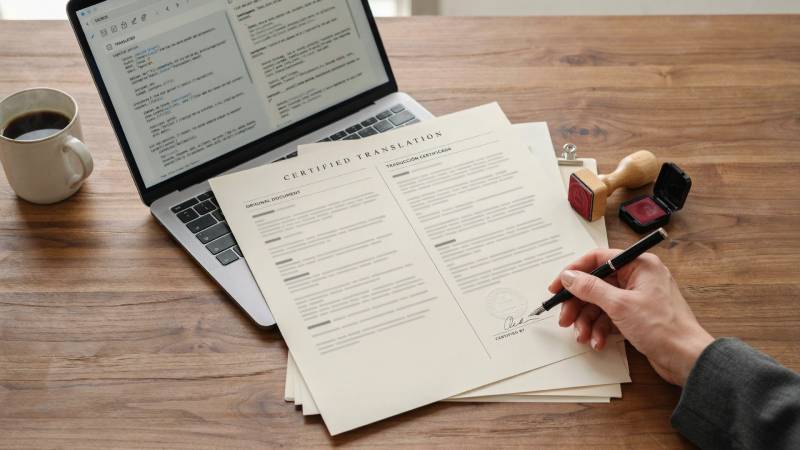
The distinction matters because certified translation involves more than converting words accurately between languages.
Receiving authorities may require a human translator or accredited provider to certify that a translation accurately represents the original document. Depending on the jurisdiction and purpose, additional formalities can also apply.
“The receiving authority doesn’t ask ‘is this accurate?,’ it asks ‘who attests that this is accurate?’ – and software can’t answer that question,” Kalkancı said.
That has created an unusual division in the translation business. AI can compete particularly effectively where speed, convenience and comprehension matter most. It cannot itself assume the professional or legal accountability required for certain official documents.
Kalkancı described that as the structural reason certified translation has remained resilient.
“AI has more or less solved translation as a language problem. It has not touched translation as a liability problem,” he said.
“When a court, a ministry or USCIS accepts a document, someone — a sworn translator, a certified professional, an accredited agency — is accepting legal responsibility for what that document says. That responsibility can’t be generated.”
Protranslate Data Shows Where Certified Translation Persists
The February figures provide a snapshot rather than evidence of an industry-wide trend.
Protranslate says certified translation has represented the majority of its business for years, with its share stable or increasing. However, the company does not have a year-by-year dataset available to quantify that change.
Its February numbers are nevertheless substantial.
The company processed 1,276 translation orders, of which 907 were certified or sworn translations. Another 36 orders involved non-translation services such as proofreading, subtitling and desktop publishing.
Certified and sworn work therefore represented about 71% of translation orders, or about 69% of all orders.
More importantly, the underlying figures show exactly what those percentages represent: 907 certified translation orders and $2.81 million in total order value.
The data points to a part of the translation market where better artificial intelligence alone may not remove the human intermediary.
AI can produce the words.
For certified translation, someone may still have to put their name behind them.