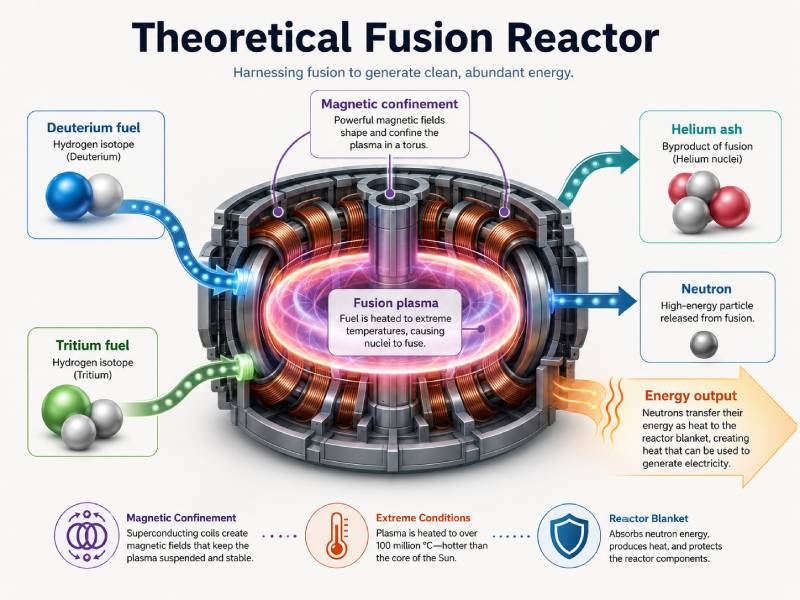

Related coverage: In 2024, John McCormick examined the broader fusion energy myth, including ITER delays, tritium scarcity and the difficulty of turning fusion physics into practical power. The Tritium Bottleneck is still a problem.
Even very smart people, the ones who look at fusion as the way of the future for clean energy, completely misunderstand the reality, and that includes scientists.
Yes, fusion energy is clean, sort of. That is, the byproducts of the actual reaction which produces the power does not leave a lot of radioactive waste.
No, it is not clean because of some details few people understand. This is a bit complicated but not hard to understand and is explained below. (Why do I understand this? First, I am a trained physicist and the physics is extremely basic. Second, my only corporate job was in logistics so I see bottlenecks easily and look for them.)
But the fundamental problem with fusion energy is simple. Fuel. The fuel “burned” in every fusion reactor which has produced more energy than consumed is not from sea water. Tritium and duterium are the fuels. They are both hydrogen. Duterium is not rare. Tritium is extremely rare and is, in fact, produced in a certain kind of nuclear fission reactor in Canada. The only place in the world where tritium is produced. The reactor makes very little tritium and is being shut down.
The quick summary is this, the ONLY fusion reactors which actually produce energy, the only actual working designs, need tritium. In fact even one test reactor will use the entire world supply of tritium just to start one full energy test.
You can make tritium in other reactors, fusion reactors, if you include a special metal jacket. This jacket is highly dangerous, it burns easily and is hard to put out once it catches fire. That is one source of radioactive waste in a usable fusion reactor.
To get that metal to produce tritium requires high power neutrons. Easy enough, but high power neutrons not only destroy almost anything, including the metal needed to build a fusion reactor, they also make that metal radioactive.
A simple analogy is quite easy to understand. Consider if you had a great, wonderful coal fired power plant but are in a country which has no coal. For fusion simply replace coal with tritium and country with planet.
Those interested in the details should read on.
Some of the research for this article was done by Google Gemini AI, but much of it is simply from my background in physics and is so fundamental that my classes many decades ago are all you need.
Forensic Audit of The Tritium Bottleneck in Fusion Energy
The prevailing public narrative regarding nuclear fusion—often marketed as “limitless energy from seawater”—suffers from a severe Information Gap. While deuterium is indeed abundant in Earth’s oceans, the specific reaction currently pursued by nearly every major experimental reactor (including ITER and SPARC) is the Deuterium-Tritium (D-T) reaction.
As a physicist I recognize that the “limitless” claim fails at the primary fuel source. Tritium is not a commodity; it is a vanishingly rare isotope that represents a critical structural bottleneck for the entire fusion enterprise.
1. The Fuel Geometry: D-t Vs. The “seawater” Narrative
The D-T reaction is the “path of least resistance” in fusion physics because it has the highest nuclear cross-section at the lowest achievable temperatures (roughly 150 million °C).
(A nuclear cross section (\(\sigma \)) measures the probability of a specific interaction (such as scattering, absorption, or fission) between an incident particle and a target nucleus, expressed as an effective target area. Measured in barns (1 BARN IS 10^-28 SQUARE METER), a higher cross section indicates a greater likelihood of a nuclear reaction occurring.)
However, the fuel requirements are asymmetrical:
- Deuterium ($D$): Stable, abundant (1 in every 6,420 hydrogen atoms in seawater). We have enough to power civilization for eons.
- Tritium ($T$): Radioactive (half is gone in twelve years), trace amounts in nature (produced by cosmic rays), and chemically identical to hydrogen, making it nearly impossible to contain perfectly.

2. The Global Inventory: a Decaying Asset
As of mid-2026, the global uncommitted inventory of tritium is in a state of accelerated entropy.
- The Supply: Virtually all commercial tritium is a byproduct of CANDU (Canadian Deuterium Uranium) heavy-water fission reactors. These reactors produce roughly 0.5 kg to 1.0 kg of tritium per year as a nuisance byproduct.
- The Decay: Because of its 12-year half-life, the global stockpile loses approximately 1 kg per year to natural radioactive decay.
- The Deficit: The current global accessible inventory is estimated at 10–15 kg. ITER, which is currently preparing for its first research phase in 2026, will require almost the entire global supply (10–15 kg) just to begin its deuterium-tritium operations.
Forensic Reality: We are currently burning our seed corn. There is no “tritium mine” and never can be. When the remaining CANDU reactors in Ontario are decommissioned over the next decade, the primary faucet for fusion fuel will effectively close.
So, tritium is necessary for power fusion. There is very little tritium. The only source of tritium is closing and would cost billions to build a new one which would produce very little tritium.
Still think fusion is the energy of the future?
Well there actually is another way to produce tritium.
3. The “breeding” Gambit: The Lithium-6 Problem
To solve the rarity of tritium, fusion designers propose the Tritium Breeding Blanket (TBB). The theory is that the high-energy neutrons (14.1 MeV) released by the fusion reaction will strike a blanket of lithium-6 surrounding the plasma, transmuted it into tritium.
This “fuel-generation” scheme faces three massive engineering hurdles:
- Neutron Economy: For every tritium atom consumed, at least one new tritium atom must be bred. Because of neutron absorption in structural materials and leakage, the Tritium Breeding Ratio (TBR) must exceed 1.1. NOTE, no one has done this yet.
- Structural Entropy: 14.1 MeV neutrons are highly destructive. They cause “swelling” and embrittlement in the EUROFER97 steel and other specialized alloys used in the reactor wall. The very process of creating fuel destroys the machine.
- Toxicity and Hazards: Effective blankets often require Beryllium (as a neutron multiplier) and Lithium-Lead mixtures. These materials are toxic, fire-prone, and introduce significant environmental entropy into a system marketed as “clean.”
4. The Economic Fallacy: High-energy, Low-density
While the “fusion successes” of 2024–2026 (such as the NIF’s ignition and SPARC’s magnet tests) are legitimate physics breakthroughs, they do not address the Total System Cost.
If a reactor cannot breed its own fuel at a rate significantly higher than its consumption and decay, it remains a “fission-powered” fusion experiment. Without a viable lithium-breeding infrastructure, fusion is simply an extremely expensive way to utilize the waste products of 1960s-era heavy-water fission technology.
The Verdict: Signal vs. Noise
The “seawater” narrative is marketing noise. The “tritium shortage” is the forensic signal.
There are other ways to create fusion and one in particular appears to be workable in theory.
But there are serious problems with a boron deuterium fusion reaction.
While scientists and engineers are struggling to economically produce the kind of steel needed to build a fusion reactor, the steel being produced can’t be used for the boron deuterium reactors, it wouldn’t last long enough to be worth building.
And, by the way, almost all of the steel produced today is owned by China. The steel plants in the UK produce the kind of steel needed for the tritium reactors. But China bought them six years ago.
True energy sovereignty through fusion would require bypassing the D-T bottleneck entirely in favor of Aneutronic Fusion (such as Proton-Boron 11 or Deuterium-Helium 3). These reactions require temperatures an order of magnitude higher than D-T, making them a “Singularity-level” technical challenge that 2026 technology is nowhere near solving.
Tritium Bottleneck in Action
To summarize the real tritium bottleneck.
Fusion is NOT a practical way to produce power.
- The only fusion reaction which has worked requires tritium, about 20 Kg just to start the first reaction.
- The entire world supply of tritium is 12 Kg and ten percent of that decays every year.
- The only place tritium is now produced is in several Canadian reactors which are being shut down.
BTW, Elon Musk, no dummy, points out that we already have an enormous fusion reactor showering us with free power every day. This reactor needs no new fuel, no repairs, and no expertise. We already use this fusion reactor to produce heat and electricity.
This fusion reactor is called The Sun.
While fusion experiments are valuable science, they will not replace fission, wind, solar, gas, or coal power.
Another fantasy energy production method deserves one or two paragraphs to dismiss.
Antimatter is a powerful source of clean energy, the only major problem with that is, ignoring it is impossible to safely use it, the only source is the largest machine ever built, CERN. Another minor problem is that it takes about one million times more energy to produce antimatter than that same amount of antimatter can produce.