
A glucose reading normally lives inside the app connected to a continuous glucose monitor. Irakli Kurtanidze wanted his somewhere harder to miss.
Kurtanidze, founder of Sugar Sense and a Type 1 diabetic for more than 12 years, spends much of his working day at a computer. Pulling out a phone repeatedly to check a number that can change throughout the day never made much sense to him.
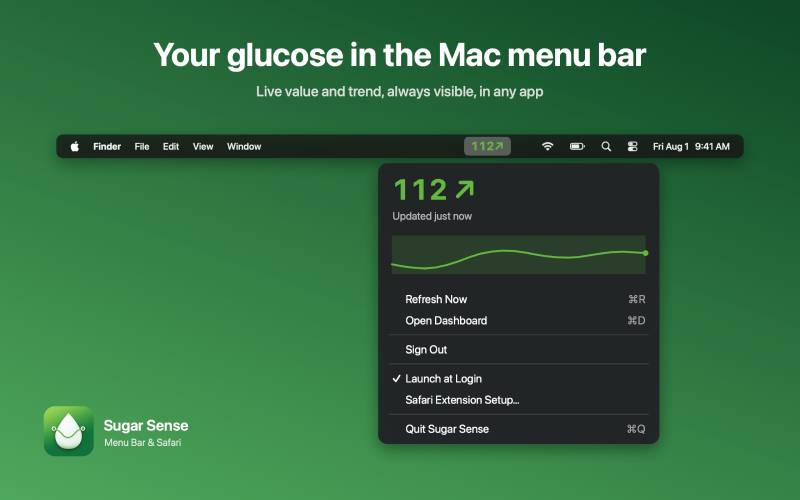
He wanted to see it in the corner of his computer screen. On his watch. In his browser. In the car. Or hear it by asking a voice assistant.
There was another, more serious reason.
“There were nights when a single alarm did not wake me,” Kurtanidze said. “I am not blaming any product; deep sleep is sometimes stronger than one phone.”
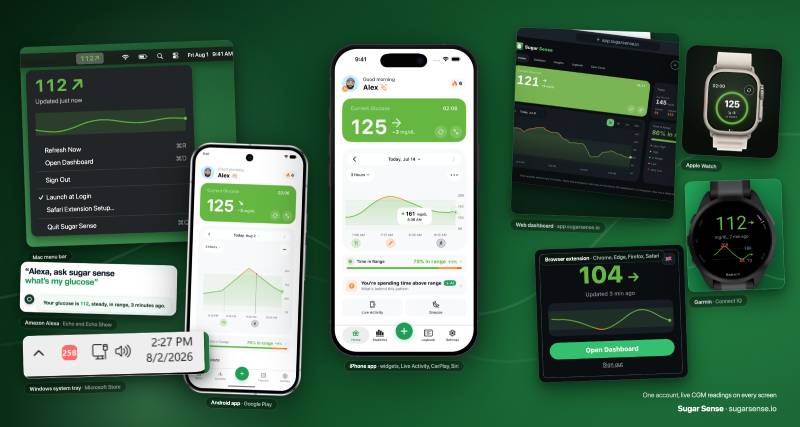
That experience helped shape Sugar Sense, a continuous glucose monitoring companion app designed to take readings from existing CGM systems and make them available across an unusually broad collection of everyday devices.
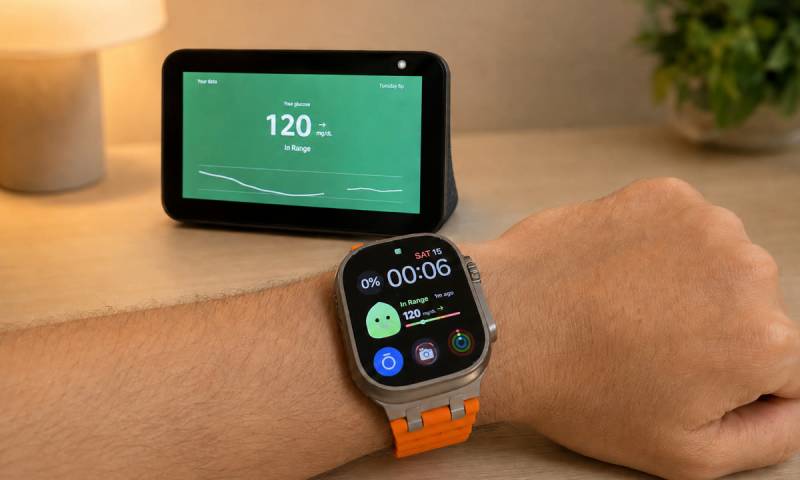
Sugar Sense currently connects with FreeStyle Libre, Dexcom and Nightscout data and can display glucose information through iPhone, Android, Apple Watch, Garmin watches, a live web dashboard, Windows system tray, Mac menu bar, browser extensions and Amazon Alexa.
For Kurtanidze, the objective wasn’t to replace the manufacturer’s CGM app. It was to build another layer around it.
One Glucose Reading, More Places to See It
Kurtanidze has used FreeStyle Libre since its early days and also uses a Dexcom G7 from time to time.
Changing sensor ecosystems exposed another annoyance. Each came with its own application and sharing arrangements. Switching could mean a different interface and having to reconnect family members who follow his glucose readings.
“I wanted one account that treats FreeStyle Libre, Dexcom and Nightscout the same,” he said.
Then came what he calls the “every screen” idea.
“I work at a computer most of the day, and a phone in the pocket is a poor home for a number you live by,” Kurtanidze said. “I wanted the reading in the corner of my screen, on my watch face, in the browser toolbar, on the car display, even by voice.”
Sugar Sense first went live on Apple’s App Store in April 2025. Its ecosystem expanded substantially during 2026.
Browser extensions reached Chrome, Edge, Firefox and Safari in July. August brought Alexa, a Windows system-tray app, Mac menu-bar access and the Android app on Google Play. Garmin support followed on August 24 through a glucose widget and data field on Garmin’s Connect IQ store.
The result is that someone working on a computer, for example, can glance at a current glucose reading without opening a phone app. An Alexa user can ask for the latest reading aloud.
That breadth is one of Sugar Sense’s central claims, but Kurtanidze is careful about how he states it.
The company says Sugar Sense operates on “more surfaces than any diabetes app we know of,” rather than claiming categorically that no competitor can match it.
Checking The Competition
Kurtanidze supplied NewsBlaze with the company’s comparison of official CGM applications and independent companion tools. He said every row was rechecked against current official sources in August 2026.
Dexcom G7, for example, supports iPhone, Android and Apple Watch, including direct-to-watch capability, as well as official Garmin apps and Siri. But the comparison found no Dexcom consumer desktop application, browser extension, Alexa skill or live consumer web dashboard.
Gluroo supports iPhone, Android, Apple Watch, Wear OS, a web app and Siri. Sugarmate provides iPhone, Android and web access, although its former Mac application and Alexa skill were discontinued in January 2025.
Nightscout is a notable exception to simple comparisons. As a self-hosted platform, it can be extended across many devices and services, including voice assistants. But users must deploy and maintain their own server and may need separate third-party applications for individual devices.
Sugar Sense itself can use Nightscout as a data source.
Kurtanidze said the company would welcome evidence of an application it has overlooked.
“If a reader shows us an app that covers more, we will stand corrected,” he said.
That qualification matters. The useful distinction isn’t simply how many platforms appear on a marketing list, but whether a person can obtain a live glucose reading through them without assembling a collection of separate tools.
The Feature Sugar Sense Refuses to Build
Sugar Sense extends the places where CGM information can appear, but Kurtanidze has drawn a firm boundary around what the software should do with that information.
It does not recommend insulin doses.
He gives three reasons, in order: safety, regulation and product design.
“Insulin needs shift with food, activity, stress and illness, and a dosing suggestion that is wrong even once can put someone in hospital,” Kurtanidze said.
“Dosing belongs to the person, their care team and, where prescribed, regulated dosing systems. A companion app is not the place for that math, so we simply never do it.”
The boundary extends to Sugar Sense’s AI features. Its food scanner and insights functions are designed to refuse dosing questions.
Kurtanidze said the company deliberately operates as a supplemental information tool rather than moving into medical-device territory associated with dose calculation.
Sugar Sense also tells users it complements official CGM applications and should never be their only means of detecting a low-glucose event.
That distinction becomes particularly important because the application includes its own alerts and can provide an advance warning of an expected low.
Kurtanidze said his experience sleeping through an alarm led him to want “a second, independent layer with its own alarms,” along with a forecast that warns roughly 20 minutes before an expected low and alerts designed to distinguish an urgent low from a less critical high.
Building From a Country Where CGM Access Is Limited
There is also an economic reason Kurtanidze thinks about diabetes software differently.
He lives in Georgia and buys his own CGM sensors from Germany.
Georgia operates a state diabetes program that has provided CGM systems free of charge to children with Type 1 diabetes since 2022. According to information supplied by Kurtanidze, adult eligibility is limited to certain categories, including people with blindness, cerebral palsy, Down syndrome and Duchenne muscular dystrophy.
Kurtanidze does not fall within those categories.
“An adult with type 1 diabetes and none of those conditions, which is my case, receives no state or insurance coverage for sensors,” he said.
Abbott’s Libre is not officially marketed in Georgia, he added, which is why he purchases sensors from Germany.
Kurtanidze supplied NewsBlaze with supporting material including a peer-reviewed study of Georgian families published in Healthcare in 2021, which reported that FreeStyle Libre was not subsidized in Georgia and described families purchasing devices abroad. He also provided Georgian sources concerning the subsequent state CGM program.
That experience also influenced Sugar Sense’s business model.
Kurtanidze said the company set a rule from the beginning that its core safety functions would remain free.
Real-time readings, glucose alerts and family following are available without charge. Sugar Sense instead charges for additional convenience and analysis features, including the Apple Watch app, AI-powered insights, its food scanner and CarPlay.
“We decided what had to be free first and built the model around that, not the other way round,” Kurtanidze said.
He said the free safety layer earns trust and daily use, while some users later choose premium features.
“It works as a business precisely because it was not designed as a funnel,” he said.
For Kurtanidze, that decision is tied directly to the cost of living with diabetes.
“When you know first-hand what this condition already costs people, charging them again to hear an alarm at night was never on the table,” he said.
A Companion, Not a Replacement
Sugar Sense remains a relatively young independent product operating alongside much larger diabetes technology companies.
Kurtanidze declined to disclose its current user count or detailed platform-usage numbers. He said iPhone remains its largest platform because it launched more than a year before the others.
But the underlying design choice behind Sugar Sense is readily visible.
Instead of asking people with diabetes to continually return to one application to see their glucose reading, Sugar Sense is attempting to put that reading wherever they already happen to be.
For Kurtanidze, that might mean the corner of a computer screen during the working day, a watch while away from his desk, Alexa when his hands are occupied — or another alarm when one phone isn’t enough.