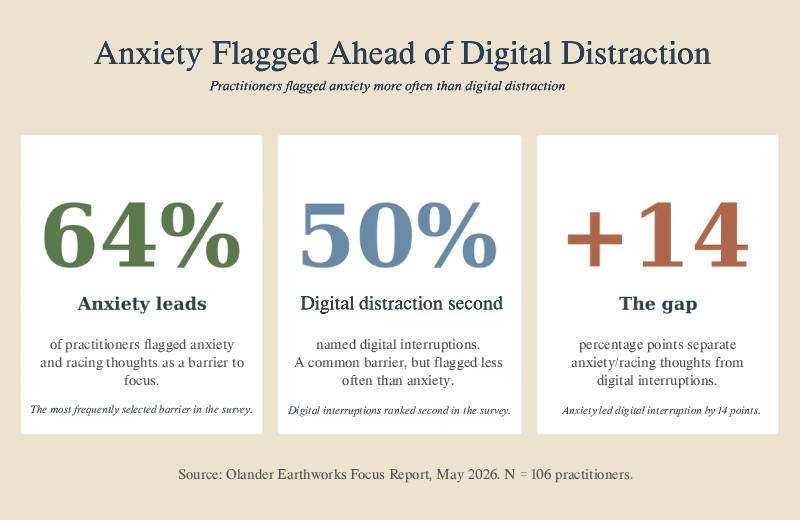

Phones often take the blame when adults struggle to concentrate. But a survey of 106 U.S. practitioners found anxiety and racing thoughts were flagged more often than digital interruptions as barriers to adult focus.
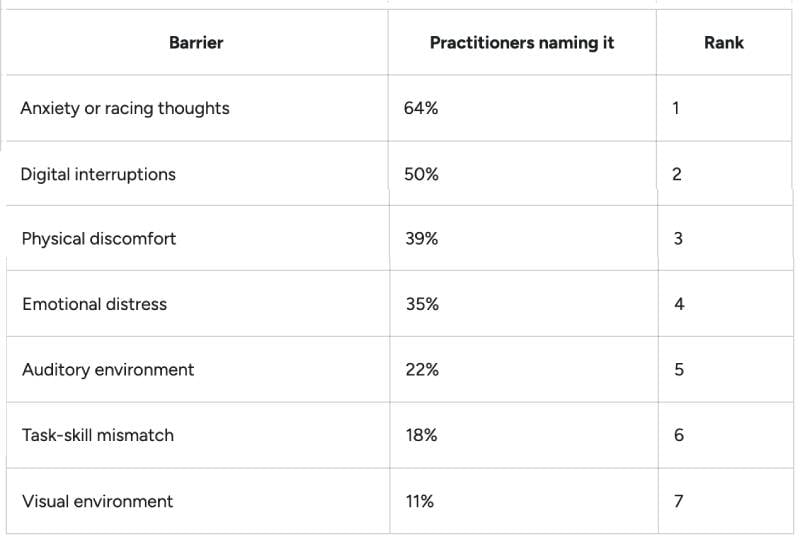
In the May 2026 Olander Earthworks survey, 64% of respondents selected anxiety or racing thoughts, compared with 50% who selected digital interruptions. The multi-select question allowed practitioners to identify more than one barrier.
There’s an important distinction here. The result does not mean 64% chose anxiety as the single cause of focus problems.
Instead, practitioners in the sample flagged it more frequently than digital distraction, by 14 percentage points.
Adult Focus Barriers Go Beyond Screens
Other reported barriers included physical discomfort at 39%, emotional distress at 35%, auditory environment at 22%, task-skill mismatch at 18% and visual environment at 11%.
Olander Earthworks conducted and published the research. The company makes sand trays and other tactile products used on desks, in homes and in some therapy settings.
The company recruited respondents through professional health and wellness networks.
The sample was broader than licensed mental-health clinicians. Licensed therapists and counselors made up 27%, while psychologists and occupational therapists each accounted for 8%.
Other respondents included psychiatrists, psychiatric nurse practitioners, coaches, educators, workplace wellness practitioners, researchers and a range of allied professionals.
Justin Lindholm of The Canny Vulture, whose work with Olander produced the research, confirmed to NewsBlaze that the barrier question allowed multiple selections.
He said the finding should not be described as 64% choosing anxiety as their single biggest barrier.
Starting May Come Before Motivation
The more interesting part of the research may come after the ranking.
Olander also asked practitioners to describe techniques they had seen clients use when moving into sustained concentration or “flow.”
One hundred of the 106 respondents provided written answers. Olander said 40 independently described a similar pattern: beginning the task before motivation or a feeling of readiness had arrived.
The company grouped recurring elements in the answers into five categories: resetting the environment, engaging the body, breathing, naming one goal and making a low-stakes start.
Practitioners commonly described combinations rather than a single technique.
Examples included clearing a desk, putting a phone away, taking several deliberate breaths, using a small physical or tactile action, defining one immediate objective or allowing an intentionally imperfect start.
Those responses do not establish that such techniques cause better concentration. They report what practitioners said they had observed among clients.
They do, however, complicate the idea that focus begins only after someone becomes motivated enough to work.
In many of the responses, starting appeared to come first.
What The Adult Focus Survey Can and Cannot Show
Olander describes the research as a small, anonymous, self-reported practitioner survey.
It was not a clinical trial and was not nationally representative. It measured practitioner perceptions and observations rather than directly measuring clients’ concentration or mental state.
That makes the findings useful as an observational snapshot, rather than proof that anxiety causes more focus problems than phones across the U.S. population.
A separate Olander survey in June explored what practitioners observe when adults take part in open-ended, screen-free creative or tactile activities.
That study included 121 mental-health and allied practitioners. Eighty-two percent said adults now have fewer opportunities for unstructured, screen-free activity than in the past.
Of the 108 respondents who said they use open-ended creative or tactile activities with clients, 69% reported more open verbal communication after clients became engaged in the activity.
Olander said that survey asked about the category of activity rather than any company product. It also described the sample as small, self-reported and not nationally representative.
The two studies do not prove that screens are unimportant. Digital interruptions still ranked second in the May survey.
Instead, the research points to a more nuanced question about adult focus: whether the visible distraction is sometimes only part of the problem.
Within this practitioner sample, anxiety and racing thoughts were flagged more often than digital interruptions, while many respondents described action itself as part of the route back into focus.
The full Focus Report is available from Olander here: Olander Earthworks Focus Report