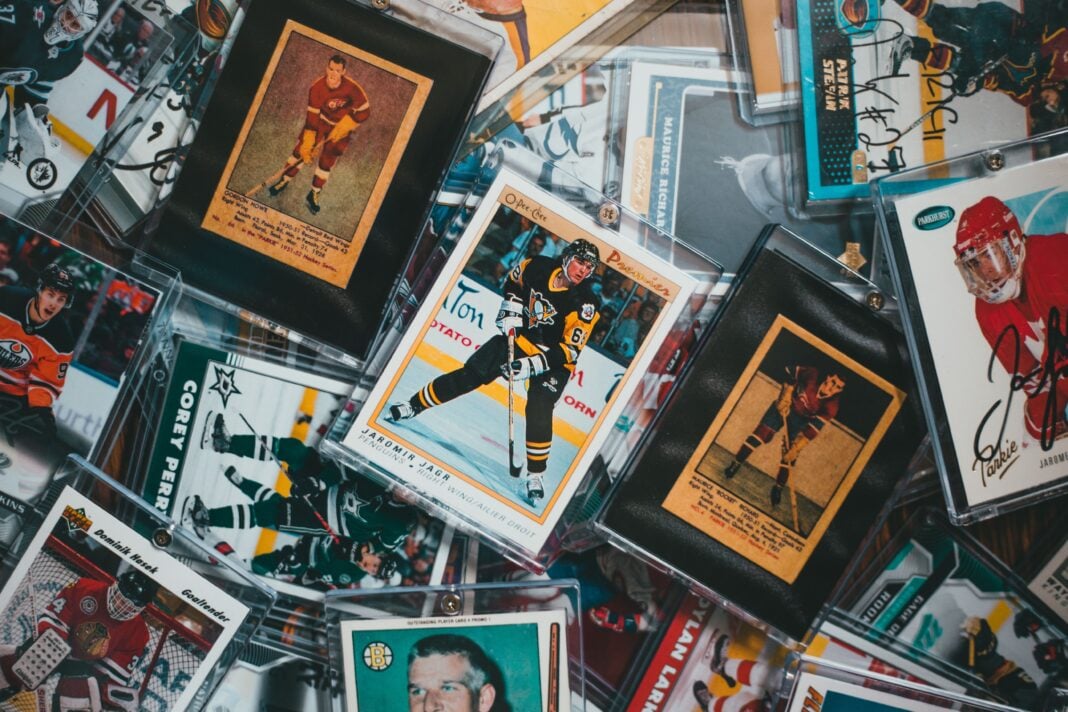

Take the box in. That is the honest answer for anyone holding a late relative’s shoebox of baseball cards and wondering whether it hides real money. One Anderson family did exactly that in the spring, hauling a grandfather’s box of 1980s and 1990s cards to a card shop Anderson SC collectors already use. A nine year old rode along to hold the lid down. That shoebox had been holding out on them for two decades.
The argument in one line: an inherited box from that era is worth far less than the internet promises. Finding the two or three cards that break the rule is the part you cannot do alone. Headlines make it harder. In June 2026, Sports Collectors Digest reported that a PSA 7 copy of the 1984-85 Star Michael Jordan rookie sold for $89,060 at a Goldin auction, a public record for that card. Numbers like that travel fast, and they set expectations a rubber banded shoebox cannot meet. Nothing in a 1990 stack is that card.
A Shoebox Nobody Knew How To Read
The box itself was unremarkable, which is the point. Roughly a thousand cards, banded in stacks of fifty, mostly 1988 through 1993. A handful of older ones sat loose at the bottom in yellowed penny sleeves. The family had typed a few names into a search bar and found asking prices in the hundreds for cards that trade for a dollar or two. What we find most often is exactly that gap, because a listing price is what a stranger hopes for and a sale price is what somebody actually paid. Cards from the late 1980s were printed in enormous quantities, so condition and scarcity decide nearly everything. A kid recognizing a Hall of Famer is a good instinct and a poor appraisal. The parent’s real question was never what is this worth. It was who do I even ask.
Two weeks of guessing at a kitchen table produced nothing useful. Sorting by team felt productive and said nothing at all about value. The one thing they got right was leaving the cards alone, with no cleaning, no trimmed corners, and no old sleeves peeled off in a hurry.
Walking It To The Counter Step By Step
The visit started with the lid off and the whole box on the counter. A first pass is triage rather than appraisal. Pull the pre 1980 cards, the rookies, and anything with sharp corners and clean centering, then set the rest aside as bulk. Call it an hour of counter time for a box that size. Honestly, closer to two once the sorting turned up a 1989 Upper Deck run worth checking card by card. Bulk is not an insult, it is a category, and it usually accounts for most of an inherited box.
Storage came up before pricing did, for a good reason. A peer-reviewed accelerated aging study published in Heritage Science found that increased relative humidity drove a 40 to 68 percent reduction in paper strength properties. In plain terms, damp storage weakens the cardboard itself. An unheated South Carolina garage in August is not neutral storage. Semi rigid holders and a dry interior room are cheap fixes.
Three cards were worth grading, and the shop handled the submission paperwork instead of sending a first timer to sort out PSA, Beckett, CGC and SGC alone. Anyone can check a graded card’s certification number for free through PSA’s Cert Verification lookup. It returns the grade on file for that serial in seconds. That is the first stop whenever a slabbed card turns up in an inherited lot, since a swapped label is easier to catch than most people expect, and the check costs nothing beyond the ten seconds it takes to type the number in. A signed ball in the same box needed a different kind of authentication.
Grading is a waiting game, so the timeline matters before anyone commits. The first week was intake, the submission form, and photographs of each card going into the package. By week three the order showed as received and nothing else moved, which is normal. Grades posted online during month two, and the slabs shipped back after that. Within 45 days the family had three graded cards and a much shorter list of worries. Turnaround shifts with service level and with how backed up the grader is.
Should I sort the cards myself before I bring the box in?
You do not need to, and a rushed sort can cost you money. Leave the cards in whatever order they arrived, take off any rubber bands, and bring the whole box. The odd card buried in a stack of commons is often the one that pays for the trip.
Is it worth grading cards from the late 1980s?
Usually not, and that answer saves people money. Grading fees plus shipping and insurance run past what most cards from that decade are worth in any grade. The math only works on genuinely scarce cards, or on one that will grade near perfect. A shop that talks you out of submitting forty cards is doing you a favor.
What The Collection Was Actually Worth
Here is the verdict on that box, in round numbers and as one example rather than a promise. About 900 cards of bulk worth maybe forty dollars as a lot, a dozen mid grade stars at a few dollars each, and three cards worth sending out. Say the graded three land where the counter estimate suggested. The box then sits near six hundred dollars, most of that value in four items. It was not the number the family hoped for on the drive over. It was a number they could act on, and the shoebox stopped being a mystery. Families who carry a box to a card shop Anderson SC collectors trust tend to leave with a value they believe and a decision about the next step.