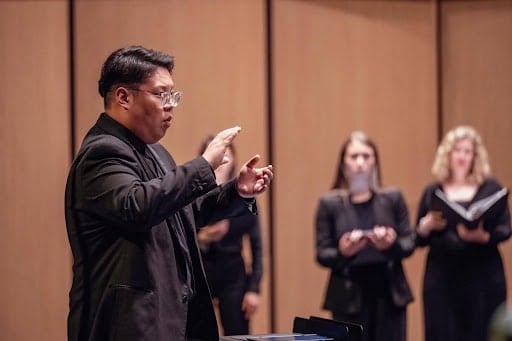

In an era where global connectivity defines progress, Dr. Hwanwook Lee stands as a beacon of cultural synthesis within the realm of music. An accomplished conductor, educator, composer, and scholar, Dr. Lee’s distinguished career seamlessly bridges continents, cultures, and generations, earning him a respected stature in both academic and professional music communities. At the heart of his work lies a profound commitment to musical excellence, cultural exchange, and robust education, all delivered through a distinctive artistic voice rooted deeply in tradition yet dedicated fervently to innovation.
With over a decade of international experience in choral conducting and music education, Dr. Lee’s journey is marked by an unwavering pursuit of mastery. His extensive academic background provides the bedrock for his diverse career, culminating in a Doctor of Musical Arts in Choral Conducting from Texas Tech University. Prior to his doctoral studies, he earned two Master of Music degrees in Choral Conducting—one from Missouri State University in the United States and another from Hansei University in South Korea. His foundational studies include a bachelor’s degree in Church Music with a concentration in composition from Seoul Theological University, providing him with a comprehensive understanding of both sacred and secular musical traditions.
During his doctoral tenure at Texas Tech University, Dr. Lee was not only a dedicated student but also a pivotal contributor to the institution’s choral program. He served as Instructor of Record, demonstrating his leadership and pedagogical prowess by conducting the Matador Singers (Tenor/Bass Choir) and the University Singers (Treble Voices). His versatility further extended to his roles as associate conductor for the University Choir (the premier mixed ensemble) and Scarlet Voce (Treble Voices).
Beyond conducting, he played a crucial role in shaping future musicians by assisting with undergraduate courses in choral conducting and choral techniques. His operatic experience includes serving as Chorus Master for Texas Tech’s acclaimed production of Mozart’s La Clemenza di Tito. His exceptional contributions were recognized with the prestigious Outstanding Graduate Student award at the Texas Tech University School of Music in 2024, an achievement complemented by his recognition as Instructor of Record for two consecutive years, underscoring his consistent impact and leadership.
Beyond the academic realm, Dr. Lee has made significant contributions to K-12 education and community music. Most recently, he applied his expertise as Associate Choir Director at Odessa High School in Odessa, Texas. In this role, he independently and collaboratively led six diverse ensembles, including Varsity Tenor/Bass Choir, Dominante, Bel Canto, and Broncho Legacy. His leadership was instrumental in elevating the overall quality and cohesion of the school’s choral program, instilling a deeper appreciation for choral music among young aspiring artists.
Parallel to his academic and K-12 roles, Dr. Lee possesses a rich history in church music, serving as a church choir director in South Korea for over ten years. He led adult and youth choirs at various congregations, including Yehyang Presbyterian Church and Youngbok Presbyterian Church, overseeing regular worship services, special music events, and community outreach. A testament to his entrepreneurial spirit and nurturing leadership, he founded and expanded a youth choir that went on to win first prize at the distinguished Kyung-in Synod Youth Choir Competition. His comprehensive involvement spanned music selection, rehearsal design, mentorship, and performance planning, deeply impacting countless lives through music.
Even during his doctoral studies in the United States, his reputation preceded him, leading to an invitation as a guest artist by Heavenly Light Korean Methodist Church in South Korea, where he conducted the church choir for special services.
As a composer and arranger, Dr. Lee’s artistic vision shines through a distinctive fusion of Korean melodic identity and Western choral tradition. His choral work, “A Change of Heart,” published by Chorus Center, one of South Korea’s largest and most reputable choral music publishers, exemplifies this unique blend. The piece was performed by the Changwon City Choir, a professional ensemble, at the annual “The Innovative Choir Seminar,” the country’s largest and most prestigious church music conference, marking a significant milestone in his compositional career.
It is this profound understanding and seamless integration of disparate musical traditions that truly define Dr. Lee’s artistry. To delve deeper into this unique interweaving of cultures, Dr. Lee recently shared insights into his philosophy and practice, particularly concerning Korean traditional music and its influence on his work.
When asked to shed light on Korean traditional music, known as “gugak,” and its popular instruments, Dr. Lee offered a nuanced perspective for Western audiences.
He explains: “Traditional Korean music, known as gugak, is a deeply rooted art form with a history spanning several centuries.” The term means “national music” in Korean, and it includes folk music, religious music and encompasses dance and ceremonial traditions.
Unlike Western music, gugak is based on a very different musical language, notes Lee. “Its melodies are fluid, its rhythmic structures (jangdan) are cyclical, and it places great emphasis on emotional expression and the beauty of space and silence,” he said. “One Korean musicologist even described it as ‘music of curves,’ reflecting its graceful and non-linear qualities.”
He further elaborated on its instrumentation: “Gugak values harmony between nature and humanity, and features unique traditional instruments such as the gayageum (a plucked zither), haegeum (a two-stringed fiddle), daegeum (a large bamboo flute), janggu (an hourglass drum), and piri (a double-reed pipe). These instruments produce distinctive timbres and are used in genres such as sanjo, pansori, and jeongak.” In fact, many of these instruments have been introduced to American audiences through Korean cultural content. “As a choral conductor, I find that understanding the tonal and rhythmic qualities of gugak is a valuable asset—especially when exploring East-West musical fusion or pursuing fresh interpretive possibilities,” said Lee. “The jangdan rhythms offer an exciting way to retrain rhythmic sensitivity in choral settings.”
Dr. Lee elaborated on his approach to integrating these elements into Western contexts: “I strive to incorporate diverse musical elements into my programming and interpretation. For example, I often introduce choral works by Korean or other Asian composers, or perform contemporary pieces inspired by traditional music from the region,” he said. “Through these selections, I aim to offer audiences a new sonic experience—something that expands their musical palette and introduces unfamiliar yet meaningful sound worlds. I also take the opportunity to share aspects of Korean phonetics and rhythm with choir members, helping them develop linguistic sensitivity through music. It’s not just about presenting a piece, but about guiding them into an experience of the Korean aesthetic of sound.”
He further notes the practical benefits of Korean phonetics in vocal instruction: “Since Korean is a phonetic language, it allows for a wide range of subtle vowel sounds to be expressed clearly, and in some cases, I’ve found it even more effective than IPA when teaching pronunciation—especially vowels.” Dr. Lee added.
“Furthermore, I am also interested in programming pieces that integrate vocal techniques from gugak, such as sigimsae (ornamental inflections), which add expressive depth. Moreover, I actively seek out repertoire that reflects Korea’s cultural, social, and historical narratives—for instance, art songs or choral works based on poetry from the Japanese occupation period. This was a time when Korean emotion and identity were powerfully expressed, and such works allow performers and listeners alike to connect with a deeper emotional and historical context.”
When contemplating the similarities between these two seemingly disparate musical worlds, Dr. Lee acknowledged their distinct origins while highlighting their modern convergence. “I believe that traditional Korean music and Western music originate from different starting points and historical contexts,” Dr. Lee began, outlining the foundational distinctions. “Western music has been systematized around harmony, structure, and the development of polyphony, whereas Korean traditional music has evolved with a focus on melodic flow, human emotion, and the movements of nature. These differences are also reflected in their social roles—Western music has often been formalized within churches, courts, and concert halls, while Korean music has been used more organically in daily life, rituals, and community-centered practices.”
However, Dr. Lee emphasizes that in the modern era, a fascinating convergence has taken root. “In the modern era, however, there has been a growing exchange of influence between the two musical worlds. Western composers have drawn inspiration from pentatonic scales, non-Western rhythms, and timbral explorations, while many Asian composers have actively adopted Western harmonic language and choral techniques. As a choral conductor, I find these points of intersection especially exciting—they offer rich, creative possibilities. Although the two traditions are distinct, they are deeply connected through the ways they expand one another and continue to evolve together.”