
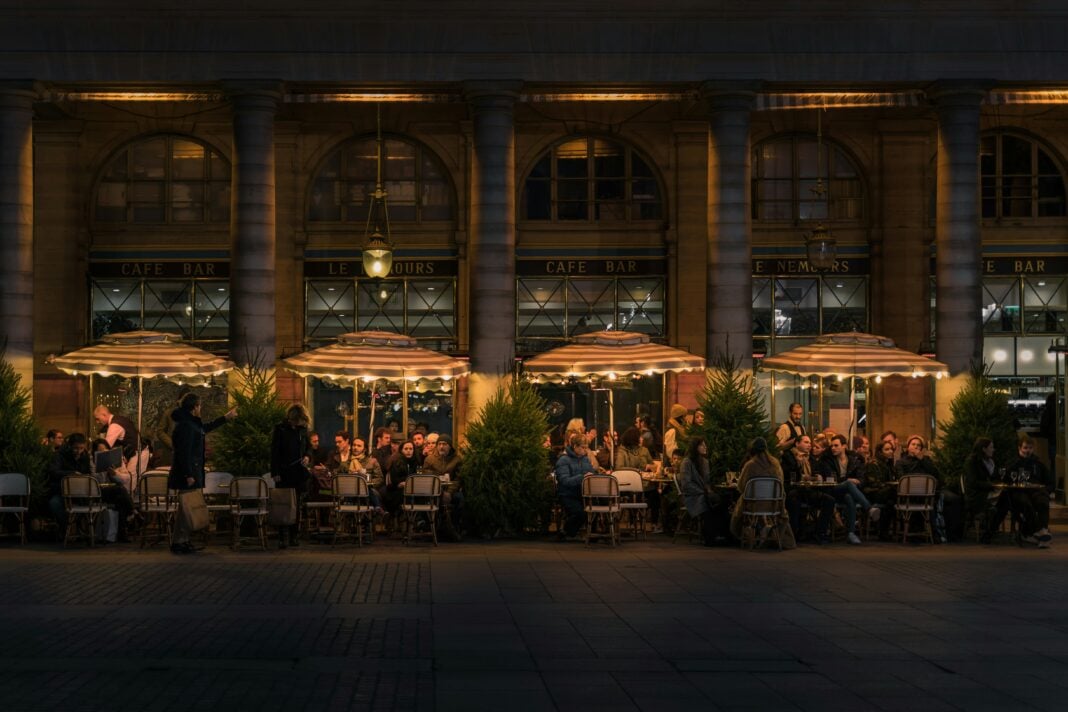

For years, the hospitality business model operated on the single assumption that a restaurant could exist anywhere. With the same aesthetic vocabulary, the same material palette, the same menu logic, replicated across cities and cultures, a brand could feel at home globally. But this meant that there was little acknowledgment of where the restaurant actually is. It was a model built for scale, and for a while, it worked.
The assumption is now exhausting itself.
Shivani Pinapotu, a Brooklyn-based spatial designer whose work spans interior design, exhibition environments and scenography has been watching this shift closely. “There’s a kind of restaurant that could exist anywhere, and increasingly, it does,” Pinapotu says. “What I find more interesting are spaces that are deeply specific to a place, a community, a food culture.” For Pinapotu, the future of dining harkens to our fundamental need to belong.
The isolation of the COVID-19 pandemic made the social function of dining viscerally clear, Pinapotu notes. When restaurants closed, people mourned not the food but the room, the neighborhood, and the presence of other people. “The pandemic didn’t create the desire for communal dining,” Pinapotu notes. “It clarified it.” Diners returned with a heightened appetite for meaning and a decreased tolerance for environments that felt hollow or interchangeable.
Restaurateurs, too, returned with renewed optimism. According to the Foodservice Equipment Distributors Association (FEDA), restaurant startups are surging in the post-pandemic economy with new restaurants opening up and registering with the National Restaurant Association. This is drastically higher than what would have been the projection before the pandemic, indicating the quiet but profound transformation of the hospitality industry in its wake.
Designers are now tasked with the hard questions: “How do we design for belonging?” The communal table has long been the default answer, a familiar gesture toward togetherness that doesn’t always deliver it. Pinapotu argues against the trope and advocates for hyperlocal design as a spatial ecosystem.
Instead of importing a global template and planking it down in any city, it asks what a neighborhood already understands about gathering, food and culture. “When a space feels inevitable to its location, it gains a resonance that can’t be replicated,” Pinapotu explains. Hyperlocal, in that sense, is reparative.
For business owners and developers, this represents a move toward authenticity as a primary value proposition in hospitality design.
Achieving it requires a design intelligence that facilitates it at every scale. The threshold between public and private space, the acoustic environment that makes conversation possible, the lighting that creates intimacy without exclusion, the layout that encourages eye contact and ease. These are all considerations that encourage commensality and allow us to be truly present with each other.
Pinapotu’s perspective is informed by a diverse professional history, including her work in theatrical productions. She worked on the scenography of Soul Tapes at Trinity Repertory, a production rooted in Black folk culture, as well as on the production team for White Box, a metaphorical drama directed by Sabine Theunissen and choreographed by Gregory Maqoma, which had residencies at La Monnaie in Brussels, the Orion Theatre in Stockholm and the Brown Arts Institute in Providence. Her collaboration with world-class composers, choreographers, and lighting designers like Sabine Theunissen, Catherine Graindorge, Gregory Maqoma, and Ellen Ruge, taught Pinapotu that a space only becomes “fully itself” when it is inhabited. This “spatial intelligence” is what she now applies to hospitality, treating every restaurant as a stage where the community’s story is told.
“I think working with people at that level of practice so early in my career was clarifying; it was truly an experience of a lifetime,” she said. “It set a professional standard of craft and showed me what a village looks like. Sabine’s set design work carries an extraordinary spatial intelligence; she constructs a world with its own internal logic. Watching that process up close taught me that space communicates through the relationships it creates between objects, bodies, mediums, light, and void. Catherine Graindorge’s score for White Box filled and shaped the spatial experience and underscored the abstractions on the screen and bridged it to the scene on the stage, and Gregory Maqoma’s choreography made the set legible in a completely different way; bodies moving through space revealed dimensions of the design that were invisible until they were inhabited.”
Pinapotu adds: “What struck me most was how each discipline was in constant conversation with space, without negotiating with each other.”
With a Master of Design (MDes) in Interior Studies and a history of accolades including the 2023 Dorner Prize for her project (un)heard voices at the RISD Museum, Pinapotu has consistently focused on the intersection of culture and environment. From her early training in Delhi and Bangalore to her current practice in New York, her work remains committed to culturally responsible and inclusive design.
Looking toward the future of American restaurants, Pinapotu predicts a move away from the restaurant as spectacle and toward the restaurant as community infrastructure. In this model, the rigid boundaries between markets, social spaces, and dining rooms begin to dissolve.
“The most interesting spaces emerging now are ones that function as neighborhood anchors that reflect the cultural identity of where they exist,” she says. This multi-functional approach suggests a new business reality where restaurants serve as “porous” environments, acting as reliable hubs for gathering rather than just points of consumption.
As the hospitality sector continues to navigate a post-pandemic world, Pinapotu’s vision suggests that the most successful businesses will be those that stop trying to fit in everywhere and start trying to belong where they are. In her view, the future of dining isn’t just about the food, it’s about the “permission to be present with each other.”

