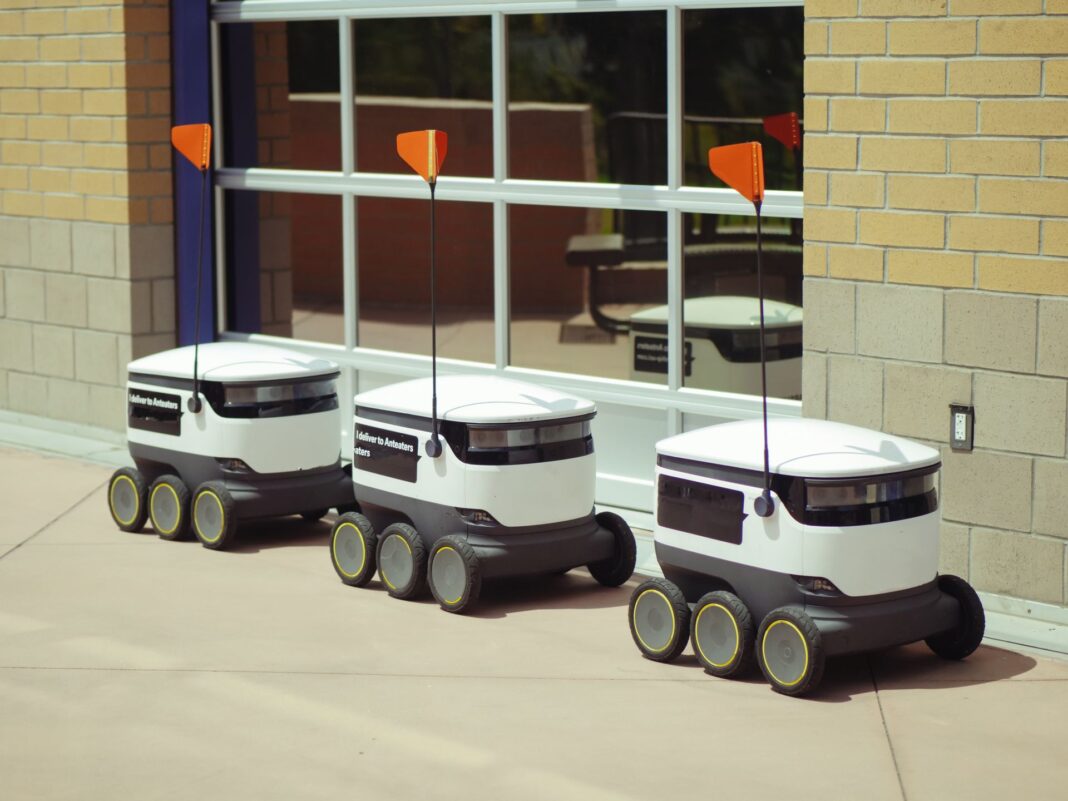

A six-wheeled delivery robot rolls along a busy sidewalk, carrying someone’s lunch to an office a few blocks away. It approaches a coffee shop, turns unexpectedly, and collides with a pedestrian stepping outside.
The person is injured, the robot continues its route or comes to a stop, and an unusual question emerges: Who is responsible when an autonomous delivery machine causes an accident?
These robots are becoming a familiar sight in some American cities, but the legal questions surrounding them are less straightforward. Depending on how the service operates, responsibility could involve the company running the robot, the business arranging the delivery, or the manufacturer responsible for its design.
The Company Behind the Robot Matters More Than the Logo
A delivery robot may display a restaurant’s branding without belonging to that restaurant. Some businesses partner with independent robotics companies that own and operate the machines, while other delivery arrangements involve different combinations of manufacturers, technology providers, and service operators.
That distinction becomes important after a collision.
The company operating the robot may control its deployment, maintenance, software updates, and response to unexpected obstacles. Some systems also allow remote human assistance, although that doesn’t necessarily mean someone continuously watches every robot or can intervene instantly.
If an operator failed to maintain equipment, ignored known safety problems, or deployed a robot in unsuitable conditions, those decisions could become relevant to a negligence claim. Investigators would need to establish what the operator controlled, what precautions were reasonable, and how the collision occurred.
A pedestrian who sees a familiar retail logo shouldn’t assume that business is automatically the responsible party.
Could the Restaurant or Retailer Share Responsibility?
Imagine a restaurant using an outside delivery service. A robot strikes someone while completing an order, and the injured pedestrian wants to know whether the restaurant can be held accountable.
The answer may depend on the relationship between the businesses.
Hiring an independent delivery company doesn’t automatically make a restaurant liable for everything that company does. However, a retailer’s own actions could matter if it exercised meaningful control over unsafe operations, contributed to a hazardous situation, or had responsibilities imposed by applicable law.
Contracts may help explain who maintained the robots, selected delivery areas, and handled safety complaints. Those agreements don’t necessarily determine what an injured pedestrian can recover, but they can clarify the companies’ respective roles.
The distinction between an independent contractor and an employee may also be relevant to certain liability theories. State law and the actual working relationship matter more than the labels businesses use.
What Happens When the Technology Fails?
A collision might result from poor maintenance or an operational decision. It could also raise questions about the robot itself.
Autonomous delivery machines rely on sensors, software, and mechanical systems to navigate sidewalks. They must identify obstacles, respond to changing conditions, and operate around pedestrians whose movements aren’t always predictable.
Suppose a robot repeatedly fails to recognize people approaching from a particular angle. Investigators might examine whether its sensors, design, or navigation system contributed to the collision.
That could potentially raise product-liability questions involving a manufacturer or another responsible supplier. But software-related claims are particularly complex, and whether a particular technology qualifies under applicable product-liability law can vary.
A malfunction also isn’t established simply because a robot struck someone. Investigators would need evidence showing how the system behaved and whether a defect, unreasonable operating practice, or other factor caused the injury.
Sidewalk Rules Are Still Developing
Unlike cars, delivery robots operate in spaces primarily designed for people walking, using wheelchairs, pushing strollers, or navigating crowded storefronts.
States have taken different approaches to regulating these machines. Some laws address personal delivery devices directly, including operating speeds, weight restrictions, insurance requirements, and interactions with pedestrians. Local governments may impose additional rules where permitted.
The Pedestrian and Bicycle Information Center’s brief on sharing spaces with robots provides an overview of the issues these devices create for sidewalk safety.
For an injured pedestrian, the applicable rules may help establish what a company was required to do. A violation could be relevant to a claim, although it doesn’t automatically establish liability in every jurisdiction.
The Evidence May Disappear From the Sidewalk Quickly
One complication with delivery robots is that the machine involved may leave the scene or be collected by its operator before anyone understands the extent of an injury.
Photographs showing the robot, its identifying markings, the surrounding sidewalk, and any visible damage can help establish what happened. Witness information and nearby surveillance footage may also prove useful, especially when the parties disagree about the robot’s movements.
Medical evaluation should take priority when someone is hurt. If the injuries are significant, personal injury lawyers may help identify the relevant companies and determine whether potentially useful records, such as operational logs or available video, should be preserved.
Not every robot stores the same information, and the existence of detailed navigation records shouldn’t be assumed.
As autonomous delivery expands, collisions will continue raising questions that ordinary sidewalk accidents rarely involve. A machine may be doing the driving, but companies still make decisions about its design, maintenance, and operation.
Determining who should answer for an injury means examining those decisions rather than simply blaming whichever logo happens to be on the robot.