
Adding insulation feels like the responsible fix. For most homes, it’s only half the job, and doing it out of order can make things worse.
The story is familiar enough to be a pattern. A homeowner notices the house is stuffy in summer and drafty in winter. The energy bills are too high. Someone tells them they need more insulation. They hire a crew, get a foot of blown-in fiberglass laid across the attic floor, and wait for things to change.
They don’t.
Lane Pace has watched this play out more times than he can count. A building performance specialist working across the Southern United States, Pace spends his days diagnosing why homes fail to stay comfortable despite real investment in equipment and materials. His answer, more often than not, is that homeowners are treating the symptom while the actual problem goes untouched.
“Insulation and air sealing are two different things that do two different jobs,” Pace says. “The industry treats them as interchangeable. They’re not.”
Heat and Air Are Not The Same Problem
Insulation slows the transfer of heat through a solid material. Think of it as resistance: the thicker and denser the material, the harder it is for warmth to pass through. That resistance is measured as R-value, and more of it is generally better. But R-value only tells you how a material performs when air is not moving.
Air sealing is a different operation entirely. It closes the gaps, cracks, and penetrations through which air physically moves in and out of a home: around recessed light cans, plumbing and electrical penetrations, attic hatches, and the seams where different building materials meet. Where insulation slows conduction, air sealing stops infiltration.
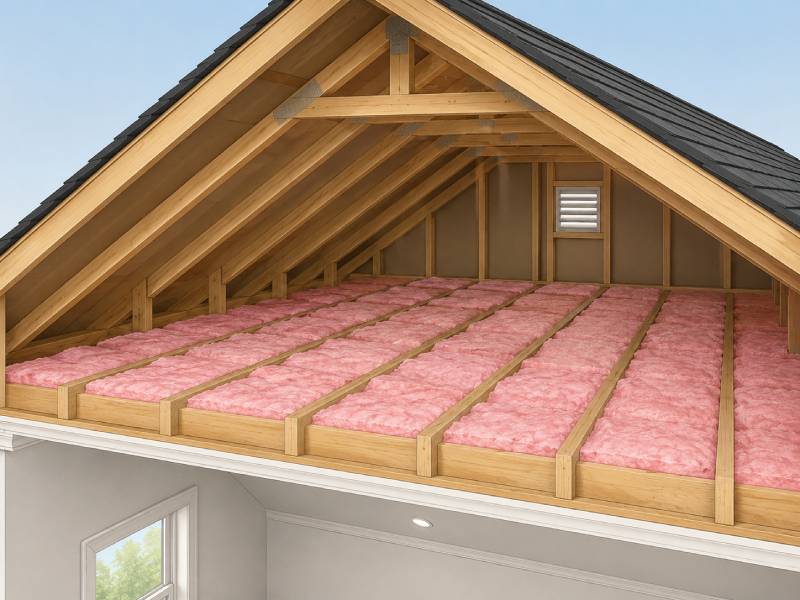
The reason the distinction matters is that air moves through a house regardless of how much insulation is present. Warm air rises and finds a way out. In winter, it leaks through the attic and gets replaced by cold air pulled in from below. In summer, superheated attic air pushes down into living spaces. No amount of R-value stops this if the gaps are still open.
“When homeowners focus only on insulation, they miss the bigger picture,” Pace says. “The building itself determines whether heating and cooling systems can perform as intended.”
The Gaps Nobody Sees
Most air leakage in a home is invisible from the living space. It happens in places homeowners rarely inspect: around recessed lights punched through the attic floor, at the junction where wall framing meets ceiling drywall, where pipes and wires run through top plates, and around attic hatches that fit loosely in their frames. Each gap is small. Together, they can add up to the equivalent of leaving a window open all year.
This is why a house with R-38 insulation across the attic floor can still feel unbearable in August. The conditioned air is not being held at the ceiling. It is moving through the gaps created by every light fixture and penetration above it, and the insulation sitting on top of those gaps does nothing to stop that movement.
Why The Industry Sells It Wrong
Insulation is a product. It arrives on a truck, gets installed by a crew, and generates a clean invoice with R-value specifications. Air sealing is slower, less visible work: tracing every penetration and seam in a home’s envelope, then closing them with caulk, foam, or rigid materials. It doesn’t photograph well. It doesn’t produce a spec sheet. It is harder to sell.
The practical result is that homeowners often pay for insulation and get none of the air sealing that makes it effective. Many insulation contractors are not trained in building performance. They know how to install product. Diagnosing how a home moves air is a different skill set, one that requires different certifications and a different kind of site assessment.
“Insulation works best when it’s part of a broader strategy that includes air sealing,” Pace says. “Otherwise, you’re treating the symptom, not the cause.”
A Humidity Problem in Disguise
In hot, humid climates, the stakes go beyond comfort. Moisture travels with air. When humid outdoor air migrates through gaps into cooler interior spaces, or when conditioned air escapes into a hot attic, moisture hits a cold surface and condenses. Do that repeatedly over a summer and you have the conditions for mold, rot, and structural damage.
Fiberglass batts and blown-in cellulose both absorb moisture. Once wet, their thermal performance drops and they can begin harboring biological growth. A home along the Gulf Coast or in the Southeast that gets an insulation upgrade without proper air sealing is not just getting an incomplete fix. It may be creating a moisture problem that takes years to surface and thousands of dollars to correct.
Spray Foam Is Not a Shortcut
Spray foam has gained traction because it insulates and air-seals in a single application, expanding to fill cavities and close gaps as it cures. In the right situation, it works well. But it is not a universal answer, and homeowners are frequently oversold on it.
Applied incorrectly or in the wrong climate conditions, spray foam can trap moisture rather than block it. It can complicate roof inspections, affect resale, and void manufacturer warranties on roofing systems. It is also considerably more expensive than conventional insulation, which means a misapplied job costs more to fix.
Pace’s position is that the question of which material to use comes second. The first question is what the house actually needs, and where. “The goal is improving how the home performs as a system,” he says. “You can’t get there by starting with a product.”
What to Ask Before Any Work Begins
Before signing any insulation contract, Pace says homeowners should get clear answers to three questions: Does this scope include air sealing, or just insulation? Where specifically have you identified air leakage? And will you test the house before and after to confirm the result?
A blower door test is the standard diagnostic. It pressurizes the building and measures how much air escapes, establishing a baseline and pinpointing where leakage is concentrated. Not every contractor offers it. If a contractor proposes work without first measuring the problem, Pace is clear about what that means: they are guessing.
The symptoms homeowners typically blame on failing equipment often point somewhere else entirely: rooms that never reach the set temperature, HVAC systems that cycle constantly without stabilizing the house, humidity that persists through summer, energy bills that stay high regardless of what gets replaced. None of those point to a broken system. They point to a building that is not holding conditioned air.
Seal the building first. Then insulate. In that sequence, both do the job they were designed for. Get the order wrong and the money spent on insulation is money spent on a problem that has not actually been solved.