
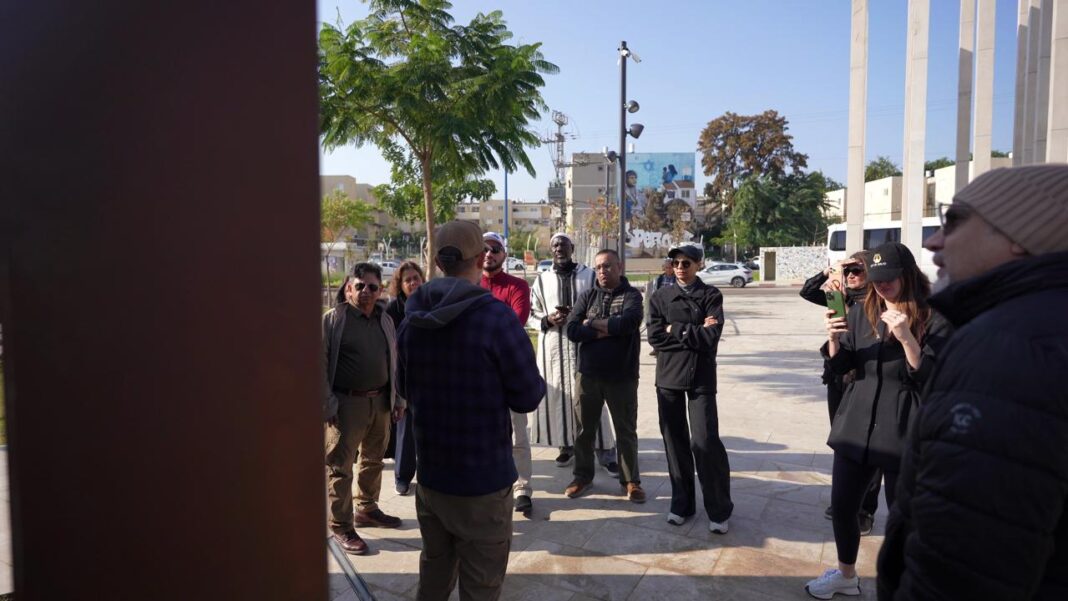

In December 2025, a group of Muslim American civic leaders, educators, and activists embarked on a journey to Israel as part of a multifaith delegation hosted by the Combat Antisemitism Movement . They carried the weight of intention, accountability, and a commitment to witness a reality far beyond the headlines. Their mission was confronting extremism, combating antisemitism, and fostering interfaith dialogue — goals that were emotionally charged and deeply human.
In this exclusive interview, Anila Ali, founder and CEO of the American Muslim & Multifaith Women’s Empowerment Council (AMMWEC), reflects on the delegation’s goals, her motivations, and the vital role played by two visionary collaborators: cinematographer Gregory Bado, whose visual storytelling effectively steered the narrative flow, and content strategist Vanesa Levine.
Q1: You’ve been a leading voice in Muslim American civic engagement for years. What personal experiences led you to take this delegation to Israel?
Anila Ali: For me, it has always been about seeking truth, especially the kinds that are often overlooked. Within a world where people are often reduced to ideological labels, I believe that true understanding comes from embracing the lived experiences of others and acknowledging our shared humanity. As a Muslim American woman, I have spent my career standing against hate, speaking at forums such as the White House Summit on Countering Violent Extremism, and pushing back against narratives that divide.
As we noticed antisemitism on the rise globally, I felt that it wasn’t just a political issue, it was a direct threat to humanity. When the opportunity arose to join a Muslim multifaith delegation hosted by the Combat Antisemitism Movement, it felt like a natural extension of that work. When I founded AMMWEC, I sought not just to spark conversation, but to cultivate genuine understanding. That meant going beyond rhetoric and seeing firsthand what’s happening on the ground. I wanted our delegates to experience Israel not through fragmented media portrayals, but through authentic, multi-faith experiences. To know the land and the people, especially to witness Muslims praying openly in the Jewish state, to hear Druze community leaders speak about peace, and to meet survivors of terror, it was all crucial for leadership grounded in truth, not assumption or propaganda.
Q2: How did the collaboration with the Combat Antisemitism Movement come about?
Anila Ali: The visit to Israel was part of a delegation hosted by the Combat Antisemitism Movement, an organization that brings together leaders from diverse communities to confront rising antisemitism and build partnerships grounded in mutual understanding. Through this initiative, Muslim American leaders had the opportunity to engage directly with Israeli society, meet community leaders across faiths, and deepen dialogue around coexistence and shared responsibility in combating hate.
Q3: What did the delegation see and experience on the ground in Israel?
Anila Ali: Our journey, organized as part of the multifaith delegation hosted by the Combat Antisemitism Movement, took us across Israel, from the bustling lanes of Tel Aviv to the historic streets of Jerusalem, and from the serene landscapes of Haifa to the rugged terrain of the Negev. We met educators, community leaders, religious figures, survivors of violence, youth activists, and everyday citizens who shared their stories of resilience and coexistence.
One moment that particularly stands out for me was when we visited the Western Wall. For many of the Muslim American delegates, it was their first time there. Watching them place their notes in the wall with such reverence and sincerity was profoundly moving. Also, importantly their visit to the Temple Mount and realizing that Al-Aqsa mosque was different from the Dome of the Rock, a profound learning experience. We also visited Rahat, a Bedouin city closer to Israel’s borders. Despite enduring the trauma of rocket fire, the residents of Rahat continue to advocate for peace and stand with their country. Then of course, meeting a Palestinian muslim and an Israeli Jewish person still working together for peace. These experiences were powerful because they defy the simplistic narratives we so often hear in the media. They learnt how different religious or minority communities live side-by-side and are part of the fabric of the society.
Q4: What was the purpose of the delegation organized by the Combat Antisemitism Movement?
Anila Ali: The delegation aimed to bring together voices from Muslim communities across the United States to engage firsthand with Israeli society, understand the realities on the ground, and foster deeper conversations about combating antisemitism. By creating space for direct engagement, the program encouraged leaders to build relationships, challenge assumptions, and contribute to a broader effort of promoting interfaith understanding and cooperation.
Q5: You had a team of creative professionals, including Gregory Bado and Vanesa Levine. How did they shape how the story was told?
Anila Ali: Gregory and Vanesa did much more than document our trip; Gregory’s cinematography guided the production’s emotional pacing, and together they helped translate the experience of this multifaith delegation hosted by the Combat Antisemitism Movement, into a story the world could understand and feel. Their work was emotional, personal, and strategically vital to our mission.
I must add that our delegation was at Acre when we came to know about the Bondi attack. We did a live show right away condemning the deadly attack and pronouncing that we stand with our Jewish brothers and sisters. Gregory and Vanesa were there to film us. That way, they got to know us, our delegation members and their learning experiences. Throughout, cinematographer Gregory’s camera captured the essence of our delegation, demonstrating his ability to manage complex field logistics while framing the perfect shot. He filmed moments of intimacy, solidarity, and introspection, moments that words alone could never convey. He captured conversations with Jewish and Muslim leaders, prayer moments at sacred sites, the emotional testimonies of survivors, and the quieter, more personal scenes, the laughter shared over a meal, the silence after a hard conversation. Gregory’s talent lies in his ability to capture human connection, to find meaning in the unspoken.
Vanesa played an equally essential role. She didn’t just shape how we communicated the delegation’s story; she ensured that the story reached the right audience, especially online. Her expertise in digital storytelling helped turn those raw moments into narratives that resonated deeply with global audiences, particularly younger people. She ensured that the stories of coexistence and peace weren’t confined to a documentary but lived on social media feeds, sparking conversations across continents.
Q6: Tell us more about Gregory and Vanesa Levine’s role, and how she contributed to the mission.
Anila Ali: Vanesa Levine is an interfaith peace activist and a Harvard-educated creative professional. She is an award-winning advertiser, and her company, Vanesa Studios, specializes in content productions, marketing, and digital storytelling through social media.
While Gregory focused on capturing raw cinematic moments and guiding the on-the-ground production, Vanesa worked tirelessly to refine those moments, making them accessible to the world. For instance, one morning in Haifa, we had an impactful conversation with a Muslim business owner about coexistence, not as an abstract idea, but as a daily practice. Gregory filmed her words and gestures. Vanesa then took that footage, paired it with cultural context and visual pacing, and created social media stories that reached audiences globally. Many viewers shared how that story shifted their perception of peace and cooperation.
Vanesa’s ability to turn moments of truth into impactful digital stories ensured that our message didn’t just stay archived in a documentary. It became a living conversation, engaging people who might never have encountered these narratives in any other way.
Q7: What was one Vanesa-shaped moment that surprised you?
Anila Ali: One of the most unforgettable moments came when Vanesa orchestrated a live broadcast from the Temple Mount. Several delegates, including myself, shared reflections on religious freedom in real-time. Coordinating the technical side was challenging, especially given the security protocols, but Vanesa’s ability to shape the conversation and respect historical and cultural sensitivities was extraordinary.
Thousands joined from around the world, asking questions and sharing reflections. The engagement was electric; it wasn’t just a broadcast; it was an opportunity for real-time dialogue across cultures. Vanesa’s creativity, precision, and understanding of digital audiences brought that moment to life in a way that exceeded all expectations.
Q8: How did Gregory’s and Vanesa’s collaboration complement the delegation’s goals?
Anila Ali: Gregory provided the cinematic and structural depth; Vanesa brought the reach. Together, they gave us a living archive, a record of our journey that was not only shared but also used as a tool for ongoing education and dialogue.
For example, during Hanukkah in Tel Aviv, we attended a menorah-lighting ceremony with Jewish, Muslim, and Christian participants. Gregory’s camera captured the emotion of the moment, the expressions on people’s faces, the warm glow of the candles, and the sense of unity. Vanesa then turned that footage into short, poignant clips that spread across social media, providing context and inviting reflection, not judgment.
Through their combined efforts, we were able to convey a message that connection, empathy, and coexistence are not abstract ideals; they are achievable when we see people beyond the stereotypes.
Q9: What do you want readers to take away from this delegation’s story?
Anila Ali: I want readers to understand that peace is not some distant, abstract ideal; it’s a practice. It’s in the conversations we have in our living rooms, the meals we share, and the deep listening we engage in. Most importantly, I want people across faiths and communities to understand that true leadership and understanding requires bearing witness before bearing judgment.
Creativity is vital. Narrative is everything. Gregory and Vanesa’s work showed that how we tell a story is as important as the story itself. If we want bridges, we need builders. If we want understanding, we need storytellers. When truth meets courage, transformation becomes not just possible, but inevitable.
This interview highlights the integral roles played by Anila Ali, cinematographer Gregory Bado, and Vanesa Levine in a unique interfaith mission organized as part of a multifaith delegation hosted by the Combat Antisemitism Movement, an initiative aimed at strengthening cooperation across communities in confronting antisemitism . By emphasizing human connection and the power of storytelling, they have brought a much-needed dialogue to the forefront, offering both inspiration and a blueprint for positive change.

