
A plant operator serving about 3,200 connections called last August with the same complaint three weeks running. Musty water, a chlorine bite behind it, and a bed of high activated carbon that nobody had tested since the day it was loaded. He wanted to know which grade to buy next, and whether the sales sheet in front of him meant anything at all. The argument here is that the brand on the bag matters far less than whether the grade fits the load you actually have, and whether the supplier will let you recheck the numbers later.
Taste And Odor Complaints Point To Carbon Breakthrough
Complaints that arrive after a stretch of warm weather usually point at one thing. The bed has hit what operators call breakthrough, meaning the adsorption sites are full and the taste-and-odor compounds ride straight through the vessel untouched. In practice this usually means the media had been coasting for months before anyone tasted the difference, because surface water hands a carbon bed its heaviest organic load in late summer while sample results go unread. Test before you assume, though. A bed that has broken through and a chlorine dose someone raised in June look identical from the tap.
One point deserves to be blunt. Carbon strips taste, odor, and a fair share of organic chemicals, and it disinfects nothing at all. EPA lists odor as a secondary aesthetic standard set at 3 threshold odor numbers and states plainly that odor-free water is not necessarily safe to drink. The supply still has to be disinfected and still has to meet EPA and state health limits.
Not All Activated Carbon Performs The Same
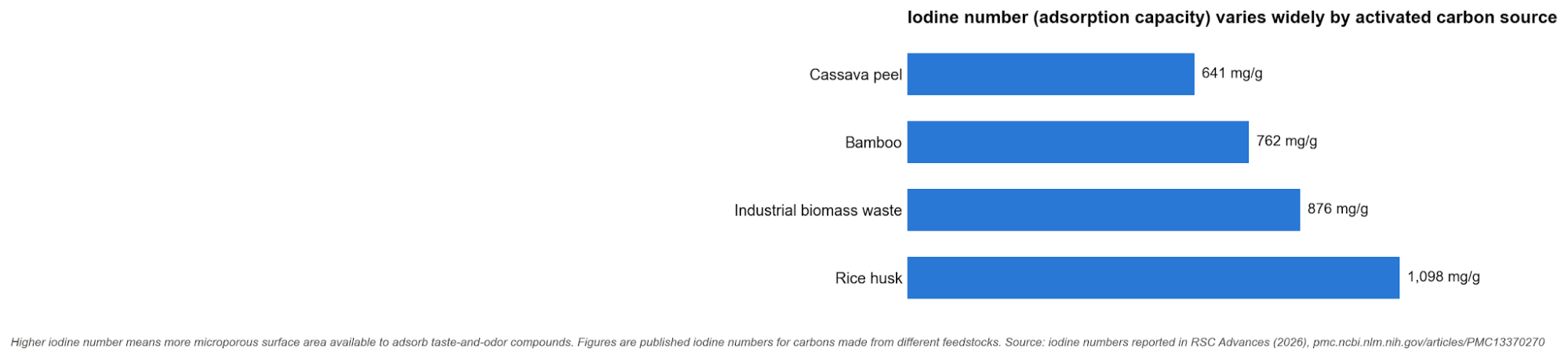
Two carbons quoted at the same dollars per cubic foot can differ by half their working capacity. The figure to ask for is the iodine number, and published values for carbons made from different feedstocks run from the low 600s to well past 1,000 mg per gram. Ash content is the other half of the story, since ash does no adsorbing and can wash back into treated water. A coconut shell carbon and a coal-based carbon behave differently on the same well, and neither one is universally better.
What To Ask A Carbon Media Supplier
Suppliers answer differently once they know you intend to check. Ask for documentation on the actual lot headed to your plant rather than the product line’s brochure range, and ask what happens if the bed exhausts early. A vendor who cannot answer the fourth question below is selling you a bag, not a treatment plan.
- What are the iodine number and ash content on the specific lot you are shipping me? A good answer is a lot certificate of analysis, not a product-line range.
- Is this media certified for drinking water contact under NSF/ANSI 61? You want a yes with the certifying body named.
- What backwash rate and bed expansion does this grade need at my water temperature? Look for a number in gallons per minute per square foot.
- Do you regenerate spent carbon, and what does the returned media test at? A supplier who regenerates should hand you before and after numbers.
Price belongs in that conversation too, and the pressure behind it is getting sharper. In June 2026 the American Water Works Association pointed to modeling that has the average household’s annual drinking water bill climbing from roughly $429 today toward nearly $1,000 by 2050 if utilities lean mainly on local rates. Small systems feel that early, because a media change is a lumpy cost spread across a few thousand connections instead of a few hundred thousand. Carbon that exhausts in nine months was never the cheap option.
Matching Grade To Your Contaminant Load
Start with what your own samples show, not with what the catalog leads with. Geosmin and MIB at nanogram levels reward a high iodine number carbon with pore structure skewed small. A steady chlorine and broad organic load rewards raw capacity and contact time instead. Particle size is the second half of the match. North Dakota State University Extension rates activated carbon filters on a scale running from about 50 microns at the least effective end down to 0.5 micron at the most effective. Finer is not automatically better, since a tighter rating buys removal at the cost of head loss and heavier backwashing.
Here is the part no supplier will put in writing, and I cannot pin it down either. There is no dependable published figure for how many months a given grade will last on your particular source water, because service life bends to organics, temperature, flow rate, and whatever the watershed did last spring. Two systems buying the same media in the same county will not land on the same answer. Run a pilot column if the budget allows. Otherwise your first bed is the pilot, so sample the mid-bed port monthly.
Choosing A Supplier You Can Recheck
The supplier decision outlasts the media decision by several bed changes. Regeneration service, lot documentation, and a willingness to be tested six months after the invoice cleared separate a supplier from a vendor. That difference keeps the next taste complaint from becoming another blind purchase order. Buy high activated carbon from someone who volunteers the ash content before you ask, treat the bed as one stage in a train rather than the whole answer, and put mid-bed sampling on the calendar before warm weather arrives. Then next August’s phone call never happens.