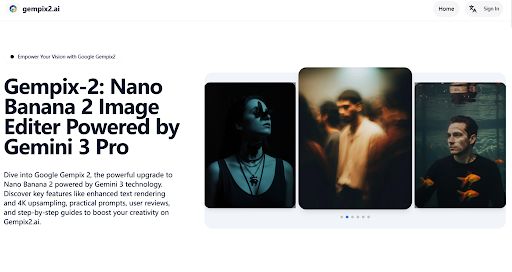

The past year has seen a dramatic shift in AI image generation. What began as aesthetic experimentation — producing stylized illustrations and viral social-media images — is now evolving toward precision, identity consistency, and real editing workflows. Google’s first Nano Banana model (Gemini 2.5 Flash Image) unexpectedly became a cultural phenomenon, known for fast generation and the ability to preserve facial identity during edits.
Now, leaks from Gemini’s internal UI and early developer traces point to a successor: Google Nano Banana 2, referenced internally as Gempix-2. While Google has not officially released the model, evidence suggests that Nano Banana 2 could be part of the upcoming Gemini 3.0 update, bringing higher native resolution, stronger prompt interpretation, and improved text rendering. Platforms like Gempix2.ai have already stated that once the model becomes available, they plan to offer Nano Banana 2 free online for testing, making it easier for creators to explore new AI image model without regional restrictions.
What Is Gempix-2 and How Is It Related to Nano Banana 2
Within the Gemini ecosystem, Google uses internal model identifiers to differentiate image-focused releases from text-only language models. The term “Gempix-2” appears in pre-release UI traces and refers to the second major iteration of Gemini’s image-generation track.
The name breaks down into two parts:
– “GEM”: shorthand for Gemini, Google DeepMind’s multimodal large-model family
– “PIX”: shorthand for pixel / image, signaling that this model specializes in visual generation
– “2”: indicating the second generation in this image-model lineage
In the community, this model is widely referred to as Google Nano Banana 2, because the first Nano Banana model (Gemini 2.5 Flash Image) unexpectedly gained a playful nickname after going viral on social platforms. Internally, however, Google appears to classify the model as Gempix-2, suggesting its position as the next dedicated Gemini Nano Banana 2 model.
What Improvements to Expect from GemPix 2
Higher Resolution for Production-Ready Output
Early internal traces suggest that Nano Banana 2 (Gempix-2) may increase native resolution beyond the first model, enabling cleaner details suitable for commercial or print use. Unlike the earlier Nano Banana model, which often required external upscaling tools, the Gemini 3 Pro Image upgrade indicates more robust visual clarity straight from the model.
Better Prompt Interpretation and Editing Precision
A recurring limitation of current image models is prompt drift, where AI adds elements that users did not request. Nano Banana 2 AI image generator is expected to improve prompt execution, following instructions more faithfully — whether specifying camera angle, lighting, or object placement. This shifts the model from “creative guesswork” toward controllable editing.
Stronger Character and Identity Consistency
The original Nano Banana became popular because it could preserve facial identity through multiple edits. Gempix-2 is expected to refine that capability, keeping character features consistent when generating image variations or applying new Nano Banana 2 prompt instructions — a capability Midjourney and other models still struggle with.
Improved Text Rendering for Infographics
Leaks suggest enhancements to how the model handles text inside images, including labels, UI elements, and diagrams. If Nano Banana 2 AI image editing can reliably render legible text, it opens the door for generating slide visuals, posters, or simple charts directly from prompts — something current image models handle poorly.
Why Nano Banana 2 Could Change the AI Image Industry
The AI image generation space has largely been driven by aesthetics rather than editing control. Tools like Midjourney excel at producing visually striking artwork, but they struggle with iterative edits, identity consistency, and precise instruction following — all of which are essential for real production workflows instead of one-off images.
The Nano Banana model (Gemini 2.5 Flash Image) was the first indication that Google was moving in a different direction. It introduced fast generation, consistent faces, and simple text-based editing, shifting the focus from “beautiful output” to usable output.
Now, Nano Banana 2 — internally referenced as Gempix-2 — pushes that transition further. Expected improvements like higher native resolution, better prompt execution, and reliable character consistency suggest a future where AI image models are not just creativity tools, but actual production tools. If the leaks are accurate, the upcoming Gemini 3 Pro Image upgrade positions Nano Banana 2 as a model built for iteration, asset revision, and workflow integration — not just visual surprise.
How to Access Nano Banana 2 Free Online
Although Nano Banana 2 (Gempix 2) has not been officially released yet, multiple platform references and early UI traces indicate where users will most likely be able to access the model once it launches.
Gemini App (iOS / Android)
When Google Nano Banana 2 launches, it is expected to appear first in the Gemini App, where users can upload images and use prompts to generate or edit visuals. Access, however, may vary due to region or Google account restrictions.
Google AI Studio (Web Platform)
Developers will likely gain early access to Gempix-2 through Google AI Studio, where the model can be tested with prompts and integrated via API. While more flexible, the platform usually requires a Google login and may need billing setup for extended use.
Gempix2.ai — Free Online Access (No Region Limit)
Platforms like Gempix2.ai plan to provide Nano Banana 2 free online immediately after release, allowing users to test the Nano Banana 2 AI image generator, editing features, and workflows without regional limitations.
Gempix-2 (Nano Banana 2) Signals a Shift Toward Practical AI Image Generation
The first Nano Banana model showed that AI images could go beyond aesthetics and begin supporting real creative workflows. With the arrival of Google Nano Banana 2 — attached to the upcoming Gemini 3 Pro Image update—the expectation is no longer just “better pictures,” but better control: higher native resolution, accurate prompt execution, improved text rendering, and reliable visual consistency. While the model has not been released yet, the direction is clear. Gempix-2 points to a future where AI image generation becomes not only creative, but also repeatable, editable, and usable in real production environments.
As soon as Nano Banana 2 becomes publicly available, platforms like Gempix2.ai plan to offer Nano Banana 2 free online, giving creators and developers a straightforward way to explore new Nano Banana 2 prompt workflows without geographical or login restrictions. Whether the model will meet the expectations set by early signals remains to be seen, but one thing is certain: Gempix-2 has already shifted the conversation from visual novelty to workflow impact—and the industry is watching closely.