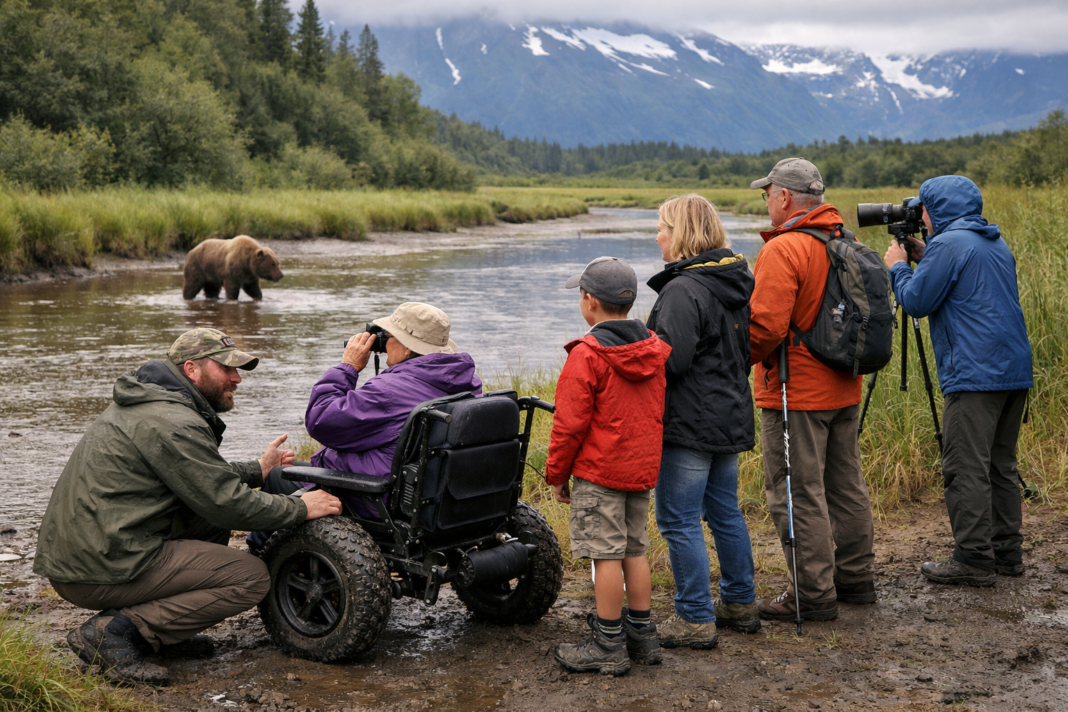

Key Takeaways
- Compare Alaska bear viewing tours by walking distance, trail surface, stairs, and transfer steps—not just bear photos—if the group includes older adults, kids, or travelers with uneven stamina. • Look for Alaska bear viewing tours that explain boat access, heated cabin space, seating, and bathroom availability, because comfort often decides whether a mixed-generation day stays enjoyable. • Ask whether a bear viewing tour uses managed observatory rules and guided trail etiquette; those details usually matter more for family safety than the word “adventure” in the tour title. • Match the right bear viewing option to the group’s real mobility level: some Alaska bear viewing tours work well for guests who can handle a steady half-mile walk, while others are better for low-strain wildlife viewing from the boat. • Watch for vague tour descriptions. The strongest bear viewing tours spell out age fit, time on site, walking difficulty, and support for mixed-ability travelers before anyone books.
One detail now decides more family bookings than the bear photos do: can everyone in the group actually manage the day? In Alaska bear viewing tours, that question has moved from the fine print to the center of the decision, especially for families traveling with grandparents, older kids, and one person who’s less steady on stairs or uneven ground. A tour can promise brown bear sightings, black bear habitat, or classic river and falls viewing, but if the walk is longer than expected—or the transfer from boat to dock feels shaky—the day changes fast.
That shift isn’t minor.
It reflects a broader change in how mixed-generation groups judge wildlife trips in bear country: safety, walking difficulty, bathroom access, seating, and time on site now carry as much weight as the viewing itself. The honest answer is, some tours have gotten better at describing those realities, while others still lean on glossy images and leave families guessing. And for travelers trying to compare a boardwalk observatory, a gravel-path walk, or a low-strain boat-based tour, guessing isn’t good enough.
Why mobility is now a deciding factor in Alaska bear viewing tours
How mixed-ability family groups are reshaping bear viewing tour expectations
One strong shift stands out in family travel planning: the person choosing a bear trip usually isn’t asking only, “Will there be bears?” They’re asking who in the group can handle the day. Grandparents. A seven-year-old. A teen who hates long waits. Somebody with a replaced knee. That’s changed the way people compare Alaska bear viewing options across the market.
In practice, mixed-generation groups don’t sort tours by hype. They sort them by friction. If a tour involves a boat transfer, a dock step, a staircase, and a half-mile trail on gravel before anyone sees a single brown bear, families want that spelled out in plain English—not buried under dreamy wildlife copy. That’s the news angle here: mobility details have moved from a side note to a buying filter.
Why safety, walking difficulty, and comfort now matter as much as bear viewing itself
Bear sightings still sell the trip. But comfort decides whether the group books. Heated cabins, steady seating, bathroom access, rail height for shorter travelers, — the ability to sit between viewing periods all matter more than operators used to admit.
And safety language matters just as much. A strong operator explains trail etiquette, food restrictions, spacing, and how guides manage human behavior around black and grizzly habitat—because the real risk isn’t just wildlife presence, it’s tired guests making bad decisions late in the day. Fatigue changes judgment. Fast.
And that’s where most mistakes happen.
That’s why families comparing Guided bear tours Alaska now read descriptions with a different eye. They’re looking for honest limits, not heroic marketing.
What mobility-aware Alaska bear viewing tours actually look like on the ground
Short walks, stairs, boardwalks, and gravel paths: what travelers need described
Plain descriptions win. The best tour pages now break the land portion into pieces: transfer from boat to shore, number of steps, trail length, surface type, places to pause, and how long guests stand once they arrive. If an operator says the walk is “easy,” that’s not enough. Easy for whom?
A useful description might tell a family that the route includes a short staircase and roughly a half-mile on compacted gravel and wooden walkways, with railings in a few spots but not everywhere. That kind of detail lets a traveler compare one observatory-style bear site with a boat-only wildlife cruise, a river stop, or a lodge-based outing near a lake or falls. Realistically, that comparison is what families need before committing a whole day.
Boat access, heated cabins, bathrooms, and seating that change the day for older adults and kids
Mobility isn’t only about walking. It’s also about recovery between activity blocks. A stable boat ride with indoor seating can turn a borderline trip into a good one—especially for older adults, younger kids, or anyone managing back pain, balance issues, or motion anxiety. A bathroom on board can matter more than one extra hour of wildlife time.
Here’s what most people miss: a family member who can walk a half-mile may still struggle with cold exposure, repeated step-downs, or two hours of unsupported standing. That’s why comfort features aren’t luxuries. They’re part of access.
Why guided observatory rules make bear viewing safer for travelers with uneven stamina
Structured bear observatory visits usually work better for mixed-ability groups than free-form wilderness hikes. There are rules. Good. Food stays out, voices stay low, spacing stays tight, — the guide controls movement if a bear changes direction or comes close to the platform.
A former guide would put it this way: the rules protect the slowest person in the group. They also protect the strongest walker from getting casual. On managed Alaska bear viewing trips, consistency beats swagger every time.
Let that sink in for a moment.
- Short, defined trail segments help guests pace themselves.
- Clear no-food rules reduce avoidable risk around bears.
- Guide-led movement keeps families together.
- Purpose-built viewing areas lower the chance of crowding mistakes.
Which Alaska bear viewing tours fit different mobility levels best?
Best bear viewing tours for travelers who can manage a half-mile walk at a steady pace
For guests who can handle a moderate walk and a few stairs, observatory-focused tours are often the best fit. They give people a real destination, meaningful viewing time, and a more controlled environment than a long backcountry trek. That matters for families who want actual bear behavior—salmon runs, feeding patterns, social spacing—without turning the day into a physical test.
One example often discussed in family planning circles is Anan bear observatory tours from Wrangell, where the appeal isn’t only close-range viewing. It’s the managed access, the defined walking route, and the fact that guides can set expectations before anyone starts moving. That kind of structure tends to work well for older kids and grandparents traveling together.
Best bear viewing options for families needing low-strain wildlife viewing from the boat
Some families should skip the trail entirely. A boat-based wildlife day won’t place guests on a bear platform, but it can still deliver strong animal viewing with far less physical strain. For a group with one traveler who can’t manage uneven surfaces, that trade-off often makes sense.
There’s a practical distinction here. “Low strain” does not mean “zero movement.” Guests may still need to board the vessel, step across a threshold, and shift between indoor and outdoor viewing spaces. But compared with a trail-to-observatory setup, the load is lighter.
So what does that mean in practice? A family choosing between a river tour, a coastal wildlife cruise, or a dedicated bear stop should compare the total movement load over six hours—not just the hardest five minutes.
When a bear viewing tour is a poor fit for toddlers, wheelchairs, or guests needing zero walking
Blunt truth. Some bear tours are a bad fit.
Sounds minor. It isn’t.
If a traveler needs zero walking, can’t manage transfers, or relies on a wheelchair that isn’t suited to gravel, bridges, or narrow trail sections, a remote bear observatory may not be the right choice. The same goes for toddlers on trips where guides need quiet, close group control in active bear country. Small sounds become big issues around wildlife, and parents should hear that before booking, not after arrival.
Families also need to be wary of marketing that treats every tour like it works for everybody. It doesn’t. A low-elevation boardwalk near a lodge, a river platform, and a remote platform reached by boat are three very different products, even if all three show great reviews and dramatic bear photos.
Are tour operators doing enough to explain access, age fit, and risk?
The biggest gaps in bear viewing tour descriptions that leave families guessing
Not yet. Too few pages describe the day with enough precision. They’ll mention a national park permit, a cruise-friendly schedule, maybe a lake or river setting, maybe even falls with brown bears fishing, but leave out the parts families actually need to compare.
Three gaps show up again and again:
- Walking details are vague. “Moderate” tells a planner almost nothing.
- Transfer steps are ignored. Dock height and boat boarding can be the hardest part.
- Age fit is softened. If a trip is poor for toddlers, say it plainly.
What honest accessibility language should include before anyone books a bear tour
Honest access language should cover distance, surface, stairs, standing time, seating, bathroom realities, food rules, and whether guests can pause if the group pace feels too fast. It should also explain whether guides can offer minor assistance or only verbal direction. That distinction matters—a lot.
And it should use concrete phrasing. Think “half-mile on compacted gravel with one short staircase” instead of “brief scenic walk.” Think “viewing platform requires periods of standing” instead of “comfortable observatory experience.” Families can handle hard facts. They can’t plan around fluff.
Simple idea. Harder to get right than it sounds.
Why mixed-ability groups should compare trail surface, transfer steps, and time on site—not just bear photos
Photos flatten reality. A bear at a river, a black bear near brush, a grizzly sow with cubs, even a distant polar image in broad search results—none of that tells a family whether Grandpa can get from the dock to the platform without burning all his energy before the main viewing window.
That’s the honest answer. Mobility fit is cumulative. Ten manageable pieces can still add up to one bad day.
- Trail surface: gravel, mud, boardwalk, roots, bridges.
- Transfer steps: dock to boat, boat to shore, shore to trail.
- Time on site: how long guests stand, sit, wait, and watch.
- Support style: guide-led pace, safety stops, group splitting rules.
How families can compare Alaska bear viewing tours before booking
A practical checklist for judging safety, comfort, and walking difficulty on bear viewing tours
Families don’t need a perfect system.
They need a usable one. The strongest planners compare tours with a short checklist and score each category from 1 to 5: walking difficulty, transfer complexity, bathroom access, cold exposure, seating, age fit, and guide control.
That checklist works better than chasing buzzwords like affordable, ultimate, quest, or once-in-a-lifetime. Those words don’t explain whether a traveler can do the day. A plain scoring system does.
- Walking load: total distance, not just trail length.
- Surface: compacted path beats loose rock for most travelers.
- Comfort: heated cabin, back support, room to sit.
- Safety structure: observatory rules, group spacing, food restrictions.
- Family fit: minimum age guidance and tolerance for waiting.
Questions to ask about guides, observatory etiquette, and support for older travelers
Ask direct questions. Does the guide set the walking pace? Are there stairs? Is there a chance to sit before or after the viewing window? How long are guests on their feet? Can the group split if one traveler moves slower? If there’s a river landing or island stop, how stable is it underfoot?
One more question matters more than families think: what happens if a guest tires early? The answer tells people whether the operator has a real risk-management plan—or just a nice gallery.
What the strongest bear viewing tours now share in common for mixed-generation groups
The best tours share a few traits. They don’t blur safety language. They treat comfort as part of access, not a bonus feature. And they prepare families for the rhythm of the trip—the boat time, the waiting, the standing, the rules, the moments that feel easy until fatigue stacks up.
It’s not the only factor, but it’s close.
That shift is overdue, and it’s starting to shape the whole category. For families comparing Alaska bear viewing tours, the winner won’t just be the one with the most dramatic bear at the falls, the prettiest mountain backdrop, or the strongest park credentials. It’ll be the one that tells the truth about what the day asks of every traveler on board.
Frequently Asked Questions
What should families look for when comparing Alaska bear viewing tours?
Start with four things: safety rules, walking difficulty, time on the water, and how the operator handles mixed ages. The best Alaska bear viewing tours spell out the trail surface, group size, bathroom access, and whether guides manage spacing and behavior around bears. If that information is vague, that’s a red flag.
Are Alaska bear viewing tours safe for kids and grandparents?
Some are. The safer fit for multi-generation groups is a managed bear viewing site with strict observatory rules, short walking distances, and guides who control the pace—especially if one traveler is 7 and another is 77. The honest answer is that age matters less than mobility, noise control, and whether everyone in the group can follow instructions fast.
How hard is the walk on most bear viewing tours?
It varies a lot, — families get tripped up here. Some bear viewing tours involve only a short walk on firm trail or boardwalk, while others add stairs, uneven ground, or longer distances that feel tougher in rain. Ask for the real version, not the brochure version: total walking distance, elevation change, and whether walking sticks help.
What’s the best time of year for Alaska bear viewing tours?
Peak viewing usually lines up with salmon runs, when brown bears and black bears concentrate near streams and falls. That timing creates the classic scenes people picture—bears feeding, younger bears learning from older sows, and long stretches of active viewing instead of random sightings from a moving boat. Short version: timing matters almost as much as the guide.
The short version: it matters a lot.
Will we actually see bears on an Alaska bear viewing tour?
No one honest can promise wildlife. But a well-run trip to a known bear viewing area during the right window gives families much better odds than a generic wildlife cruise where bears are only a possibility. In practice, the strongest tours build around seasonal behavior, not hope.
What’s the difference between an observatory-style bear tour and a general wildlife trip?
An observatory-style trip is built for bear viewing first. You usually have set rules, controlled access, and longer stationary viewing time, which works better for families who want clear expectations and less chaos. A general wildlife trip may show whales, sea lions, river scenery, or a brown bear onshore—but it isn’t the same thing.
How close do people get to the bears?
Closer than most first-time guests expect, — never on their own terms. Good Alaska bear viewing tours keep people in designated areas and use distance, barriers, timing, and guide control to reduce risk—because the goal isn’t thrill-seeking, it’s safe viewing. If a tour sounds casual about proximity, skip it.
What should families wear and bring on a bear viewing day?
Dress for cold, wet weather even if the morning looks calm. Waterproof layers, warm mid-layers, steady shoes, and a small day bag work better than bulky gear, and food often has to stay off the trail or out of the viewing area (that rule matters). Bring cameras, medication, and patience.
Are these tours a good fit for travelers who don’t hike much?
Yes, some are—just not all.
Families should look for tours that describe the route in plain English, with details on stairs, trail surface, and total time on foot, because “easy” means one thing to a fit couple and something else to a group with a child, a parent, and a grandparent. That mismatch causes more bad tour choices than weather does.
How do you pick between famous bear regions, river sites, and falls?
Pick based on your group’s tolerance, not the biggest-name map pin. Some people hear words like national park, lake, island, river, or falls and assume the experience is the same everywhere—it isn’t. For families, the better choice is usually the tour with the clearest rules, the shortest uncertain walking segment, and the most predictable viewing setup.
The standard for Alaska bear viewing tours is shifting, and that’s good news for families traveling with different ages, stamina levels, and comfort needs. Bear sightings still matter, of course—but the stronger tours now earn trust by being plain about the walk, the footing, the steps on and off the boat, the rules at the viewing site, and what a guest will actually need to manage for several hours. That kind of detail doesn’t soften the adventure. It makes the right fit easier to spot.
And that’s where mixed-generation groups need to stay disciplined. A tour that works well for a steady walker in decent shoes may be a poor match for a toddler, a guest who needs zero walking, or an older traveler who does fine on flat ground — struggles with stairs. The honest answer is simple: the best choice usually isn’t the one with the most dramatic bear photos—it’s the one with the clearest access description and the most realistic safety plan.
Before anyone books, families should make a side-by-side comparison sheet with five items: walking distance, trail surface, transfer steps, seating and bathroom access, and guide support. That step will save frustration—and it will lead to a better day in bear country.
For more great reading, visit our site and explore related topics.