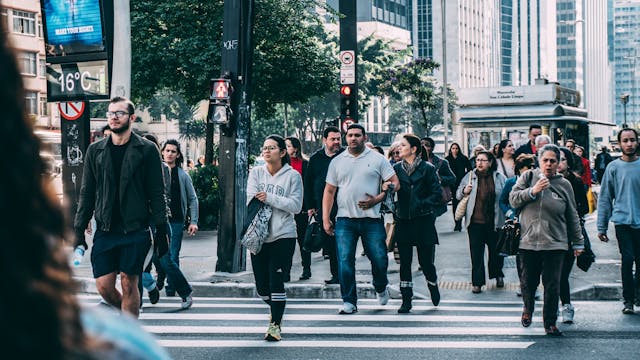

Look at the streets of nearly any American city, and you’ll see lots of cars. Even in areas with high foot traffic, pedestrians have to run the risks that come with sharing walkable spaces with automobiles. This makes cities less convenient, while also posing major risks of pedestrian injuries and deaths.
The complete streets movement is a push to make cities more accessible to all users, regardless of their mode of transportation. That means planning, construction, design, and maintenance of streets have to account for the needs of not just motorists. They also have to account for the safety and livability of streets for pedestrians and bicyclists.
Complete Streets Is a Process
The complete streets revolution makes cities better for pedestrians by implementing a handful of key processes. Foremost, the complete streets approach applies to all projects, unless a project meets clearly outlined exceptions. No particular interest gets a political carve-out for a less friendly street without meeting an exception that makes sense within the complete streets program. Land-use planning has to be proactive, and projects have to meet specified performance metrics.
Design Elements of Complete Streets
Common design elements in cities that have joined the complete streets revolution include protected bike lanes, better sidewalks, and raised crosswalks. ADA-compliant features make streets more accessible to pedestrians of all abilities. Transit improvements like dedicated bus lanes reduce the number of vehicles on the road and improve the transition from walking to riding, too.
Traffic control systems also make a big difference. Speed bumps discourage aggressive speeding in pedestrian-heavy areas. Curb extensions narrow the roadway near crossings, providing a necessary buffer to protect pedestrians. Angled face-out parking discourages vehicle accidents by forcing greater attention and slower maneuvers. Roundabouts can also reduce crashes compared to classic intersections with two-way stop signs.
Parallelism
Parallelism is another key element. Routes for all modes of transportation should work together rather than against each other. Someone should easily be able to drive to a parking garage, grab a bus, and then disembark on foot to their destination without having to worry whether a particular mode will get them there. When a single route can’t accommodate all modes, there should be parallel alternate routes that accomplish this goal.
The main benefit of parallel design is that it makes choosing different transportation modes simpler. You don’t have to worry whether walking, biking, driving a car, or riding a bus will serve your purpose. All modes will do. The net effect is that people don’t feel like their choice is between driving a car or just not going somewhere.
Road Diets
Another factor is imposing road diets. Suppose a street has four undivided lanes going in one direction. A diet would call for converting it to two through lanes and a center left-turn lane. The subtracted lane would then become a dedicated bike lane. This design reduces rear-end and right-turn crashes while also minimizing risks to pedestrians and bicyclists.
Notably, this also saves cities money by reducing street damage and the number of emergency responses. Often, this happens without reducing the auto traffic volume. Likewise, complete streets projects have often produced economic wins thanks to local upticks in business activity.
Complete Streets Are Safer Streets
Cities across America are adapting Complete Streets plans, including Fremont, California, a city that saw 39 pedestrian accidents resulting in 5 deaths in 2022. streets make cities safer. The most successful projects have reduced vehicle and pedestrian accidents by as much as 47%. With a process-level commitment to better planning, complete streets are redesigning American cities away from the car-centric model and toward pedestrians and others.