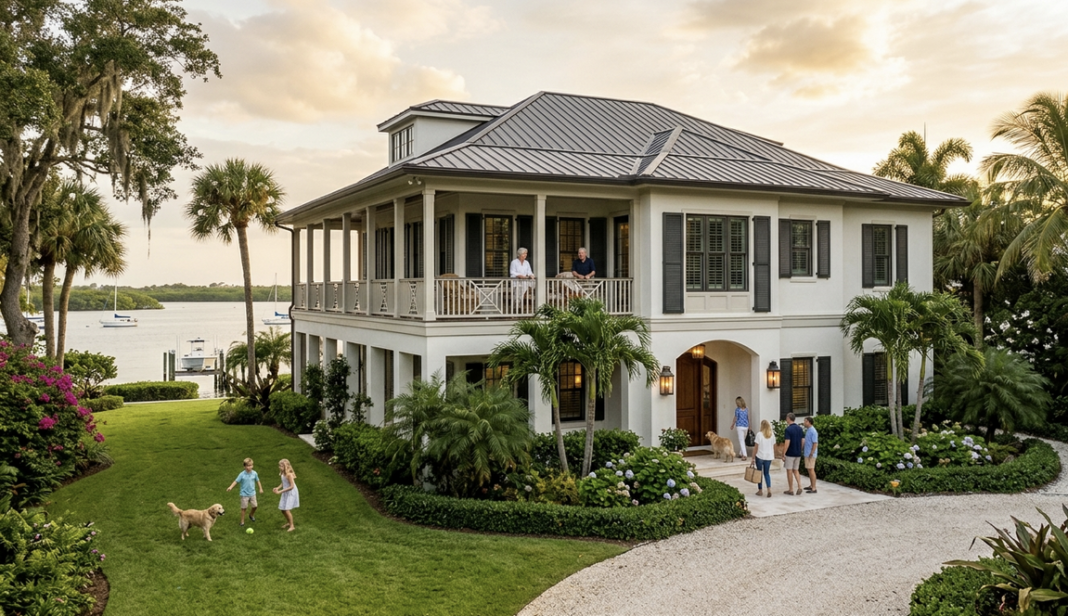

Why Florida’s most discerning buyers are commissioning homes built to outlast them, and what that demands of the people who build them.
For most of the last two decades, the American luxury home market was sold on novelty. Bigger square footage, bolder finishes, a new architectural language every five years. Kent Pecoy, the Southwest Florida builder behind some of the region’s most enduring coastal estates, watched that cycle from a distance. His firm, Kent Pecoy & Sons Construction, has spent more than 45 years building the kind of homes that are rarely flipped, rarely renovated beyond recognition, and almost never abandoned to a new owner’s vision within a decade.
Now, Pecoy says, a different kind of buyer is showing up at his table. They are not asking what the house will look like on Instagram. They are asking what it will look like in 2075.
“There is a real shift happening with our clients,” Pecoy said. “They are commissioning homes for their grandchildren. That changes every conversation we have, from foundations to fixtures.”
A Return to Permanence
The multi-generational estate is not a new concept in American architecture. The great houses of Newport, Palm Beach, and the Hamptons were conceived as family seats, designed to be inherited, expanded, and lived in across lifetimes. What has changed, according to Pecoy, is who is now asking for that kind of home and why.
His client roster increasingly includes entrepreneurs in their late 50s and 60s who built businesses they intend to pass down, alongside professionals in finance, medicine, and technology who watched their parents’ generation lose homes in storms, divorces, and forced sales. The lesson they took from it was simple. A house is only an inheritance if it survives long enough to be inherited.
“We are seeing buyers who explicitly do not want a trophy,” Pecoy said. “They want a working family home. They want the kitchen sized for holidays in 2050. They want guest wings that can become caretaker suites. They want a house their grandchildren will fight over for the right reasons.”
What Multi-Generational Actually Requires
Building for permanence is harder than building for resale, and Pecoy is direct about why. The structural and systems decisions are different. Foundations are engineered for sea level projections, not current conditions. Roof assemblies are specified for storm cycles that have not yet arrived. Mechanical systems are designed to be serviced, replaced, and upgraded across three generations of technology, not sealed behind drywall and forgotten.
It also requires a different relationship with the client. Pecoy’s firm now routinely consults with estate attorneys and family office advisors before construction begins, mapping out how the property will be held, maintained, and eventually transferred. That kind of coordination was rare a decade ago. Today, Pecoy says, it is becoming standard for the upper end of the Florida market.
“Building a multi-generational home is partly a construction project and partly an estate planning exercise,” he said. “If you don’t think about both at the same time, you build a beautiful house that gets sold the moment the original owner is gone.”
The Florida Specific Challenge
Doing this work in coastal Florida adds a layer that builders in other regions do not face. The state’s revised building codes, the insurance market’s tightening posture, and the documented intensification of storm patterns mean that a home built today must answer questions that buyers in Connecticut or Colorado never have to ask.
Pecoy treats this as an advantage rather than a constraint. His firm has spent four decades refining how coastal estates are sited, elevated, and detailed for the specific failure modes the Gulf Coast presents. When a family is making a 50-year decision, that institutional knowledge is what they are actually paying for.
“You cannot rush this work,” Pecoy said. “You cannot value-engineer it. The clients who understand that are the ones building homes their families will still be living in when none of us are around to see it.”
A Market Correcting Itself
For an industry that spent years measuring success in turn times and per-square-foot premiums, the multi-generational estate represents a slower, quieter kind of demand. Pecoy is not predicting that it will dominate the luxury market. He is predicting that it will continue to define the part of the market that matters most to builders who plan to be around in 20 years.
“The boom builders are gone or going,” he said. “The clients who are left are the ones who were never chasing the boom in the first place. That is the work I want to be doing for the rest of my career.”
Members of the editorial and news staff of the News Blaze were not involved in the creation of this content.