
In the manufacturing world, “Lean” has become a bit of a loaded term. For some, it conjures images of tidy workbenches and color-coded shadow boards. For others, it’s a management philosophy about culture and respect. But at its absolute core, Lean is about one thing: the ruthless elimination of waste.
It is about ensuring that every ounce of material, every minute of labor, and every kilowatt of energy goes directly into creating value for the customer. Anything else—scrap, rework, waiting, over-processing—is burning money.
While we often focus on the process changes needed to go Lean (like moving machines closer together or reducing batch sizes), we often overlook the hardware that makes it possible. You cannot improve what you cannot measure. Without data, Lean is just a guess.
This is where the role of high-quality precision measuring equipment moves from the quality control lab to the center of the business strategy. Metrology—the science of measurement—is the sensor system of the factory. It provides the hard, cold facts that allow managers to tighten processes, reduce errors, and ultimately, run a leaner, more profitable operation.
Here is how the right measuring tools act as the engine for a Lean transformation.
1. Attacking the “Muda” of Defects
In the Seven Wastes of Lean (Muda), defects are arguably the most expensive. When you produce a part that is out of spec, you haven’t just wasted the raw material. You have wasted the machine time, the tool wear, the operator’s wages, and the energy used to make it. If you try to fix it (rework), you are spending even more money to save a bad investment.
Traditional manufacturing often relies on post-process inspection—making a batch of 100 parts and then checking them at the end to see how many are good. This is not Lean; this is sorting.
Precision metrology allows you to move to in-process inspection.
- The Shift: Instead of waiting until the end, modern coordinate measuring machines (CMMs) and machine tool probes check the part while it is being made.
- The Result: If a cutting tool wears down by 10 microns and the part starts to drift out of tolerance, the equipment detects it immediately. The machine stops or auto-corrects. You don’t end up with a bin full of scrap; you make a minor adjustment and keep running. This stops the bleeding before it starts.
2. Smashing the Setup Time Bottleneck
One of the pillars of Lean is “Single-Minute Exchange of Die” (SMED)—the ability to switch a machine from making Product A to Product B as fast as possible. Long setup times kill efficiency because they force you to run huge batch sizes just to justify the downtime.
Manual setup is slow and prone to human error. An operator using a dial indicator to manually “tram” a part or find a zero point can take 20 or 30 minutes.
Precision measuring equipment automates this.
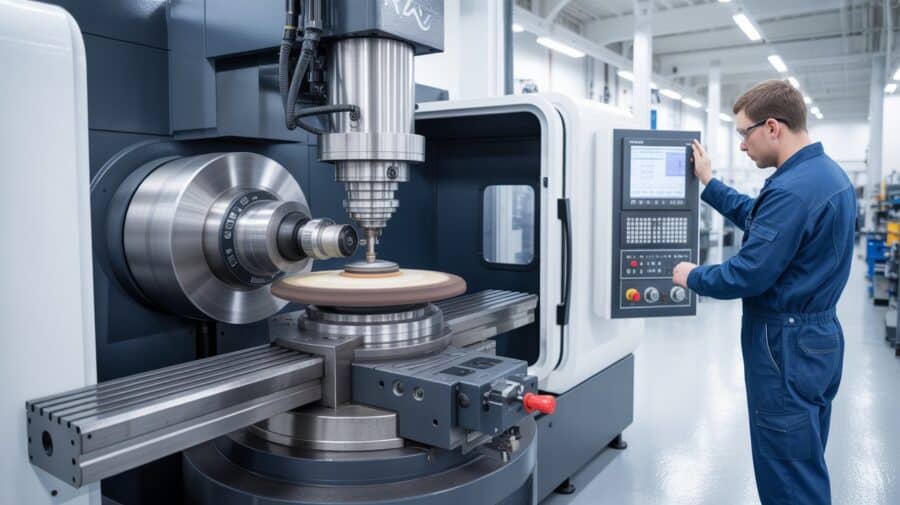
- Touch Probes: A spindle-mounted touch probe can locate a part fixture, calculate the angle, and update the work offsets in seconds, not minutes.
- Tool Setters: Laser tool setters measure the length and diameter of the cutting tools instantly.
By slashing setup time, you gain the ability to run smaller batches efficiently. This reduces your inventory costs (another Lean goal) and makes your shop far more agile and responsive to customer orders.

3. Validating the Process (Statistical Process Control)
Lean manufacturing isn’t about hoping for the best; it’s about statistical certainty. You need to know that your process is capable of holding the tolerance.
If you are using cheap, hand-held calipers that have been dropped on the floor three times, your data is garbage. You cannot make decisions based on it.
High-end metrology equipment provides the Repeatability and Reproducibility (Gage R&R) required for statistical process control (SPC).
- The Insight: When you trust your measurements, you can spot trends. You can see that a dimension is slowly creeping toward the upper limit over the last 50 parts.
- The Action: This allows for predictive maintenance. You can change a tool or adjust a parameter before a bad part is ever made. You are no longer reacting to failures; you are managing the health of the process.
4. Eliminating the Waiting Waste
We have all seen it: a pallet of finished parts sitting on the shop floor, gathering dust, waiting for the quality control (QC) team to sign off on them. The machines are idle because the operator is waiting for the green light to continue the run. This is the waste of waiting.
Modern metrology is moving out of the climate-controlled lab and onto the shop floor. Ruggedized CMMs, portable articulating arms, and handheld laser scanners allow operators to verify parts right at the machine.
- The Flow: By decentralizing the measurement process, you keep the product moving. The feedback loop is shortened from hours to minutes.
- The Culture: This also empowers the operators. They own the quality of their work because they have the tools to verify it themselves, rather than relying on a separate force in the QC lab.
5. Confidence for Just-In-Time (JIT) Delivery
The ultimate goal of many Lean systems is just-in-time delivery—producing only what is needed, when it is needed. This slashes inventory costs, but it removes the safety net. You don’t have a warehouse full of spare parts to fall back on if production fails.
JIT requires absolute confidence. You have to know that the part you make today will fit the customer’s assembly tomorrow.
This confidence comes from calibration and precision. It comes from using high-quality styli that don’t flex, probes that trigger instantly, and software that interprets the geometry correctly. When your metrology is sound, your supply chain is secure. You can operate without the “fat” of excess inventory because you trust your ability to produce a perfect part on demand.
Lean is not just about organizing tools or holding Kaizen events. It is about precision. It is about tightening the feedback loop between what you intended to make and what you actually made. By investing in the right measuring technology, you are giving your team the eyes they need to see the waste, eliminate it, and build a manufacturing process that is as efficient as it is effective.