
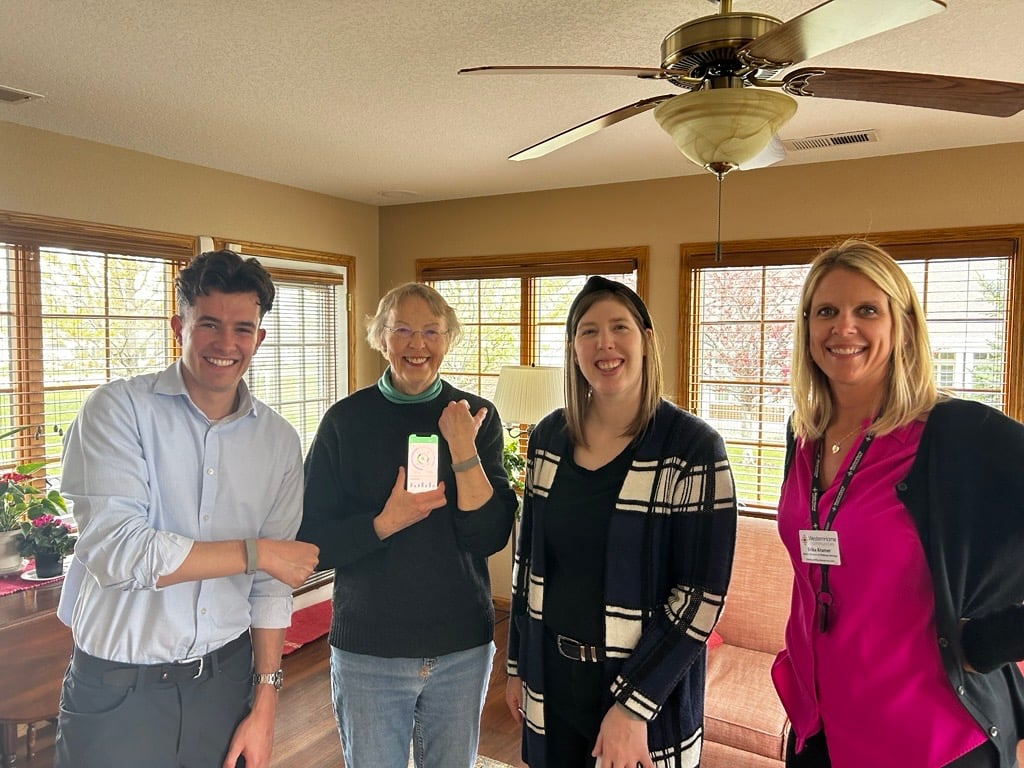

When you enter a new industry, it is tempting to think the hardest part will be proving that you have a good product. Matthew Costigan learned that it can be something else entirely. Sometimes, the hardest part is simply getting people to trust you.
Matthew moved from Ireland to the United States in 2023 to help build PacSana‘s presence in the American market. There was no established customer base waiting for him and no long list of industry contacts he could rely on. He had to start conversations, and then keep having them. In an industry as relationship-driven as home care, that process mattered just as much as the technology itself.
Starting Without a Network
Matthew ‘s background gave him an early understanding of business and sales. Growing up in Clarinbridge, Galway, he would accompany his father to trade shows as a teenager, helping at a booth for a product his father had brought from the US into the European market. Years later, that experience would become useful in a very different setting.
After graduating from University College Dublin during the pandemic, Matthew eventually joined PacSana and began working on market research and business development. He spent time learning the industry in Ireland, the UK, and the US. When the opportunity came to build the company’s US presence himself, he took it.
The move meant starting over in a market where he did not yet have the relationships that would normally make the work easier. For Matthew , there was no shortcut around that. He had to earn his place one conversation at a time.
The First Lesson Was to Listen
In sales, there is often pressure to make the pitch as quickly as possible. Matthew found that the better approach was almost the opposite. Before asking an agency to consider new technology, he needed to understand how that agency actually operated. That meant showing up, listening to agency owners and staff, learning about their day-to-day challenges, and seeing where a solution could genuinely help.
It sounds simple. In practice, it takes time. Home care is not an industry where relationships can easily be replaced by a cold email or a clever presentation. Providers have spent years building relationships with clients and their families, so they are naturally careful about bringing something new into that environment. A new company has to show that it understands what is at stake.
That is why Matthew ‘s approach was based on being useful before asking people to buy into an idea. Small pilots became part of that process, and each conversation offered another opportunity to learn. Each successful step helped build a little more credibility, and over time those small wins started to add up.
You Cannot Rush Credibility
One of the biggest lessons Matthew Costigan took from the experience was patience. Launching something new rarely follows the timeline you imagine at the beginning. There are delays, setbacks, conversations that go nowhere, and opportunities that take much longer than expected. That can be difficult for anyone building a business, and it becomes even more challenging when you are trying to establish yourself in a market where people have no reason to know who you are yet.
His answer was consistency. Instead of trying to create the impression that he already belonged in the industry, he focused on learning it, and that distinction matters.
Credibility is not something a person can simply announce. It develops through repeated actions: showing up, listening, following through, learning from what did not work, and returning with something useful. Eventually, people start to remember you, and then they start to trust you.
A Major Partnership Was Built on the Small Steps
That long-term approach eventually contributed to one of the biggest milestones in Matthew Costigan’s US journey. Right at Home, a national home care organization with more than 600 franchises across the United States, evaluated close to 100 technology companies. The process was narrowed to roughly 12 companies for a formal RFP, followed by pilots with three finalists.
Matthew represented PacSana throughout the process. He sourced the relationship, helped run the pitch, negotiated terms, and worked toward closing the partnership alongside PacSana CEO Feargal Duignan. PacSana was selected in December 2024, and the resulting partnership became RightAssist, Right at Home’s technology arm, now live in more than 130 offices nationally.
It is an impressive outcome. But the lesson is not simply that persistence eventually produces a large partnership. It is that major opportunities are often built through many smaller moments that happen long before the final agreement is signed: the meeting where someone finally takes your call, the pilot that gives a team enough confidence to continue, the conversation where you learn something you had previously misunderstood, the follow-up message that proves you meant what you said. Those moments rarely make headlines. They are often what builds the foundation for the headline.
Being Willing to Adapt Matters
Building relationships in a new market also required Matthew to adjust. He found that even communication could work differently in the United States than it did in Ireland, so he had to become more deliberate in how he spoke, slow down his pace, and pay attention to how people expected business conversations to happen.
None of these changes meant abandoning where he came from. They meant understanding that entering a new market requires humility. It is easy to assume that what worked at home will work somewhere else. Sometimes it will, and sometimes it will not. The ability to notice the difference and adapt can be more valuable than trying to force the same approach everywhere.
The Outsider Advantage
Starting without an established network is difficult. But there can also be something useful about being the outsider. You have to ask questions that people who have been in an industry for years might take for granted. You have to pay attention, and you have to learn quickly, since you cannot rely on your reputation to open every door.
Matthew ‘s experience in the US reinforced a lesson he now carries with him: being genuinely curious has to come before trying to be useful. That principle extends well beyond home care. It applies to entrepreneurs entering new industries, professionals changing careers, companies entering new markets, and anyone trying to build relationships with people who do not know them yet.
The instinct is often to prove yourself immediately. Sometimes the better first step is to understand the people in front of you.
Trust Is Still a Business Advantage
Technology may be changing how industries operate, but it has not removed the need for human relationships. If anything, industries dealing with deeply personal decisions may need trust even more as technology becomes more involved. Home care is a clear example.
Families are making decisions about people they love. Agencies are choosing tools that affect how their teams work. Older adults are being asked to use technology that can influence how they experience their own independence. A good product matters, but so does the person standing behind it.
Matthew Costigan’s journey into the US market is a reminder that building something meaningful rarely happens overnight. The biggest opportunities can come from staying in the conversation long enough to understand what people need, and proving, through action, that you are there to help.
For someone entering an unfamiliar market, that may not sound like the fastest strategy. It probably isn’t. But trust has never been particularly interested in speed. It is earned slowly, through consistency, curiosity, and showing up when there is no guarantee that anything will come from it. Sometimes, those quiet efforts are what eventually open the biggest doors.

