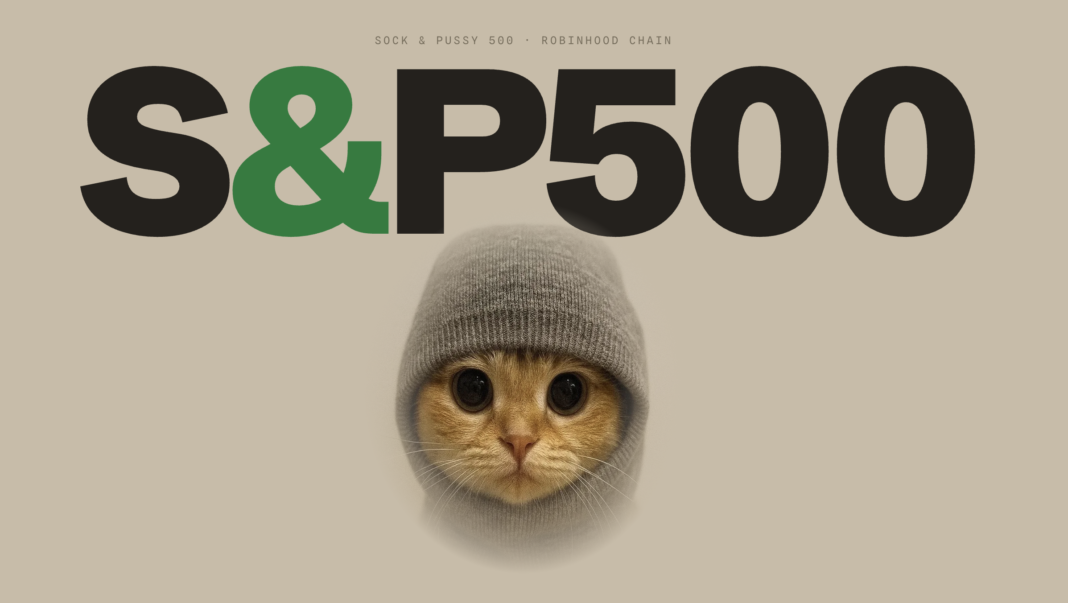

A token called Sock & Pussy 500 pays holders in tokenized stocks on Robinhood’s new blockchain. The fund manager, per the project, is a cat in a sock.
A memecoin is offering younger investors something the meme market almost never does: a payout that looks like a dividend. The token, Sock & Pussy 500, trades under the ticker $S&P500 on Robinhood Chain, and its pitch is blunt. Hold at least 10,000 tokens in your wallet and you receive distributions of tokenized stocks, sent to eligible holders without staking, claiming, or any button to press.
The premise sounds like a joke, and in part it is. The project’s own site names the fund manager as “one (1) cat in a sock,” sets the management fee at zero, and lists its rebalancing schedule as “whenever he feels like it.” The homepage closes with a line most memecoins skip: “$S&P500 is a memecoin. It is not affiliated with Standard & Poor’s, Robinhood Markets, or any actual index. Nothing here is financial advice, it’s a cat wearing a sock.”
What makes the gimmick legible, rather than pure nonsense, is the rail it runs on.
Why the stock-dividend angle works now
Robinhood spent the past year building the infrastructure that a token like this needs. In June 2025 the company launched Robinhood Stock Tokens for European customers, giving them tokenized exposure to more than 200 U.S. stocks and ETFs with dividend support, and announced its own Ethereum Layer 2 blockchain built on Arbitrum’s technology. The company opened a public testnet for that network, Robinhood Chain, in February 2026, and the mainnet followed in mid-2026.
On that chain, real equities exist as ordinary crypto tokens. A tokenized share of Tesla is an ERC-20 contract labeled TSLA. Nvidia trades as NVDA, the S&P 500 ETF as SPY, and even private companies such as SpaceX appear as tokens. Each one moves the same way any crypto token moves, in whole units or fractions, which is why a memecoin can, in theory, hand those tokens to its holders as a distribution.
That is the mechanic Sock & Pussy 500 is leaning on. Buy the token on Uniswap, keep your balance above the 10,000 threshold, and the project says tokenized stocks land in your wallet automatically. Drop below the line and the eligibility drops with you.
The appeal to a younger investor
The framing targets a specific frustration. Traditional dividend investing asks for patience, a brokerage account, and enough capital that quarterly payouts amount to more than pocket change. A memecoin that promises stock distributions collapses that into a single on-chain purchase, then dresses it in the visual language Gen Z already trades in: cats in balaclavas, an “annual shareholder meeting” staged in front of a stock exchange, a “head of risk management” that is a kitten on a horse.
Whether the distributions arrive as advertised is the open question, and it is the one that separates this from an actual index fund. The project publishes a contract address and a live DexScreener chart, and points buyers to a Uniswap v2 pool on Robinhood Chain. It does not publish audited reserves, a distribution history, or any accounting for where the tokenized stocks come from. Holders are trusting a pseudonymous team and, by the site’s own admission, a cat.
The risk nobody should gloss over
Memecoins remain among the most volatile and thinly regulated corners of crypto. Prices can collapse in hours, liquidity can vanish, and a project promising real-asset payouts carries the added risk that those payouts simply stop. The tokenized-stock layer underneath is new enough that even Robinhood’s own chain only reached mainnet this year. None of that is disclosed in a prospectus, because there is no prospectus.
For readers, the useful takeaway is the trend, not the trade. Robinhood’s move to put equities on a blockchain created an opening, and meme culture filled it within months. A token that pays you in stocks was always going to arrive the moment stocks became tokens. That it arrived wearing a sock says most of what you need to know about who it is built for.
This article is for information only and is not financial advice. Cryptocurrencies and memecoins are high-risk assets, and readers should do their own research before buying anything.