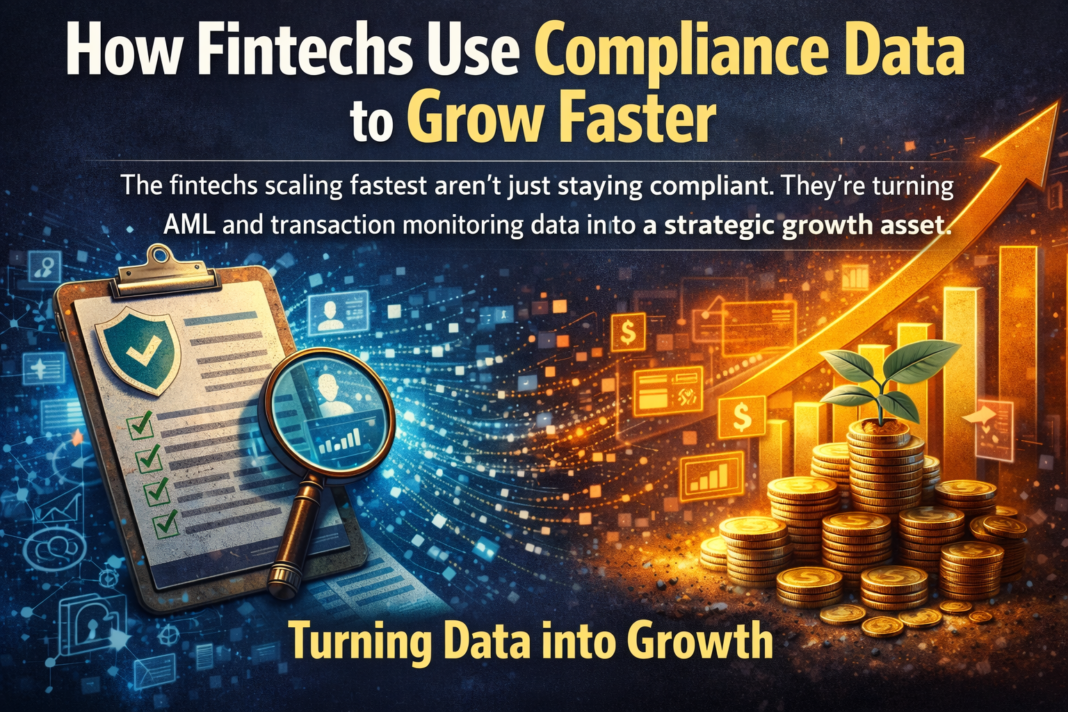

Most fintech leadership teams think about compliance and growth as separate tracks. The product team pushes toward faster onboarding, smoother payments, and better UX. The compliance team maintains monitoring systems, files reports, and manages regulatory relationships. The two functions rarely sit in the same strategy conversation.
That separation is expensive.
The transaction data that flows through a well-built compliance program is some of the richest behavioral intelligence a fintech can access. It captures how customers actually use money, what their risk profile looks like over time, when their behavior shifts, and what patterns distinguish high-value customers from high-risk ones. Institutions that treat this data purely as a regulatory obligation are leaving significant product and commercial value on the table.
The fintechs pulling ahead are the ones that have figured out how to use compliance infrastructure as a source of operational intelligence, not just a cost of doing business. That shift in thinking is central to what AI-native financial crime compliance makes possible: a compliance program that produces business intelligence as a byproduct of doing its core job well.
What Kind of Data Does a Transaction Monitoring Program Actually Capture?
A mature transaction monitoring program sees far more than suspicious activity. Every flagged and cleared transaction contributes to a behavioral picture of each customer account. Velocity patterns, counterparty networks, transaction timing, channel preferences, and risk signal frequency all get recorded as part of normal monitoring operations.
That data does several things simultaneously. It feeds the fraud detection models that compliance teams rely on. It creates the audit trail that regulators review. And it generates a running behavioral profile of every customer on the platform, updated in real time, that reflects how that customer actually behaves financially.
Most fintechs use a fraction of that intelligence for anything beyond its immediate compliance purpose. The behavioral profiles built through monitoring could inform credit decisions, product recommendations, customer segmentation, and churn prediction. In practice, many institutions keep compliance data siloed from the product and commercial teams who could benefit most from it.
This is one of the structural problems that legacy compliance tooling tends to reinforce. Fragmented systems, where transaction monitoring, watchlist screening, and case management all operate on separate platforms with no shared data layer, make it practically difficult to extract intelligence that spans the full customer lifecycle. When compliance data lives in disconnected silos, the business value locked inside it stays there.
How Does Transaction Monitoring Data Improve Customer Risk Decisions Beyond AML?
The risk scoring logic built into a transaction monitoring program is fundamentally a model of customer behavior. It distinguishes between customers whose activity matches expected patterns and customers whose activity deviates in ways that suggest elevated risk. That distinction is useful far beyond AML compliance.
Credit and lending decisions benefit directly from behavioral transaction data. A customer’s payment patterns, income regularity, and spending consistency are all visible in their transaction history. Fintechs with lending products can use this data to make more accurate underwriting decisions than those relying solely on bureau scores, which are backward-looking and updated infrequently. Behavioral transaction data is forward-looking and continuous.
Customer lifetime value modeling becomes more accurate when it incorporates transaction behavior alongside product usage data. A customer who makes frequent, diverse transactions through the platform is a materially different lifetime value prospect than one who uses a single feature occasionally. Monitoring data makes that distinction visible at the individual account level.
Churn prediction has a transaction behavior component that most fintech product teams underweight. Declining transaction frequency, narrowing counterparty range, and reduced average transaction values are behavioral signals that often precede account closure by weeks or months. Compliance teams already see these patterns. Whether that insight reaches the retention team depends entirely on whether the two functions share data and infrastructure.
Why Do Most Fintechs Fail to Extract Value From Their Compliance Data?
Three structural problems consistently block the connection between compliance data and business value.
Organizational silos are the most common issue. Compliance and product functions report through different leadership chains, operate on different planning cycles, and rarely share data infrastructure. The monitoring platform and the product analytics platform are often entirely separate systems with no integration between them.
Data quality inconsistency is the second problem. Transaction monitoring systems are designed to capture what they need for fraud detection and regulatory reporting. The fields that matter for those purposes don’t always align cleanly with the fields that would be most useful for product analytics. Connecting the two requires data engineering work that tends to fall between the ownership of both teams.
Risk aversion around data use is the third barrier. Compliance teams are understandably cautious about how their data gets used. Using behavioral flags from AML monitoring to make product decisions raises questions about customer consent, data governance, and the appropriate boundaries between compliance and commercial functions. Those questions have answers, but working through them requires cross-functional effort that most institutions haven’t prioritized.
The institutions that have resolved these barriers most effectively tend to share a common characteristic: they chose compliance infrastructure that was designed from the start to support auditability, cross-functional access, and long-term operating confidence, rather than platforms built to satisfy a minimum regulatory requirement and nothing more.
What Does It Look Like When a Fintech Gets This Right?
The clearest examples come from institutions that have deliberately built compliance infrastructure as a shared data asset rather than a siloed function.
Nubank, the Brazilian neobank, has been explicit about how its risk and compliance data informs its credit product. Because it operates in markets where credit bureau data is sparse or unreliable, transaction behavior is one of the primary signals it uses to extend and adjust credit limits. The result is a credit product that performs better than traditional models in its target market because it is calibrated to real financial behavior rather than demographic proxies.
Revolut’s growth trajectory reflects a similar logic. Its ability to expand rapidly across markets while maintaining acceptable fraud loss rates depends on a monitoring infrastructure that generates behavioral intelligence at scale and feeds it back into risk decisions in real time. That capability doesn’t just prevent fraud. It enables the onboarding velocity that has been central to its growth.
These are not coincidences. Both institutions treat compliance infrastructure as a core competency rather than a compliance minimum, which is part of why they have been able to grow at rates that would have overwhelmed institutions with weaker monitoring foundations.
How Does Transaction Monitoring Support Sustainable Fintech Scaling?
Growth creates compliance pressure in ways that catch underprepared fintechs by surprise. Transaction volume grows faster than monitoring capacity. New customer segments bring new risk profiles that existing rules weren’t calibrated for. New markets introduce regulatory requirements that existing systems may not accommodate.
Fintechs that have built monitoring infrastructure capable of scaling with the business absorb this pressure without an operational crisis. Those that haven’t tend to face a difficult choice: slow onboarding to manage compliance risk, or accelerate onboarding and accept elevated fraud and regulatory exposure.
The benefits of transaction monitoring are most visible at scale because that is when the difference between a monitoring program built for growth and one built to minimum standards becomes operationally consequential. At 10,000 customers, a weak monitoring program is manageable. At 500,000, it becomes a material business risk.
Real-time monitoring that handles high transaction volumes without latency degradation, combined with configurable rules that can be adjusted as customer behavior evolves, is what allows a fintech to grow without its compliance program becoming a bottleneck. For enterprise financial institutions operating at this level of complexity, the platform choice matters as much as the program design. A rigid, legacy system that requires engineering work to adjust a single rule set is not compatible with the pace of change that serious financial institutions operate at today.
What Should Fintech Leaders Ask About Their Transaction Monitoring Program?
The questions that matter most for evaluating a monitoring program’s quality are not the ones regulators ask first. They are the ones that reveal whether the program is actually built to perform.
Does the monitoring system update customer risk profiles in real time, or on a scheduled basis? Scheduled updates mean there is always a window during which a customer’s risk level has changed but the system doesn’t know it yet. In a fast-moving fraud event, that window is where losses happen.
What is the current false positive rate on alerts, and how has it trended over the past 12 months? A rising false positive rate signals that rules are becoming misaligned with actual customer behavior as the platform scales. Left unaddressed, it translates directly into rising analyst costs and declining detection quality for genuine risk.
How long does it take to implement a new monitoring rule when a new fraud typology is identified? If the answer involves a development sprint, a testing cycle, and a deployment window measured in weeks, the monitoring program will always be behind the fraud landscape rather than current with it. No-code or low-code rule configuration is not just a convenience. It is a material security capability.
Can the monitoring platform produce an audit-ready case file for any flagged transaction without manual reconstruction? Regulators reviewing a firm’s compliance program want to see complete, consistent documentation of how alerts were handled. Programs that require analysts to manually compile that documentation from multiple systems are both slower and more prone to gaps.
Is the AI driving alert triage and recommendations explainable to a regulator? This is a question more institutions should be asking. AI capabilities that operate as black boxes create governance problems regardless of how well they perform. Mature compliance platforms that incorporate AI forensics document the signals behind every recommendation and every alert disposition, so the compliance team can stand behind those decisions in an audit or enforcement review without having to reverse-engineer what the system did or why.
Does Better Transaction Monitoring Reduce Long-Term Compliance Costs?
Yes, and the mechanism is straightforward. Alert quality and analyst productivity are directly related. When monitoring produces fewer false positives and surfaces higher-quality signals, analysts spend more of their time on genuine risk and less on ruling out legitimate transactions. That ratio determines how much analyst capacity the institution needs to maintain, and analyst capacity is one of the largest line items in most fintech compliance budgets.
The compounding effect is significant over time. A monitoring program that reduces false positive rates by even 20% over 12 months frees up a meaningful portion of analyst time that can be redirected toward higher-quality investigations, customer risk reviews, or regulatory reporting, without adding headcount. At scale, that efficiency gain is worth considerably more than the investment required to achieve it.
This is precisely the operational logic behind Flagright, trusted by more than 100 financial institutions across more than 30 countries. Operating as an AI operating system for financial crime compliance, Flagright brings transaction monitoring, watchlist screening, investigations, and governance into a single unified, risk-based platform. AI capabilities are embedded throughout: in alert investigation workflows, in system optimization recommendations, and in the risk scoring logic behind every compliance decision. The design priority throughout is explainability and human control. Every AI-driven recommendation comes with documented reasoning, which means compliance teams can interrogate outputs, override decisions with confidence, and produce a clean audit trail without relying on a process they can’t explain to a regulator.
For enterprise financial institutions looking to move beyond fragmented or legacy compliance infrastructure, that combination of AI maturity, unified architecture, and audit-ready design is what genuine compliance modernization looks like. The flexibility to configure controls for a specific customer base, risk environment, and regulatory footprint, backed by a client success and delivery motion that understands what complex institutions actually need, is what separates a platform built for enterprise use from one that happens to be available at enterprise scale.
Better monitoring also reduces the cost of regulatory engagement. Firms with documented, well-functioning monitoring programs spend less time in remediation discussions and more time on forward-looking compliance improvements. The audit cycle is less disruptive. The regulatory relationship is more collaborative. Both outcomes carry real operating value.
Transaction monitoring is one of those capabilities where the difference between doing it adequately and doing it well compounds in every direction. It reduces fraud losses, supports regulatory confidence, enables business intelligence, and builds the operational foundation that allows a fintech company to grow without its compliance program becoming its constraint.
The fintechs and financial institutions that treat monitoring as a strategic investment rather than a minimum requirement are the ones that tend to look back on that decision as one of the better ones they made early.